







































Short on Time
To many watch enthusiasts today, Nivada Grenchen is a boutique watchmaker that seemed to pop up out of nowhere several years ago and quickly found itself in the neo-vintage price-to-value conversation, alongside a handful of other start-up microbrands. But in actuality, the brand turns 100 years old this year, and its retro-stylish, mostly tool-oriented watches are not merely following a trend of evoking a fondly remembered era of watch design; they are actually modern remakes of watches that the brand released decades ago.
[toc-section heading="Nivada Grenchen History & Highlights"]
Watchmaker Jacob Schneider established the workshop that became the Nivada brand in 1926, in the Swiss town of Grenchen (its Swiss-German name; the French-Swiss call it “Granges”). Unlike many of its contemporaries, which were still focusing on high-luxury timepieces, Nivada Grenchen put its emphasis from the start on practical, reliable tool watches, quickly gaining acclaim for its developments in this area. Schneider’s company also was among the first to merge traditional Swiss watchmaking techniques with emerging industrial technologies. Starting in the 1930s, Nivada Grenchen became one of the first Swiss watchmaking companies to mass produce watches with automatic movements — an invention that had only been around since John Harwood patented the first one in 1923.

Nivada Grenchen (the “Grenchen” was officially added to the brand name after litigation by Movado, which was concerned about the phonetic similarity) introduced one of its most important models in 1950, a rugged, antimagnetic diver’s watch eventually called the Antarctic. From 1955 to 1956, U.S. Navy Admiral Richard Byrd led “Operation Deep Freeze,” a military-backed scientific mission to establish permanent bases in Antarctica. Bird’s crew members wore Nivada Grenchen Aquamatic watches (which were swiftly re-branded “Antarctic”) on the mission, subjecting the timepieces to sub-zero temperatures and all the other harsh conditions of polar exploration. By continuing to run reliably and accurately during this period, the Antarctic secured its place in tool-watch history.

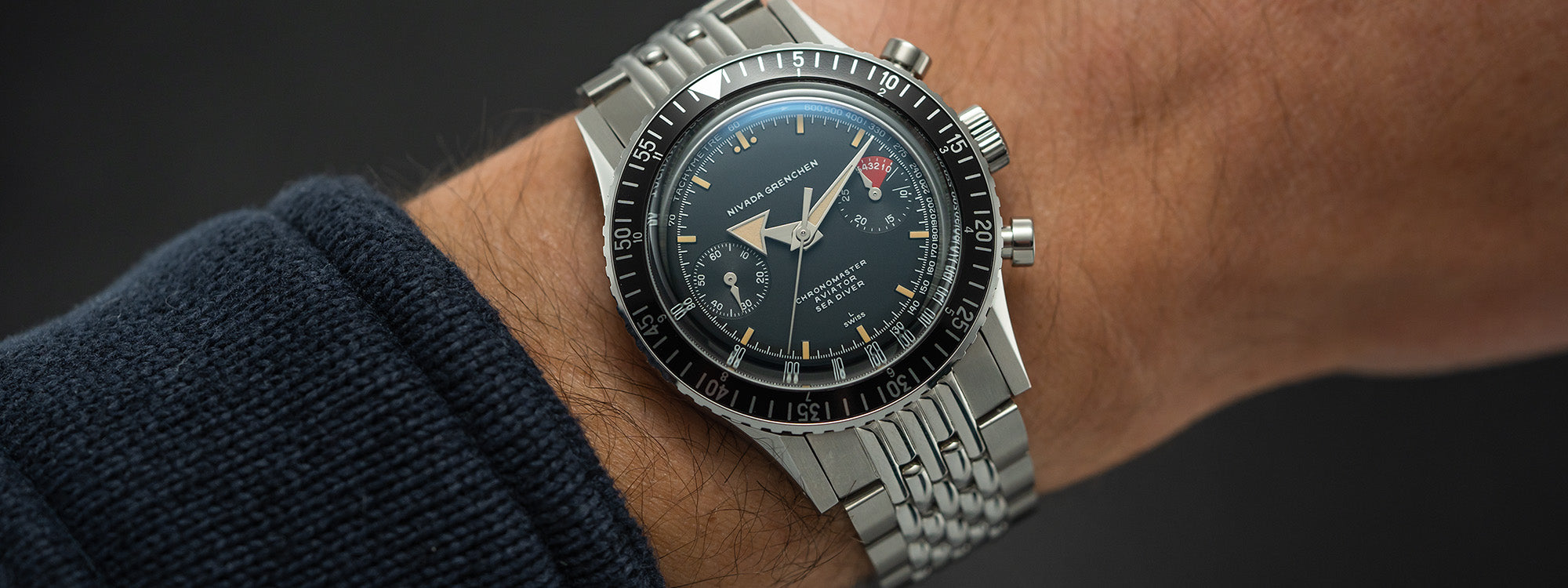
More milestones followed in the 1960s, starting with Nivada Grenchen’s release of the Chronomaster Aviator Sea Diver in 1961. It was a multi-purpose tool watch with a chronograph, tachymeter scale, regatta-countdown, and dual-time functions — a utilitarian, sport- and travel-oriented combo rarely seen even today, much less back then. Another significant dive-watch, the Depthomatic, debuted in 1964, proving to be uniquely suited to the growing sport of skin diving. The similarly named Depthmaster, which hit the market in 1965, boasted a nearly unprecedented (for the time) 1,000-meter water resistance rating. Shortly thereafter came the 1970s Quartz Crisis and the long dormancy of the Nivada Grenchen brand.
[toc-section heading="Nivada Grenchen Returns"]
Nivada Grenchen finally re-emerged in 2018, the result of a partnership between two French entrepreneurs, Guillaume Laidet and Rémi Chabrat. With the watch market’s move toward revivals and retro-style designs — particularly of tool watches from the 1960s and ‘70s — already in full swing, the pair built the foundations of the new collection on the brand’s vintage classics. This was probably to be expected; however, perhaps less expected by the watch-buying public at large was Nivada Grenchen’s other mission, of pricing these neo-vintage, midcentury homage pieces far below many of their traditional Swiss-made competitors.
Appropriately, the modern Nivada Grenchen collection is centered around five pillars: Antarctic, descendants of the famed polar explorers’ watch; Chronomaster, a series of chronograph models, including the motorsport-inspired Chronoking; Autochron, another chronograph series based on a 1970s prototype that never saw full production; Depthmaster, the brand’s dedicated dive-watch collection; and F77, the (almost obligatory) integrated-bracelet, sport-luxury revival models that channel a distinct ‘70s vibe. Here is a look at each of them.
[toc-section heading="Antarctic Collection"]

As the original Antarctic is probably the most iconic Nivada Grenchen model, owing to its connection to the aforementioned polar explorer missions on the Frozen Continent in the 1950s, it follows that the Antarctic collection is the most expansive and diverse. And in most respects, Antarctic watches of today remain quite faithful to their forebears. The Antarctic Glacier editions reimagine a watch from the 1950s with their period-appropriate 35mm and 38mm stainless steel cases, manually wound Soprod movements, and sectored silver-and-black “Tuxedo” dials. A dressier version of an explorer’s watch, its water resistance is a modest 50 meters. Super Antarctic models feature 38mm steel cases, water-resistant to 100 meters, and automatic movements (the Swiss-made Soprod P024). The Super Antarctic 3-6-9 model brings an extra layer of vintage charm with its Arabic numerals at the named hour positions and an inverted triangle at 12.

Also coming in at 38mm is the Antarctic Diver, which cranks up the depth rating to a professional-grade 200 meters and features a rotating aluminum bezel and a screw-down crown. The steel case has a mostly brushed finish and the dial is matte black, hosting a pair of wide rectangular hands, a 3 o’clock date window, and the model name in vintage-appropriate script at 6 o’clock. It also contains the automatic Soprod P024 movement inside, behind a caseback engraved with a penguin, a symbol of the model’s history of South Pole adventures. The most recent addition to the Diver series is the green-dialed limited edition above.

In 2025, Nivada Grenchen expanded the Antarctic family with its first dual-time model, the Antarctic GMT, which, as per the brand’s ethos, is based on a nearly forgotten “Jet Age” model from the 1970s. The modern watch is a very modest 36mm in diameter and 11.1mm thick, faithful to the original, in brushed stainless steel, and carries a Swiss-made automatic Soprod C125 inside. The dial, in matte black or brown, is surrounded by a two-tone 24-hour scale and features a distinctive red-toned GMT hand, which moves along the scale to indicate a second time zone. Other vintage touches include the Penguin-engraved caseback, the plexiglas crystal over the dial, and the color-coordinated perforated leather strap. Pricing on Antarctic models starts at $945 for most of the core theee-handed models in both 35mm and 38mm cases, and rises to $1,050 for the Diver and to $1,740 for the GMT.
[toc-section heading="Chronomaster Collection"]

The Chronomaster collection is all descended, at least in spirit, from the legendary, original Chronomaster Aviator Sea Diver of the ‘60s, and The modern version of that watch lives up to its name, managing to somehow serve as a speed-timing chronograph, a pilot watch, and a dive watch — all rolled into one handsomely vintage-inspired package for under $2,000. The “Broad Arrow” version presented here, based on a 1960s favorite, has nearly identical case dimensions (38mm) to the original model as well as all its dial elements. Under a vintage-style domed crystal, the bicompax dial has rectangular hour markers, arrow hands, and a 30-minute subdial standing out with a pop of red in its countdown sector. Swiss movement-maker Sellita provides the period-appropriate, manually wound chronograph caliber with a hacking seconds function and a 48-hour power reserve. A retro-style beads-of-rice metal bracelet completes the picture.

It’s within the Chronomaster family that we also find a greater variety of movement options, including the hybrid “MecaQuartz” calibers inside many of the Chronoking models, distinguished by their unusual 12 o’clock date placement, aluminum tachymeter-scale bezels, and array of vibrant dial and bezel colors, with both tricompax and bicompax designs, based on the movement inside. Chronoking Racing models feature 1970s-derived 38mm steel cases, three dashboard-inspired subdials at 3, 6, and 9 o’clock, and luminous-treated hands and indexes, including a prominent central hand for the chronograph counter in a vivid, high-contrast color. The Swiss-assembled TMI VK63 Mecaquartz movement ticks inside. The MecaQuartz Chronoking models are priced starting at $610, while the automatic Chronomasters range from $1,975 for the manually wound models up to $5,000 for the special editions equipped with vintage Valjoux 23 calibers.
[toc-section heading="Autochron Collection"]

As noted above, the Autochron collection, currently the smallest in the brand’s portfolio, takes its cues from a never-commercialized prototype from the late 1970s that was an attempt, per the brand, “to bridge the worlds of motorsport and diving” — possibly a bit thematically ambitious for that time. The unconventional dial was one of several contributed to Nivada Grenchen by influential Swiss dial designer Jean Singer, and its modern interpretation combines a bidirectional rotating 60-minute bezel with an inner-flange tachymeter scale and a subdial arrangement of either 12, 6, and 9 (in the versions powered by the MecaQuartz caliber VK67) or 12 and 9 (in the models powered by the ETA/Valjoux 7750, both alongside a date display at 3 o’clock. The dials feature a subtle texture and the 38mm case comes mounted on a three-link steel bracelet, or a color-matched rubber or leather strap. Autochron prices range from $530 for MecaQuartz to $2,295 for the Valjoux models.
[toc-section heading="Depthmaster Collection"]

Nivada Grenchen’s quintessential tough dive watch, the Depthmaster, anchors another popular product family, with the most cult-classic model, the so-called Art Deco Depthmaster, aka “Pac-Man,” being the go-to favorite of enthusiasts. The core Depthmaster model, paying homage to its 1960s predecessor, comes in at 42mm in steel (14.1mm thick), with a 39mm option also offered. The 100-meter water resistant cushion-shaped case (a bit reminiscent of the Panerai Luminor) seals with a screw-down crown and features a unidirectional rotating bezel with an enrgraved dive-time scale highlighting the first crucial 15-minute segment. The “Pac-Man” nickname is evident upon discovering the very oddly shaped, luminous-treated numerals and hour markers on the matte black dial, which call to mind visual elements from the iconic 1980s arcade game. Both versions of the Art Deco Depthmaster contain the automatic Soprod P024 movement, which provides the diver a 38-hour power reserve. Most Depthmaster models are priced at $1,095, with a handful of bronze-cased models going for $1,845.
[toc-section heading="F77 Collection"]

In 2023 came the return of the F77, Nivada Grenchen’s value-oriented take on the white-hot integrated-bracelet sport watch genre. Like many of its siblings in the current collection, the F77 traces its roots to a precursor in the 1970s, which established the key elements of the model, like the sharply faceted, geometric case design, boldly minimalist dial, and wide bezel with exposed screws, all undeniably taking cues from the king of the ‘70s sport-luxury trend, the Audemars Piguet Royal Oak. The F77 line was, as expected, a big success at the outset and has already spawned a wide array of variations, including chronographs, but the core models remain the 37mm MK1 and the 41mm MK2, both powered by the Soprod P024 and most bearing a distinct basket-weave texture on their dials.

The original F77 models used stainless steel for the cases and integrated three-link bracelet, but Nivada Grenchen followed those up a year later with additional references with titanium cases and bracelets, including one with a metallic gray-toned meteorite dial. Nivada Grenchen describes the dial’s geometric patterns as “reminiscent of French painter Pierre Soulages’s style” and no two dials are exactly alike. The titanium case measures a vintage-appropriate 37mm (placing it within the MK1 subfamily), with visible screws accenting the octagonal bezel, while the dial’s broad baton hands are markers are silvered and faceted. Here again, the watch is powered by the Soprod P024, and the Titanium collection also offers mineral dials of lapis lazuli and dark blue aventurine. At the top end of the F77 line is an all-black-ceramic (case and bracelet) model with a black weave-textured dial for a monochromatic look. The F77 collection includes a range of price points, from $540 for MecaQuartz chronograph models, to $1,360 for the mineral-dial MK1s, to $1,560 for special editions in black ceramic and yellow-gold-plated steel.
Shop this Article
You May Also Like



Get your watch from TeddyBaldassarre.com and get 0% interest for up to 24 months available on select brands. Checkout with Affirm and spread your payments over 3 to 36 months. Learn More


0 Comments