
































Short on Time
The Universal Genève Polerouter is probably the most historically significant watch that enthusiasts of a certain age have never heard of. Okay, maybe that's overstating it, but the watch is certainly less, well, universal in its claim to icon status than several other, more well known models that debuted later. And yet, if it weren't for the Polerouter, which came out in the mid-1950s and which afforded an opportunity for a young, precocious watch designer to make his first mark on the industry, we may never have had the opportunity to experience some of those 1970s models that came later. Intrigued? Read on.
[toc-section heading="Universal Genève History (1894 - 1950s)"]

Despite the “Genève” that has become attached to the company’s name, the firm originally known as Universal Watch traces its roots to a smaller Swiss city, the village of Le Locle (also home to Ulysse Nardin, Zenith, and Tissot), where it was established in 1894 by watchmakers Numa-Emile Descombes and Ulysse-Georges Perret. Descombes died a few years later, and Louis Berthoud, one of the company’s most talented watchmakers, rose from the ranks to become Perret’s partner in 1897. The pair moved operations to Geneva in 1919, forging the company's modern name and identity. The firm became known for chronographs, and eventually produced both pocket watches and trench watches (pocket watches converted to wristwatches for soldiers in the field) for armies on both sides of the two World Wars.

Over the first half of the 20th Century, Universal Genève contributed several notable watches and watchmaking innovations. In 1917, when pocket watches were still the dominant style for men, the firm produced one of the first wrist-mounted chronographs. In 1933, the heyday of Art Deco, came the Universal Genève Ideo, aka the “Cabriolet” (above), which was one of the first rectangular watches with a reversible case; similarly to Jaeger-LeCoultre’s much more famous Reverso, which had preceded it just two years earlier, the watch featured the clever and useful ability to flip the case over to protect the dial. As the company became more adept at complications, it introduced classic chronograph models like the Compur (1934); the Compax (1937), touted as the first chronograph wristwatch with a three-register dial layout; and the Tri-Compax (1944, example below), an icon in its own right as one of the first timepieces to combine a chronograph with an annual calendar and moon-phase.

[toc-section heading="From Polarouter to Polerouter (1954)"]
Prolific, pioneering watch designer Gérald Genta (1931 - 2011) is today regarded as one of the undisputed legends of wristwatch history. His most iconic and impactful brainchildren — Audemars Piguet’s Royal Oak, Patek Philippe’s Nautilus, and IWC’s Ingenieur — all came out in the 1970s, when he was already a highly in-demand talent. But Genta was a relative newbie to the business, at the tender age of 23, when he contributed the design for the cult-classic aviation watch for which Universal Genève is, to many, best known today.

The watch was initially named the Polarouter and it was released in 1954 — nearly two decades before Genta’s better-known models hit the market. Its launch coincided with the first transcontinental flights made by Scandinavian Airlines Systems (SAS) from the United States to Europe over the North Pole — hence the watch’s name. Universal Genève was the official supplier of watches to SAS pilots, who chose the brand for its expertise in making antimagnetic watches. With the original Polarouters (Ref. 20217-6 in steel, 10234-1 in yellow gold, aka the first “Polerouter De Luxe”), the company rose to the technical challenge of building a timepiece that would guard against the ill effects of the Pole’s extreme magnetic fields on navigation and timing precision.

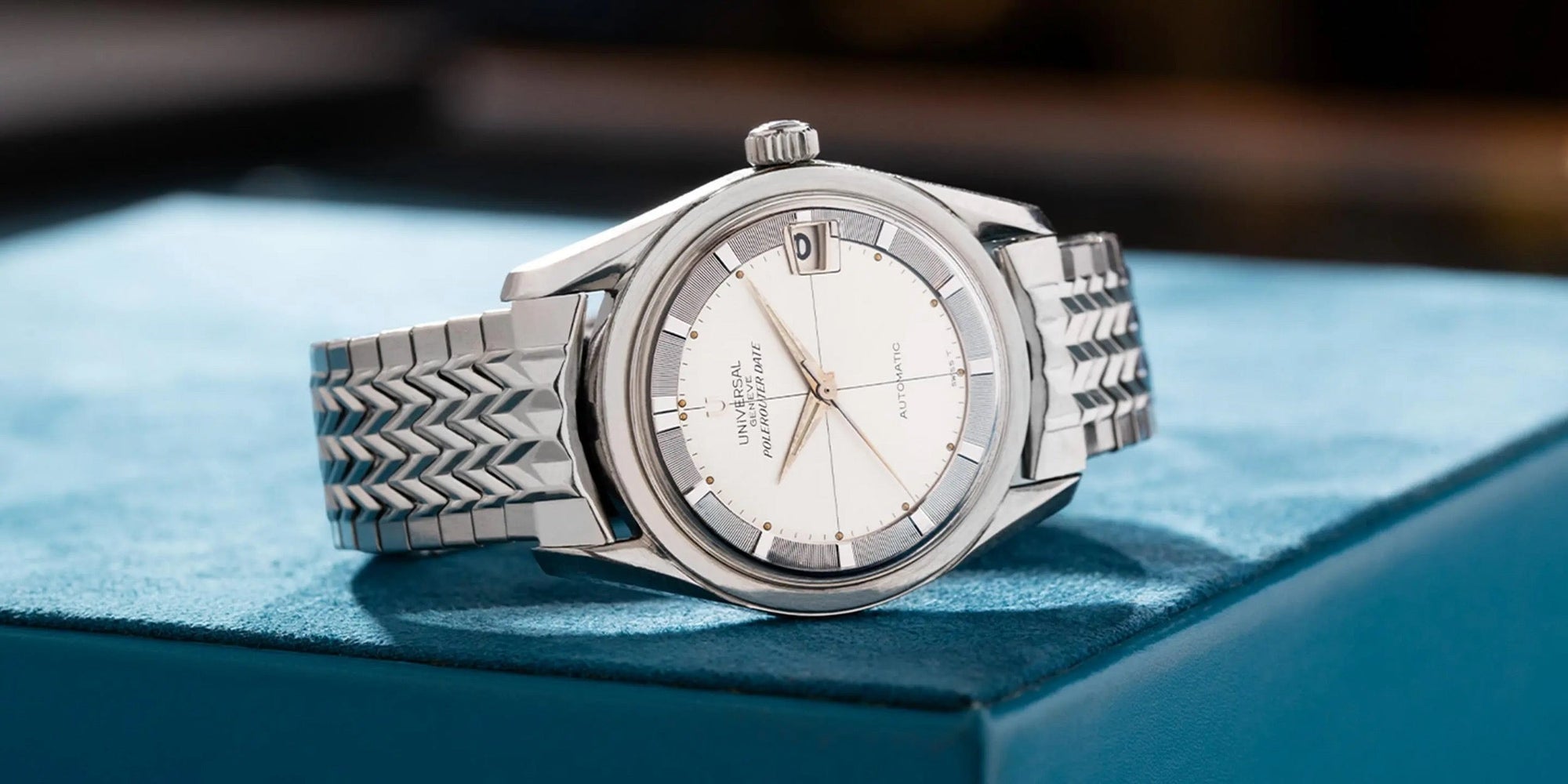
The Polarouter had a 34.5mm steel case with twisted bombé lugs, sharply pointed triangular hands, and a clean, dateless dial bordered by a textured inner ring. Other additions, like a trapezoidal date window, followed in the 1960s. It was renamed the Polerouter a year after its debut. It’s believed that Universal Genève only made about 100 pieces of the original model, with the “Polarouter” logo and the “SAS” inscription on the dial, the latter indicating that the watch was at first issued exclusively to SAS pilots. These watches are, of course, among the rarest and thus most collectible examples of the Polerouter. The civilian-marketed models followed shortly after the launch of the pilot-only ones, in both steel and the gold “De Luxe” versions.

The earliest models contained Universal Genève’s Caliber138 SS, which was an early example of a so-called “bumper” movement, a now very rare type of automatic caliber that used a weighted “bumper” rather than a more traditional oscillating rotor to wind the mainspring. As per their name, bumper rotors don’t swing back and forth in a 360-degree arc to wind the movement but “bump” back and forth in more of a 120-degree bouncing motion between two springs to do so. (Omega’s Constellation models of the early 1950s were among the other few watches that contained this type of movement.) Starting in 1955, Universal began equipping the Polerouter with the now-legendary 215 caliber instead. That movement and its descendants (example below) are also noteworthy as some of the first automatic movements to use a micro-rotor.

[toc-section heading="Epanding the Polerouter Collection (1955 - 1970s)"]
Universal Genève knew it had a hit with the Polerouter, and, as watch companies tend to do, extended the original model into a veritable family of timepieces in the ensuing years. The core Polerouter models, after adopting the microrotor Caliber 215, achieved an impressive level of thinness for the time, and the design underwent only minimal changes from Genta’s original, minimalist vision — like the addition of broad arrow hands, and enamel and cloisonné dials on some of the De Luxe editions. Universal Genève added a Polerouter Date version, the first with a calendar complication, in 1958, and quickly followed that up with a Day-Date version, equipped with microrotor Caliber 72. The former became the most popular Polerouter model of the era, overtaking the original no-date version.

Photo: Phillips
In 1961, the brand introduced the Polerouter Sub (above), which translated the watch’s aviation language into a compressor-style dive watch, which was water-resistant to 200 meters. The sportier variations continued with the rollout of the Polerouter Super in 1965, with a screw-down crown and a robustly built case that offered a 300-meter water resistance. The Polerouter Shadow, introduced that same year and also designed by Genta, held the record for the world’s thinnest automatic watch until 1978; its self-winding Caliber 2-66 measured just 2.3mm thick. In what can now be seen as a harbinger of the turbulent times that were coming for the watch industry in the 1960s, the Polerouter Electric (1963) featured one of the first “hybrid” electromechanical watch movements, which would within a decade fade from the market in favor of quartz movements.
[toc-section heading="The Polerouter's Modern Revival (2023 - Now)"]

Like many historical Swiss watchmakers that forged through the challenging years of the Quartz Crisis, Universal Genève went through a number of ownership changes in the latter part of the 20th Century and into the 21st. The first was in 1967, when the brand was acquired by New York-based Bulova Watch Company, enabling it to expand into more Asian and North American markets, and allowing the two companies to share technologies and licensing partners. In 1989, Hong Kong investment firm Stelux Holdings International, which is also the owner of another Swiss watch brand, Cyma, acquired Universal Genève. Throughout its stewardship by Stelux, Universal Genève was no longer a presence in the United States watch market. To the delight and hopeful anticipation of many longtime watch enthusiasts, that situation began to change in 2023, when Stelux sold the brand to Partners Group, the Swiss private equity firm that also holds the majority stake in Breitling. Breitling’s CEO and stakeholder Georges Kern has taken an active leadership role in returning Universal Genève to what many feel is its rightful place in the upper echelon of international watch brands. Appropriately, the first major move in that direction was a revival — thus far, a very limited one — of the Polerouter with a vintage-evocative design.

The three special tribute editions — which dropped on November 15, 2024 in honor of the 70th anniversary of the first SAS transpolar flight — serve as the harbinger of a full, revived Universal Genève collection to come in 2026. All three are unique pieces, not for commercial sale. They offer a period-appropriate case diameter of 35mm (9.95mm thick, 45.4mm lug to lug) and, even more noteworthy, all are equipped with a vintage movement from the 1960s, the legendary, microrotor-driven automatic Caliber 1-69 (57-hour power reserve, 18,000-vph frequency). Two models are mounted on black calfskin leather straps — one with a case in stainless steel and a silver dial, the other in 18k rose gold with a black dial, both featuring rose-gold-plated hands and a retro/modern mashup of the newly revamped Universal Genève logo and the historic SAS logo. The third piece, which was auctioned at Phillips in May 2025, is in white gold, with a blue dial and rhodium-plated hands, and is presented on a matching white-gold bracelet, created by revered Swiss chainmaker Laurent Jolliet in a distinctively vintage style characteristic of Universal Genève watches of the era. If the response to these models is any indication, the new versions of the Universal Genève Polerouter still to come in the regular collection are likely to put the 70-year-old timepiece on the radar of modern aficionados, and perhaps even elevate the watch to its rightful place among Genta’s acknowledged classics. For more info on the brand, visit www.universalgeneve.com.
You May Also Like



Get your watch from TeddyBaldassarre.com and get 0% interest for up to 24 months available on select brands. Checkout with Affirm and spread your payments over 3 to 36 months. Learn More


0 Comments