







































Short on Time
The IWC Big Pilot’s Watch 43, aka the “BP43,” has been on the market for five years since its high-profile debut, and it continues to lure in more curious enthusiasts who respected, but might never have pulled the trigger on purchasing, its larger 46mm predecessor. Has the American-founded Swiss watchmaker finally made the perfectly sized version of its historically important but (to some) impractically oversized aviation icon for the 21st Century? Here’s a closer look at the BP43, from its wartime origins to its modern-day technical achievements.
A Brief History Of IWC Pilot's Watches
Unlike today, the International Watch Company, founded in Schaffhausen, Switzerland, in 1868, was not in its earliest days known for making pilot’s watches. Its founder, American expat watchmaker Florentine Ariosto Jones, focused initially on luxurious, high-precision pocket watches, but the firm’s output shifted to wristwatches as the latter style grew in worldwide popularity after World War I. It wasn’t until the Second World War, however, that IWC laid the foundation for its modern renown as a pioneer of military-tough watches for aviators. Jones’s successor at IWC’s helm, Ernst Jakob Homberger, was a savvy businessman who successfully steered the company through the worldwide economic crisis of the 1930s. He also paid close heed to world events, like the military buildup in neighboring Germany, and to the interests of the younger generation, like his sons Hans and Rudolf, both aviation enthusiasts.

The historical watch that emerged from these dual tracks came out of IWC’s workshops in 1936, and it proved to be one of the most important wristwatches of the early 20th Century. The so-called Special Watch for Pilots (above) established many of the criteria that we associate with aviation watches today. It was uncommonly large for its era — 37.5mm in diameter — and made of steel rather than a more common contemporary material like chrome. It had a bezel that rotated in both directions, equipped with an arrow index that aided pilots in tracking takeoff times. Its dial was matte black, with large, legible white numerals in a classical serif font and a classic cathedral handset. Its movement featured an antimagnetic escapement, another rarity for the time — an invention meant to secure the watch’s accuracy against the magnetic fields generated by radio transmitters and radar devices, which had become standard equipment in airplane cockpits.

When war actually arrived in 1939, IWC’s management had a slew of new military customers, including the German air force.The Special Watch for Pilots, designed for civil aviation, accordingly evolved into a larger, more rugged timepiece intended for use in the cockpits of bomber pilots. First issued in 1940, it was called simply the “Big Pilot’s Watch” (Grosse Fliegeruhr in German) and it lived up to its name: the steel case was enlarged to a titanic 55mm in diameter and 16.5mm thick, and the dial’s hour markers were in a bold, straightforward sans-serif font, with an inverted triangle at 12 o’clock, flanked by two dots, for orientation. It featured an oversized, fluted, diamond-shaped crown for winding the movement, designed to be easily gripped by hands in heavy pilot’s gloves. The thick calf leather strap, secured to the case by rivets, was meant to offer enough length and sturdiness to be strapped on over those selfsame gloves. Essentially a pocket watch repurposed for the wrist, it contained a large pocket-watch movement, Caliber 52 T.S.C.
The IWC Big Pilot’s Watch is the most iconic example of the so-called “B-Uhr” style of pilot watch, which had its origins in German military aviation. Short for Beobachtungs-Uhren, which translates to “observation watches,” B-Uhr watches were all made to strict military specs, and the earliest ones, which were actually the property of the German government rather than the pilots who wore them, are among the rarest and most coveted vintage watches, especially for collectors of militaria. IWC became one of five firms, and the only Swiss one, that made these watches for the Germans during the war years; the others were German-based Laco, Stowa, Wempe, and the original A. Lange & Söhne.

The Return Of The Big Pilot
Fast forward to 2002: the luxury watch industry was reawakening from a period dominated by inexpensive quartz-powered pieces, and historical brands like IWC had started mining their rich archives for successful revivals of old classics, including several pilot-centric models. It was also — thanks to the popularity of wrist monsters like the Panerai Luminor, Hublot Big Bang, and Audemars Piguet Royal Oak Offshore — an era in which bigger was better when it came to watches.
Thus, the time was ripe for the return of the granddaddy of all IWC aviation watches, the Big Pilot’s Watch, in a stately steel case (46.2mm) that was certainly “Big” albeit not as massive as the 55mm original. Its dial, furthermore, left no doubt that this watch was not a pitch-perfect re-creation of its WWII-era ancestor: Rather than the spartan simplicity of the 1940 model’s three-handed dial, the new version (Ref. IW5002) featured a 6 o’clock date and an off-center subdial with an analog display for the watch’s week-long power reserve, a bragging right bestowed by the movement inside the case, IWC’s automatic Caliber 5011.

The 21st Century Big Pilot’s Watch and its many descendants took their place of honor among the expanding IWC Pilot’s Watch series. Nearly two decades later, however, the industry-wide trend toward bigger and bigger watches had begun to ebb substantially, and even the most iconic of the traditionally titanic timepieces, including some of those noted above, had started to offer less wrist-dominating, more widely wearable size options. The Big Pilot’s Watch 43, or BP43, was IWC’s answer to the changing mores in 2021. Its case was downsized from over 46mm to a more manageable (but still worthy of the “Big” in its sobriquet) 43mm.

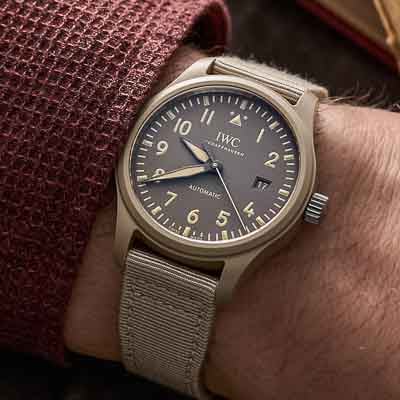
Perhaps even more significantly, its dial, unlike that of its larger predecessor, was about as historically accurate to the 1940 model as one could expect in this day and age: just a matte black, three-handed time display, with bold white numerals, sword hands, and the triangle with two dots at 12 o'clock — no power reserve, no date, none of the subdials of the chronograph editions or the city rings and scales of the UTCs and Worldtimers. The Big Pilot’s Watch 43 models, which now extend to other sub-collections including Top Gun and Spitfire, contain the in-house, automatic Caliber 82100, which boasts a 60-hour power reserve, and are the first IWC Pilot’s Watches to offer the brand-developed EasX-CHANGE system that enables the wearer to easily swap between several available strap and bracelet options. Here is a closer look at the entry-level Automatic version in steel.
IWC Big Pilot's Watch 43 Review
Case And Strap

The 43mm case of the BP43, according to longtime IWC Creative Director Christian Knoop (who I interviewed about it ahead of the model’s launch in ‘21) was the result of a long series of planning and prototyping, Knoop and his team faced the daunting challenge of finding a sizing sweet spot that would still justify the “Big” in the watch’s name but would be small enough to appeal to those whom it was clearly intended to reach: those who appreciate the design of the ‘02 Big Pilot but whose wrists were simply unsuited for its 46.2mm size. A series of both 3D printed and full-metal prototypes spanned the narrow gamut between 42mm and 44mm and ultimately yielded the happy medium version of 43mm, with a thickness of 13.9mm and a lug-to-lug measurement of 52.5mm. (By way of comparison, the longer-tenured Big Pilot’s Watch is 15.6mm thick and a lug-to-lug of 57.8mm. And both are downright modest compared to the hulking 55mm diameter of the 1940 original.)

Without a doubt, the BP43 is still quite substantial on the wrist, albeit perhaps less overpowering for many wearers, and will make its presence known proudly rather than hiding under a shirt cuff. On a leather strap, the stainless steel watch featured in these photos weighs about 115 grams, as opposed to about 150 grams for the 46mm version.The bezel is narrow, making for a very wide dial opening and thus an even greater sense of size. As per tradition, the diamond-shaped crown is large, with grooved edges, and easily gripped for winding and setting the watch.
The surfaces, as one might expect of a watch originally intended for military pilots, are predominantly satin-brushed for an overall matte appearance, while polished accents on the bezel’s top edge and lug bevels serve as a subtle nod to modern luxury. The case lugs are equipped with IWC's EasX quick-change system, which enables the strap to be swapped not only for another strap (rubber for leather, for example) but also, for the first time in the brand's Pilot’s collection, an all-new steel link bracelet. (The bracelet, of course, adds several grams to the overall weight on the wrist, just in cast this is a concern.)
Dial And Hands

If finding the perfect dimensions for the Big Pilot’s Watch 43 case was challenging, creating just the right look for the dial was just as much of a creative hurdle for Knoop and his R&D team. Scaling down the proportions of the classic 1940 dial for a smaller dimensioned case involved experimenting not only with line thicknesses, fonts, and finishes for the Arabic numerals but also with different hand shapes and other minuscule graphic details. The resulting dial is eminently readable at these reduced dimensions,, with white Arabic numerals marking every hour position except for 12 o’clock, which bears the historical orientation triangle with two dots.
On the surrounding minute track, each numeral is accompanied by a blocky rectangular index, and each of these are separated by four intermittent white hash marks. The hour and minute hands are wide and sword-shaped, while the central seconds hand is lancet-style with a tapering point that brushes the edges of the minute track. The two main hands as well as the hour markers and numerals and the 12 o’clock triangle, are coated in Super-LumiNova that emits a sharp mint-green glow in the dark.

As noted earlier, the legibility factor is enhanced by IWC’s creative decision to go back to historical basics. There is no date indication, as there is on the 46mm Big Pilot at 6 o’clock, and the element most disruptive to that earlier model’s symmetry — an analog power-reserve display on a large subdial at 3 o’clock — is also absent. The exclusion of this indicator makes sense from a utility standpoint as well as an aesthetic one.
The larger Big Pilot’s Watch carries within it a manually wound movement with an impressively robust eight-day power reserve; since the owner would need to wind that watch regularly, even if it was worn every day, a visual reminder of how much fuel is left in the watch’s tank is helpful and perhaps even essential. The BP43, on the other hand, is equipped with an automatic (i.e., self-winding) movement, and daily or even semi-regular wear would keep the watch running reliably without the need for a reminder.
The Movement

Speaking of the movement, another area in which the Big Pilot’s Watch 43 model breaks new ground for the aviation-inspired collection is with the use of a clear, sapphire window in the screwed caseback that affords a view of this watch’s micromechanical engine, IWC’s manufacture Caliber 82100. Solid metal casebacks had long been the go-to option for IWC’s Pilot’s Watches due to the necessity of sealing the movement inside a soft-iron inner case to repel magnetic fields, but modern advancements in materials for movement parts, more on which below, have largely eliminated the need for this extra layer. This self-winding movement beats at a frequency of 28,800 vph and its fully wound mainspring stores a respectable power reserve of 60 hours, or 2 ½ days.

Like most of IWC’s in-house calibers, this one is equipped with the brand’s patented Pellaton winding system, which uses an eccentric cam and two pawls that engage with the motions of the rotor in both directions for a high level of efficiency. To further optimize performance of the system, the pawls, the automatic wheel, and other vital parts are made from zirconium oxide ceramic, a virtually wear-free and magnetic-resistant material. Bridges and plates are adorned with côtes de Genève and circular graining, and the skeletonized rotor has a golden badge in its center, inscribed with an IWC emblem as well as the motto “Probus Scafusia,” the company’s motto since the early 1900s, which is a Latin phrase roughly translating to “Good solid craftsmanship from Schaffhausen.”
Variations and Pricing

Since its very high-profile launch in ‘21, the IWC Big Pilot’s Watch 43 has experienced a slow-and-steady growth into its own subfamily within the greater Pilot’s Watch collection, and IWC has exercised restraint in broadening the choices of materials and colorways.
The models that are actively on the market now include the stainless steel model photographed throughout this article (Ref. IW329301) with matte-black dial on brown calfskin leather; the same model with a dial in sunburst blue (Ref. IW329303, above) or British Racing Green (Ref. IW329306), both with color-coordinated leather straps, all priced at $9,700; and the blue-dialed model on a stainless steel bracelet for $10,700. IWC introduced the “Spitfire” version of the BP43 late in the debut year of 2021, doubling down on the military-aviation aesthetic with a 60-minute dial and an inner 12-hour ring. The steel version of the BP43 Spitfire, with a black dial, retails for $10,400, while the bronze-cased edition, with olive-green dial and strap, goes for $11,000. Learn more about the entire Pilot's Watch collection at iwc.com.


Be the first to leave a comment
Log in or to leave a comment