




Short on Time
Serious watch collectors largely consider the Seiko Alpinist to be a hidden gem within horology. This hybrid, rugged tool watch has the soul of a dress watch and a fascinating backstory that traces its lineage back to the late 1950s – the heyday of the tool watch. While many legends from that era have changed beyond recognition, the Seiko Alpinist is a rare icon that has remained stubbornly true to its DNA. Whether you're looking at a vintage original or the latest GMT traveler, the Alpinist is a perfect example of a watch with remarkable staying power. Indeed, little has evolved in terms of its design because its original fusion of utility and elegance has needed virtually no improvement. The Alpinist GMT references SPB379 and SPB377, perhaps representing the most significant functional leap in the collection’s history. But before we delve into these two specific models, it is essential to understand the heritage of a collection that has spent over six decades evolving from a niche mountaineering tool into a globally recognized pillar of modern horology.
Designed For The Climb: Some Alpinist Context

In the rugged heart of Japan's mountain ranges, there once thrived a community uniquely forged, both in spirit and physique, to endure the unforgiving terrain and isolation of the wilderness. They went by the name of “mountain men” – the Yama-otoko. Adept at living off the land and embarking on journeys that tested their resilience, endurance, and strength, the Yama-otoko were highly ambitious mountaineers and hikers who shared a deep spiritual heritage and a sheer passion for pushing limits and exploring the most treacherous of regions. Their mastery of expeditions was rooted in a profound understanding of the landscape, shifting weather patterns, and the subtle rhythms of the natural world, an intuitive expertise that felt almost second nature. Today, modern technology and equipment have made mountain climbing more accessible. That and the Seiko Alpinist, of course.
The Seiko Alpinist made its debut in 1959 under the Laurel name, created as a purpose-built tool to withstand the realities of life in the mountains. Every aspect of its design was shaped around the demands faced by the Yama-otoko, prioritizing durability, legibility, and reliability in environments where failure simply wasn’t an option. It was the Japanese watchmaker’s first foray into robust, purpose-built sports watches, and was crafted with durability, legibility, and reliability in mind. Equipped with sufficient water resistance, its robust case construction was paired with a protective leather bund strap that kept it comfortable and secure even on rough climbs.

Following the Alpinist’s initial 1960s debut, the collection evolved through subsequent generations that transitioned from the original manual-winding calibers to more modern quartz and automatic movements, along with an innovative internal compass bezel. It was not until the turn of the millennium, however, that the collection finally transcended its domestic roots to capture the attention of a global audience. The Alpinist was released as part of the SARB series in 2006, becoming a cult favorite amongst collectors, specifically the SARB017 with a rich emerald green dial. Its appeal stemmed from its nod to outdoor roots, its practical internal bezel, and its reliable Seiko 6R15 movement, complete with respectable power reserve.
After the discontinuation of the SARB017, the Seiko Alpinist moved into Prospex territory. Newer references with upgraded movements (the caliber 6R35), rugged cases, and striking dials joined the collection, including options with timezone-tracking functionality. Enter the Seiko Alpinist GMT.
Reviewing The SPB379 and SPB377
Seiko Alpinist GMT Case

As aforementioned, it wasn’t until 1995 that the Alpinist truly found its modern identity, with Seiko introducing an internal rotating compass bezel and a bold red accent on the dial - details that quickly earned the watch its now-iconic nickname, the “Red Alpinist.” It has been made available in various editions since, including a dual time version, but never with an automatic movement until the release of the SPB377 and SPB379 references in 2023. Just prior to this, Seiko’s focus had been on integrating GMT complications across its diverse catalog, specifically within the Prospex 1968 Diver, the entry-level Seiko 5 Sports, and the Presage Style 60s series. Even so, adding a GMT complication to a watch so closely associated with exploration and adventure felt like the most natural progression, and a logical one at that, especially since the overall design changes were deliberately restrained, allowing the evolution to be marked by only a handful of thoughtful updates rather than a full reinvention. There is, however, much more to discuss about these GMT models than just an additional 24-hour hand, so we’ll start with the case.
Both the Seiko Alpinist GMT SPB377 and SPB379 models take up residence on the wrist with a 39.5mm diameter and a lug-to-lug measurement of 46.4mm. The latter is arguably the more critical dimension, as the lug-to-lug span (the distance from the northernmost to the southernmost tip) dictates the watch's actual footprint and whether it remains centered within the boundaries of your wrist. For a sports watch, the Alpinist GMT occupies the more compact end of the standard 40–50mm spectrum; its restrained proportions ensuring a comfortable, well-balanced fit for a wide variety of wrist sizes. Depth-wise, both cases measure 13.6mm, allowing them to slip under a shirt cuff without a struggle.
To enhance the stainless steel construction, Seiko utilizes a specialized hard-coating treatment that significantly bolsters both scratch resistance and overall longevity. This technology, originally derived from industrial applications decades ago, was adopted by the Japanese watchmaker as a pragmatic engineering solution. Crucially, this protective layer is applied so masterfully that it reinforces the case without altering its visual character, tastefully preserving the Alpinist GMT’s refined finish and polish.

Other features include a 4 o’clock crown for actuating the inner bezel, a 200-meter water resistance, and a curved sapphire crystal. The material made its debut in 2006, with the SARB series, alongside an upgraded movement. The sapphire crystal has been treated with layers of anti-reflective treatment to rid the dial of any undesirable glare when referencing the time, and is also used on the caseback, providing a clear, undistorted view of the automatic movement at play. One thing that’s worth noting about the SPB377 and SPB379 references is the use of brushed and polished accents across the surface of both cases, including the polished bevels inside the lugs, which donate a more refined finish to the Alpinist’s classic look. Elongated guards also run up the sides of the crown, flanking it for extra protection against knocks and bumps.
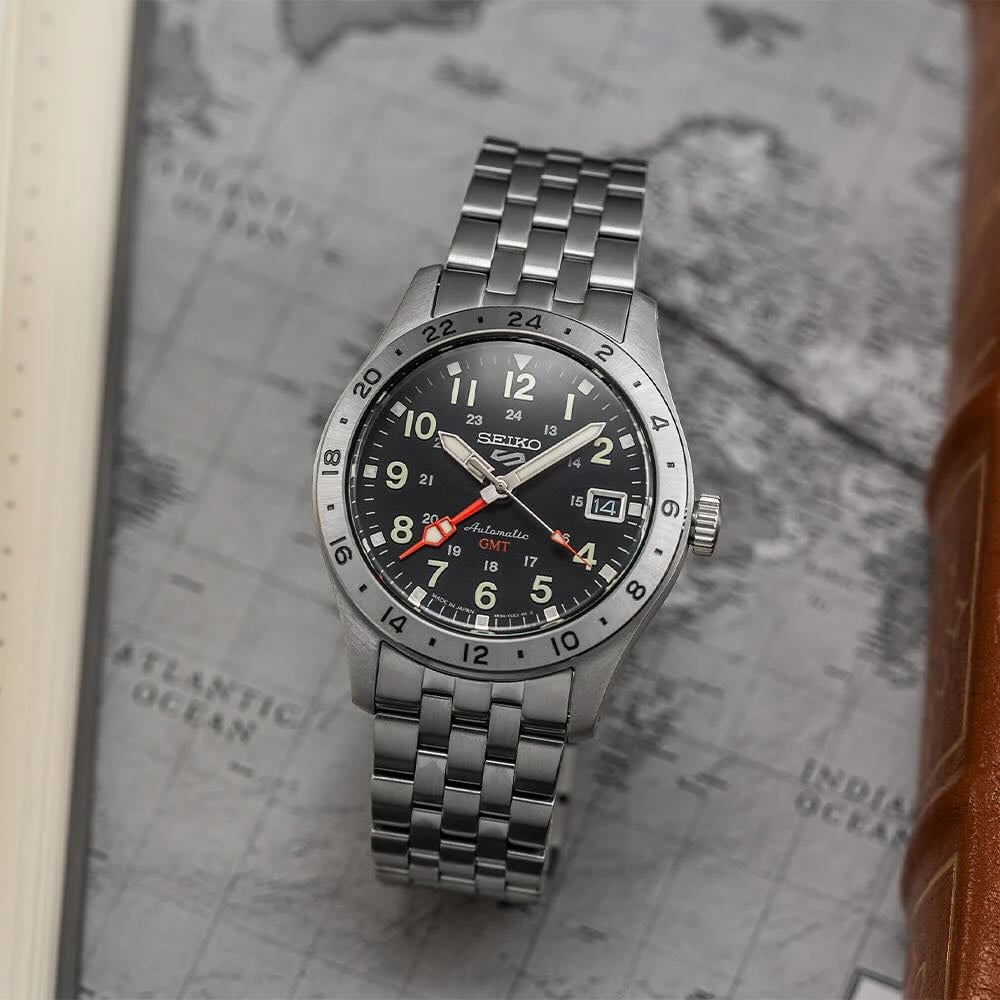
Naturally, the most striking departure from the standard Alpinist is the addition of a fixed, brushed bezel featuring black-filled 24-hour engravings. This design choice offers a classic and practical integration of the GMT function while ensuring the watch maintains its rugged, "daily beater" character. Additionally, the black filling adds legibility and a touch of contrast against the brushed steel, making it both practical for quick glances and aesthetically harmonious with the Alpinist’s outdoorsy, utilitarian ethos.
Both Seiko Alpinist GMT models are paired with color-coordinated leather straps, making them ideal companions for everything from smart-casual outfits to more formal professional attire. For added security and ease of use, they’re also equipped with a stainless steel single-fold deployant clasp featuring a convenient push-button release.
Seiko Alpinist GMT Dial

Blue and black dials have long served as the quintessential backdrops for the GMT complication, likely because their deep contrast against white indices and hands ensures peak legibility, or perhaps because blue inherently evokes the vast expanses of the sea and sky. But there is a historical element at play, also. TUDOR, Rolex, and other GMT pioneers often choose these colors for their day/night bezels. The Seiko Alpinist GMT reference SPB379 features a classic matte black colour with grey-white Arabic numerals at the cardinal points of the 12-hour track, and trapezoid-shaped hour markers in between. Alternatively, the Seiko Alpinist GMT reference SPB377 boasts a sunray blue dial with raised markers and numerals. Sidenote: standard Alpinist models diverge in design by utilizing a layout where Arabic numerals are reserved exclusively for the even-numbered hour markers.
A date indicator sits nestled neatly between the 4 and 5 o’clock location on both models, while a neatly integrated red GMT hand separates the dual time watch feature from the central hour and minute hands. These models are the office GMT type, with an independent adjustment feature that serves the watch well for its many action-based pursuits. The arrow-shaped hand is filled with lume and points to the time in another time zone on the fixed bezel. The compass scale on the rehaut, however, can be controlled via the 4 o’clock crown.
Although both models share the same design DNA, the blue reference leans into a more sophisticated aesthetic, with its sunburst dial lending a refined elegance to the wrist. In contrast, the black version is the quintessential tool watch; its utilitarian charm suggests a versatile "strap monster" that could be completely reinvented with every quick change of leather, rubber, or nylon.
Caliber 6R54 Movement

Housed securely within the case and visible through the exhibition caseback is Seiko’s dependable Caliber 6R54. This tried and tested movement is a staple in Seiko’s modern lineup, powering notable releases like the Prospex GMT Divers and the GMT Navigator Timer Reissue. This in-house caliber beats at 21,600 vph and offers a substantial 72-hour power reserve, ensuring it stays running even after a weekend off the wrist.
While it is an "office" GMT, meaning the GMT hand is adjusted independently rather than the local hour hand, it remains highly practical; as long as you are comfortable tracking your secondary time zone via the 24-hour scale, this movement provides a seamless and reliable experience.
Final Thoughts and Price

Given the Seiko Alpinist’s deep-rooted connection to the realms of adventure and exploration, many enthusiasts were left wondering why it took until 2023 for the brand to finally equip this iconic line with a GMT complication. Still, it remains widely popular amongst the Seiko-collecting community. While it is a mystery why Seiko opted not to offer either reference on a sleek stainless steel bracelet, the standard 20mm lug width ensures that finding aftermarket alternatives, from rugged distressed leather to utilitarian military-style straps, is easy enough.
Ultimately, the Seiko Alpinist GMT SPB377 and SPB379 references highlight the brand’s understanding of balancing meaningful evolution with thoughtful restraint. By meticulously preserving the hallmark case silhouette, the internal compass bezel, and the iconic dial aesthetic, Seiko ensured both models remain quintessentially "Alpinist." Simultaneously, the integration of a second time zone expands their utility, transforming them into tools that are just as capable of navigating international travel as they are of exploring the great outdoors.

The dual time zone function proves incredibly handy in conditions where it becomes difficult to differentiate day from night. Whether spelunking or travelling first class, the Alpinist is an all-rounder that can easily apply itself to most conditions, regardless of whether you’re using it to track home time or not; it remains a rare breed of timepiece that feels as much like an heirloom as it does a piece of essential equipment. The Seiko Alpinist GMT SPB377 and SPB379 are each priced at $1,150. You can learn more at seikowatches.com


1 Comment
Log in or to leave a comment
The best travel watches should possess higher-than-minimum anti-magnetic properties. As someone who had their watch become magnetized and suddenly run several minutes fast per day while away from home, I believe it should be something intrinsic to any “travel” watch.
(Of course, the alignment of the cardinal bezel markers is slightly off on the watches shown. Typical Seiko…)
Log in or to reply