






































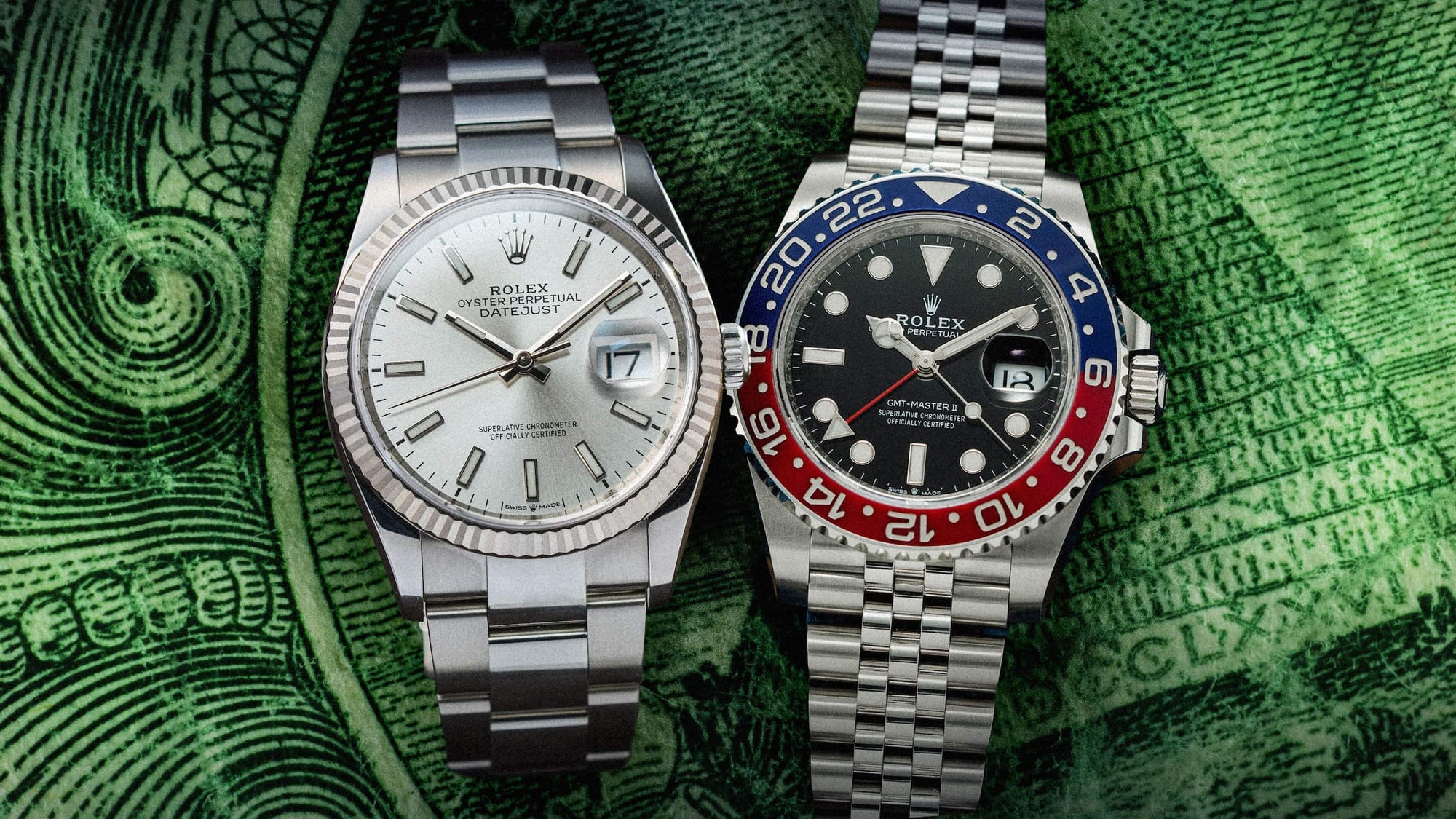
Short on Time
Rolex watches are almost never purchased on a whim, even for those with the means. They usually demand forethought, budgeting, and no small amount of patience. And just as timing the purchase matters, knowing when to hold onto a Rolex or when to cash out can be just as strategic. It’s a little like deciding whether to stick or twist in a horological game of Blackjack. Yet throughout all this, the brand has maintained a singular, magnetic presence in the luxury watch world, preserving a gravitational pull entirely its own. Its unparalleled ability to force contemplation on a soon-to-be collector sends even the most casual of admirers into deep, slightly panicked self-reflection. What personal sacrifices would they make to feel the weight of an Oyster case settling in their palm? The answer shifts wildly from collector to collector, but let’s not pretend the boundary between sensible compromise and full-on delusion doesn’t dissolve almost instantly when a Rolex enters the room. Here we will look at why are Rolex is so expensive and for what reasons.
[toc-section heading="What's In A Name?"]

Rolex has spent more than 120 years carefully crafting a story of success. This is evident in the watches worn by explorers tackling the world’s highest peaks and those braving the deepest oceans. The brand has built its reputation on exploration, precision, and uncompromising performance. Its watches feature movements engineered to outlast their owners and cases so expertly constructed they’re practically indestructible. Athletes have pushed the limits of human endurance with them firmly strapped to their wrists, and cultural icons have graced red carpets and movie screens wearing them. More often than not, these appearances require no formal endorsement. Just seeing a Rolex on the wrist of someone influential sends a clear, unspoken message: “This person has made it.”
This kind of visibility, combined with Rolex’s subtle marketing approach, allows the brand to remain aspirational without feeling forced. The manufacturer doesn’t need to bombard masses of consumers. Its marketing is self-sufficient. It’s an approach that only serves to enhance prestige further, creating an aura of exclusivity around the name. Rolex’s cultural presence and its association with exploration and achievement give it a natural pull that few other names can match.
Crucially, Rolex watches are already legends before leaving the factory. The brand’s presence transcends any formal endorsement. Seeing a Rolex on the wrist of an astronaut, an elite athlete, or a movie icon, even without sponsorship, only strengthens its reputation as the go-to watch of accomplishment.
[toc-section heading="In-House Perfection: How Rolex Builds Watches"]

Geneva is the manufacturing hub of the watch world, and here Rolex’s facilities are primarily located. The brand is almost entirely vertically integrated, meaning that it has complete control, flexibility, and creativity over its designs. It produces almost every watch part itself, from movement components to cases to bracelets. It even develops its own proprietary materials, such as Everose and Rolesor. Having this much control over the development of its watches and materials allows the manufacturer to uphold exceptional standards of quality, precision, and consistency across its entire catalogue.
Rolex also invests heavily in its Research & Development center, where, in years gone by, it has pioneered breakthroughs in antimagnetic technology, shock resistance, and lubrication. Every movement is certified to standards that supersede COSC guidelines, too, demanding a precision that few competitors can match.
Assembly is another area reflected in the price of a Rolex watch. Each watch is constructed with deliberate care and attention in what is often referred to as a “slow hands” approach. Components are methodically polished, finished, assembled, and inspected by highly trained watchmakers who test them against unfathomable tolerances. It is this level of dedication to in-house production, scientific advancement, and painstaking assembly that directly reflects in the price of a Rolex watch.
The foundation of Rolex’s supreme, self-sufficient manufacturing base is its demanding commitment to being "better than the best" – a philosophy evidenced by its control over every material, from smelting its exclusive 904L stainless steel to engineering the movement's intricate hairsprings.
Materials That Cost Money

Beyond the status and prestige that come with wearing a Rolex, the true value lies in the materials beneath the surface. Take the brand’s 904L Oystersteel, for example. It isn’t your average steel. It’s a corrosion-resistant superalloy, comprising higher percentages of chromium and molybdenum, that practically laughs in the face of sweat, saltwater, and the occasional spilled cocktail. Most watchmakers use 316L stainless steel, but Oystersteel is polished and finished to a mirror-like brilliance, and can survive oceans, deserts, and boardrooms with equal aplomb.
The brand’s investment in material research and development is not to be frowned upon. Rolex makes some equally impressive proprietary gold alloys, like Everose – a rose gold alloy with an unmistakably warm hue made from a unique blend of gold, copper, and platinum - and Rolesor – a combination of gold and Oystersteel that combines robustness with an indulgent aesthetic. These special alloys are formulated entirely in-house, promising the fade resistance and longevity that other standard golds can’t match.
The brand’s Cerachrom bezel inserts are among the best with color development and are near impossible to scratch, as are the brand’s sapphire crystals. Even the manufacturer’s seemingly minor components, such as the gaskets in a case and the brand’s special glues, are tested to withstand extreme conditions, while Rolex’s luminous material is designed to glow for decades. And, of course, Rolex has some of the best gem-setting out there. Clearly, Rolex has never been one to cut corners, which is precisely why its watches remain expensive.
Overengineered Movements Disguised as Simplicity

Rolex movements are among the most accurate and well built on earth. With the exception of some newer models like the 1908 and Land-Dweller, Rolex movements have typically been housed away behind enclosed casebacks. This isn't to say that their movements aren't exceptionally finished, however. But beneath an unassuming surface lies a movement that lacks more obvious visual flash but is symbolic of bulletproof engineering. Every component exists for a reason.
Rolex’s Chronergy Escapement, for example, is a modern reinterpretation of a Swiss lever design. It can improve energy efficiency by around 15%, delivering better precision while requiring less overall maintenance. Then you have the Parachrom hairspring, another patented innovation that is resistant to magnetism, temperature changes, and shocks. Complementing these components is Rolex’s Paraflex shock absorber system, which protects the small yet critical parts of a movement from impact. Although every Rolex movement is certified to COSC standards, it is also subjected to the brand’s Superlative Chronometer specification, guaranteeing an accuracy of −2/+2 seconds per day.
In no uncertain terms, much of the true value and resulting cost of a Rolex watch is rooted in the brand’s fanatical adherence to mechanical reliability.
Labor Training and the Human Touch

What many collectors may not appreciate when they buy their first Rolex watch is that the cost they incur is heavily underpinned by the brand’s commitment to human expertise and its perpetual service infrastructure. Unlike many manufacturers that rely heavily on automatic assembly, Rolex watches are maintained by a large workforce of specialists – humans trained by humans. These highly specialized watchmakers are trained within the company’s internal system, which costs money.
The brand’s internal training system is a colossal investment. Those who work there take years to learn the ropes, and this requires the commitment of many other senior members of staff to instill the brand values that echo through every corridor and workbench. Every technician who touches a Rolex watch must understand its precise engineering and appreciate how to uphold the company’s impenetrable reputation for excellence.
So, there are the operational costs to consider: the crafting of timepieces that meet the stringent criteria outlined by Rolex’s Superlative Chronometer standards, and the custom-made tools that make them. Also, the trained hands that hold the tools and those who train them, too. Indeed, all of these meticulous processes and resources add up, reflecting the precision, reliability, and enduring quality that justify the price of a Rolex. The brand’s manufacturing facilities are equipped with specialized air filtration systems that ensure a superior quality-control environment for each watch tested.
Crucially, Rolex accounts for the cost of ownership and the funds needed to uphold its vast service network. The brand has to carry out millions of services and repairs each year, many of which are still under customer warranty. This commitment to perpetual aftercare is part of what makes Rolex such a globally trusted brand. When buying a Rolex watch, you’re buying into years of service assurance, backed by a global network of internally trained experts who have the skills to maintain your watch for years and years to come.
[toc-section heading="Supply, Demand, and the Economics of Scarcity"]

Rolex is one of the few brands that doesn’t need to release limited editions to create scarcity. A quick glance through its portfolio shows that, if anything, the brand avoids them. Yet the paradox remains. Rolex watches are some of the hardest to actually buy at retail, and this isn’t a cynical marketing trick. Moreover, Rolex builds many watches, but does so slowly and meticulously. These standards leave no room for shortcuts. In fact, Rolex is fundamentally unable to manufacture the volume of watches required to satisfy global demand, especially models such as the Submariner, GMT-Master II, and Daytona.
This controlled and predictable production is legitimate, spilling into the very end of the chain – the authorized dealer. Here, wait lists can seem never-ending, sometimes years long, with customers often having to jump through hoops to acquire an in-demand model. The gap between supply and demand has widened so much that dealers can be very selective about who they sell to. Acquiring watches at retail suddenly becomes a system of social filtration.
The sophisticated interplay between controlled output and market perception creates a phenomenon in which the scarcity of a Rolex watch directly contributes to its value and thus inflates secondary-market prices. Some models command prices that are significantly above their official retail price. This high resale value reinforces the perceived prestige and investment-grade status of a watch, creating a powerful feedback loop. The higher the resale value, the more untouchable the brand becomes.
When you look at the bigger picture, Rolex’s availability problem is really a desirability phenomenon masquerading as a supply issue. As with any highly covetable brand, a Rolex costs whatever a consumer is willing to pay. Despite Rolex regulating global allocations and ensuring consistency across continents, it never really feels like that. Moreover, you may have to endure long, unpredictable, and occasionally existential waiting times before owning your Rolex grail, no doubt collecting a few emotional bruises along the way. Reputation becomes part of the currency in collecting long-awaited models, and getting your name put on a waiting list can feel like you’re practically auditioning for one. At the end of the day, Rolex’s availability paradox continues to feed itself.
The Resale Value of a Rolex

Unlike many other luxury products, which shed value the moment you peel off the sticker, a Rolex watch sits in a category of its own. Few luxury watch brands holds their value quite like a Rolex. The brand is a safe-haven asset in the luxury world and a place to park your money, with the reassurance that it’s highly unlikely to depreciate overnight.
The price floor for Rolex watches like the Daytona and GMT-Master remains exceptionally high. These models are textbook case studies in depreciation resistance, along with some special Submariner watches like the “Smurf” and the “Kermit.” Both can command a substantial premium on the secondary market, just as the GMT-Master II “Pepsi” can. The Daytona tells a similar story, with pre-owned market prices that have, at times, bordered on surreal. These models don’t just hold value, either. Sometimes their value can climb the moment they leave a boutique. Strap on a watch, wind it, wait for a week, and the market may reward you for your patience.
Because Rolex watches hold their value so well on the secondary market, collectors can justify the high upfront cost by viewing the purchase as a long-term investment, knowing they can sell it later if needed. Rolex watches hold their value very well, making a purchase feel less like a luxury expense and more like a way to preserve value. The company’s relentless fight against counterfeits and stricter dealer networks also helps protect the integrity of the secondary market. High resale values aren’t an accident but a byproduct of careful brand governance. Basically, it all boils down to that feedback loop. Strong resale supports strong retail demand, and strong demand pushes retail prices up.The emergence of the official Rolex Certified Pre-Owned resale network has only solidified this.
Rolex And Permanence

Rolex sells permanence. In the modern luxury world, where designs are wired for fast trends, this stands for something. You’re paying for the privilege of opting out of fashion cycles when you invest in a Rolex. Some designs, like the Datejust and Oyster Perpetual, have been around for nearly a century, and this institutional legacy is a major reason behind Rolex’s pricing structure.
Consistency is also paramount. When you look at models like the Submariner and the Datejust, their silhouettes have barely changed in decades. A modern-day Sub looks unmistakably related to its ancestors from the 1950s, and this is no coincidence. Rolex has always been a master at refining rather than reinventing. It has dedicated whole eras to tweaking proportions, upgrading internals, and trimming microns to improve its watches whilst maintaining relevance across three generations.
Rolex builds watches with the expectation that they will outlive their owners. The brand’s Oyster case is engineered for decades of abuse, while the movements are engineered for longevity and are far from fragile. Even the construction of a Rolex bracelet is made to be passed down the family line.
[toc-section heading="Rolex’s Rigorous Testing Still Matters to Collectors"]

Nowhere is Rolex’s engineering discipline more apparent than in the meticulous (some would say obsessive) procedures that take place inside its quality control center. Before any Rolex leaves Geneva, it faces an almost forensic series of checks. The movement is the first to be interrogated. Gears, jewels, escapements, rotors, and balance wheels are all inspected individually, long before they ever share the same plate. Each caliber is assembled by hand, lubricated with surgical precision, and then tested for amplitude, power reserve, and positional variation. Only then does the Superlative Chronometer certification come into play.
The Oyster case is subjected to the same forensic scrutiny as the movement. Machined to microscopic tolerances, each case is then laser-scanned to confirm structural integrity before being pressure-tested well beyond the depth rating printed on the dial. Collectors tend to appreciate a watch that can outperform its spec sheet when pushed, even if most will never put it to the test.
Even the details that seem cosmetic aren’t exempt. Cerachrom bezel inserts are checked for fade resistance, Chromalight lume is reviewed for brightness consistency, and the brand’s clasps and bracelets are put through endurance tests that simulate years of wear in compressed time. None of this is glamorous work. It eats up hours, energy, and infrastructure. Naturally, those costs are reflected in the retail price of a Rolex watch.
[toc-section heading="Is Rolex Overpriced?"]

As mentioned, the prices of Rolex watches on the pre-owned market are influenced by scarcity. The brand is also world-renowned for creating overbuilt, durable tools designed to outlast their wearers. Brands like A. Lange & Söhne target the highest level of haute horlogerie, but Rolex secures its position in the industry through its universal recognition. Compared to brands like Richard Mille and Jacob & Co., which are known for producing watches worn as grand statements of wealth and taste, Rolex is a mid-tier brand that sets the ultimate benchmark for desirability.
[toc-section heading="Conclusion: So, Why Are Rolex Watches So Expensive?"]

In the end, the reason why Rolex watches are so expensive is surprisingly simple. The brand has spent more than a century specializing in engineering an entire ecosystem, not just a product, and this empire is built on consistency, provenance, and an industrial stubbornness unlike any other manufacturer on the market. In-house manufacturing of just about every component and unbeatable build quality and accuracy make these products the standard everyone is compared to.
What really pushes Rolex into its own price bracket is the brand’s intangible reputation. The crown is a symbol of what an excellent mechanical watch should look and feel like. The manufacture produces these watches at scale, but never enough to meet demand, and it is this imbalance that fuels modern luxury: limited availability, controlled distribution, and a resale market that trades pure financial investments from one hand to another. Few other luxury items bestow such financial value. Rolex watches are perennial symbols of personal achievement. No other watch says “I made it” quite like one. According to those who own them, there is little that compares to wearing a watch that carries 120 years of engineering, prestige, and history, as a Rolex does. You can learn more over at rolex.com.
You May Also Like



Get your watch from TeddyBaldassarre.com and get 0% interest for up to 24 months available on select brands. Checkout with Affirm and spread your payments over 3 to 36 months. Learn More


0 Comments