






































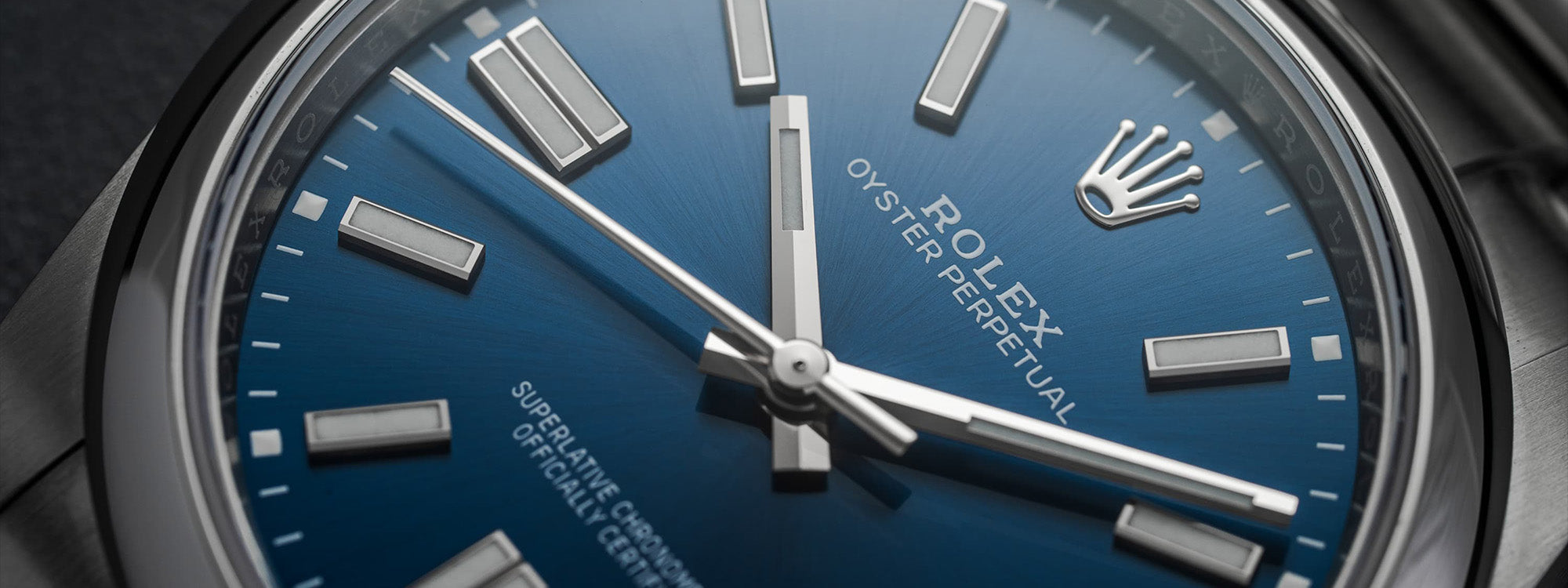
Short on Time
“Do Rolex watches tick?”
This is, apparently, a frequent question and a common concern of newbie Rolex owners, but the premise of the question is actually driven by a misconception. Virtually all Rolex watches — in fact, all watches equipped, as most Rolexes are, with a mechanical movement — are indeed ticking while they are running. If your ear is not perceiving it, that is only because the ticking is so rapid — nowadays, at least eight times per second — that the watch’s seconds hand appears to be moving in a smooth, sweeping motion. This can be quite noticeable if you have experienced only the much more visible, (and easily perceptible) one-tick-per-second movement common to the seconds hand of a quartz watch.

In fact, if your Rolex watch is ticking once per second, it might be worth taking a moment to authenticate whether or not it is real or counterfeit. Allow us to explain.
[toc-section heading="The Difference Between Mechanical and Quartz Movements"]
A mechanical movement is the oldest type of movement in horology. It uses a coiled metal spring, called a mainspring, that releases energy as it uncoils through a series of gears to drive a weighted, oscillating wheel called a balance wheel. The balance wheel’s oscillations are linked to an escapement, which periodically releases the gear train to move the hands forward to record the passing of hours, minutes, and seconds. Originally, the mainspring needed to be wound periodically by hand, first by a key, then by a winding crown attached via a stem to the movement.

Later, a type of movement was developed that could be wound “automatically,” through the motions of the wearer’s wrist. As with many other watchmaking concepts that have since become mainstream, Rolex was one of the pioneers of these self-winding movements in wristwatches. In 1931, Rolex founder Hans Wilsdorf patented a self-winding watch movement with a weighted mass that served to wind the mainspring via the motion of the wearer’s arm. Because this type of movement (above) kept the watch constantly wound as long as it was being worn, it was referred to, then and now, as “Perpetual.” It wasn’t the first self-winding, or “automatic” movement in a wristwatch — that would be the one patented by British watchmaker John Harwood in 1923 — but it was a development that spurred other watch manufacturers to begin adopting the technology in their own products. Rolex continues to equip the vast majority of its line — including the megapopular “Professional” models, like the Submariner, GMT-Master, and Daytona — with these types of movements.
To sum up, the two main types of mechanical movements are manually wound (or “hand-winding”), and automatic (“self-winding,” or, to use Rolex’s preferred terminology, “perpetual”), equipped with a weighted rotor (or “oscillating weight”) that swings with the natural motions of the wearer’s wrist. Continually wearing this type of watch will “automatically” wind it. Conversely, if the watch remains motionless for too long — say, in a safe or on a nightstand — its mainspring will run down and the watch will need to be wound and set again to start timekeeping anew. Hence, a mechanical watch movement requiring either regular winding or constant wear to keep running was one of the many issues addressed by the development of the quartz movement in the 1960s.

As explained much more thoroughly in this article, a quartz movement (above) is one that eschews a mainspring in favor of a small battery whose electrical charge passes via an integrated circuit into an oscillating crystal made of quartz, cut into the shape of a tuning fork. The crystal vibrates at a head-spinning rate of 32,768 times per second — much faster than most mechanical oscillators — to drive the hands at an incredibly precise rate, making for a watch that is accurate to -/+ 5 seconds per month; mechanical movements, in comparison, are considered accurate if they can achieve a few seconds of deviation per day. The Japanese are credited with being the pioneers of quartz technology in watchmaking, and the first watch with a quartz movement was the Seiko Astron, equipped with the groundbreaking Caliber 35A, launched in 1969. The benefits of quartz to the watch industry were several: quartz watches could be mass-manufactured easily and inexpensively and they were much more accurate than mechanically driven watches. Today, quartz and mechanical watches exist alongside each other, with the former being primarily made for the “affordable” mass-market category and the latter geared more toward the luxury end of the market.
[toc-section heading="Is Your Rolex Real or Counterfeit?"]
For the purposes of our discussion here, another identifying factor of a quartz-powered watch is that its seconds hand moves in visible, one-second jumps rather than in a continuous sweeping motion. This means that the motion of the seconds hand on the dial is an indicator of the type of movement inside the watch. In a watch with a mechanical movement, like the vast majority of Rolexes, the hand will circumnavigate the dial in a smooth, sweeping motion. This is a result of the movement’s balance beating 6, 7, 8, or even more times every second and it can make the individual ticks virtually invisible to the naked eye.

Conversely, a seconds hand that makes jerky jumps from one second to the next is a giveaway that the movement inside is quartz. Why does the seconds hand move this way when the movement is actually beating much faster than a mechanical one? Because the battery inside is using a tiny stepper motor that sends discreet, electronic pulses to advance the seconds hand, once per second, for greater accuracy. With some notable exceptions (many of which are produced by Japan’s Grand Seiko, which makes quartz-powered watches on an elite level), a quartz movement generally denotes a less expensive watch — and, in the case of a watch with “Rolex” on the dial, more often than not a counterfeit.
[toc-section heading="The Outlier: Rolex Oysterquartz"]
If you’ve got one of these every-second-ticking Rolexes and are now concerned about its authenticity, there are a handful of exceptions to keep in mind, especially if it’s a vintage model. As detailed in this article, Rolex produced a number of “Oysterquartz” watches in the 1970s, during the so-called Quartz Crisis. The first was the Ref. 5100, a limited edition of 1,000 pieces powered by the Swiss-made Beta-21 quartz movement. That model, the precursor to the "official" Oysterquartz models with Rolex’s own in-house quartz movement, was historically noteworthy as the most expensive watch in Rolex’s catalog at the time, with a chunky case and bracelet in 18k gold. Nicknamed "The Texan,” or "Texano," undoubtedly for its audacious dimensions and material, the Ref. 5100 (below) was also the first Rolex watch to use sapphire for the crystal over the dial, a forward-thinking choice in a period when mineral glass was still in common usage.

Rolex discontinued the “Texan” after its initial run of about 2,000 pieces and replaced it in the lineup with the Datejust Oysterquartz (below), which contained Rolex’s own in-house Caliber 5305, and eventually also the day-date Caliber 5505. These watches are also quite rare (fewer than 25,000 were ever produced) and very valuable, and any dealer selling a pre-owned Oysterquartz or “Texan” would likely be up-front about the movement inside. Simply put, though, if the Rolex watch you’re considering has a quartz movement, and its dial doesn’t say “OysterQuartz,” it’s probably a fake.

[toc-section heading="Modern Rolex Movements"]
As noted earlier, mMost of Rolex's most popular models today are equipped with Perpetual (mechanical automatic) movements, and the movements themselves have remained on the cutting edge of horological technology. As of the 21st Century, Rolex has achieved something very close to full vertical integration in its watchmaking and has developed a host of technical innovations, many of them patented, nearly all of them developed in the service of greater timekeeping accuracy and efficiency.

These include the antimagnetic blue Parachrom hairspring and the energy-efficient, shock-resistant Chronergy escapement, both of which aid in extending the standard power reserve in Rolex’s in-house movements — like the Caliber 3235 inside the Submariner and Caliber 3285 inside the GMT-Master II — to a lengthy 70 hours. (The integrated chronograph Caliber 4130 inside the Daytona actually achieves 72 hours, or a full three days of power.) In 2015, Rolex established its own standard for chronometric accuracy and reliability, the “Superlative Chronometer” certification, whose criteria include an average daily rate variation of a very precise -2/+2 seconds per day as well as a host of other attributes. Rolex watches are tested in its own laboratories in the areas of Precision (the aforementioned -2/+2 rate variation), Power Reserve (according to the stated specs), Waterproofness (10 percent extra safety margin for watches rated at 100 meters, 25 percent extra for divers’ watches rated to 300 meters and above), and Self-Winding (ensuring the perpetual rotor operates with no friction or other obstructions).

Most Rolex movements on the market today achieve a frequency of 28,800 vph (that's eight beats per second), but in 2025, Rolex wowed the watch community with the new Caliber 7135, a high-frequency automatic movement that made its debut inside the new Land-Dweller (above). Its regulating system is driven by the new Dyapulse Escapement, made of silicon, which delivers friction-free pulses of energy to the oscillator. The nearly unprecedented result is a three-handed movement that beats at a frequency of 5 Hz (or 36,600 vph), which means the watch can measure time to 1/10-second while still maintaining the established “Superlative Chronometer” standard. You can discover more details on the Land-Dweller and its historic movement in this video from Teddy and this in-depth article by Danny Milton from Watches & Wonders ‘25.
Aside from the aforementioned Land-Dweller and a few other special editions, you can’t see most of these movements in action; Rolex, unlike many other watchmakers today, doesn’t generally put exhibition windows in its casebacks to offer a view. However, you can appreciate the results on the dial side of the watch — namely, that smooth-as-silk sweep of the seconds hand that’s actually the result of tens of thousands of tiny ticks every hour.
You May Also Like



Get your watch from TeddyBaldassarre.com and get 0% interest for up to 24 months available on select brands. Checkout with Affirm and spread your payments over 3 to 36 months. Learn More


0 Comments