




Short on Time
Fundamentally, mechanical and quartz movements do the same thing: they both tell the
time. But the ways in which they both do it couldn’t be more different. Not to get into a
comparison guide here, but in a nutshell: a mechanical watch is powered by a mainspring
that’s either wound by hand or automatically through wrist movement. Energy is released
through a complex system of gears, an escapement, and a balance wheel that beats steadily back and forth. There’s no battery, just centuries-old engineering refined to an art form. These watches aren’t the most accurate, but accuracy isn’t really the point. Craftsmanship, tradition, and the emotional connection are.

Quartz watches, on the other hand, are powered by a battery and use an electrical current to make a quartz crystal vibrate at 32,768 times per second. That vibration is incredibly stable, which is why quartz watches are vastly more accurate and require far less maintenance. They’re practical, reliable, and often more durable for everyday use, as well as being notably more affordable. Neither system is inherently “better,” though. Mechanical watches speak to passion and heritage, while quartz prioritizes precision and convenience. Ultimately, it’s less about the movement inside and more about what you want your watch to represent on your wrist.

Next-Level Accuracy
Some watches measure accuracy in seconds per day, others by seconds per month. But
there also exists a small group of timepieces that compete in a completely different league from those, and they’re engineered with one goal above all else — to deliver ultimate, unwavering, almost obsessive precision. Some of these radical solutions to timekeeping elevate the conversation far beyond standard quartz performance. Examples like Breitling’s SuperQuartz and Citizen’s Caliber 0100 dissolve the boundary between traditional watchmaking and pure scientific precision, making them feel less like simple movements and more like laboratory-grade timekeeping instruments.
On the mechanical front, ideas like Zenith’s Defy Lab oscillator and Grand Seiko’s
groundbreaking Spring Drive technology prove that true accuracy often comes from
questioning the basics and starting again, rather than simply refining what already exists.
Let’s explore how some of these innovations push timekeeping accuracy to new heights as we delve into the most accurate watches and what they reveal about the future of precision horology.

Watches That Push the Limits of Accuracy
It’s impossible to talk about the accuracy of mechanical watches versus quartz without first acknowledging the profound impact the Quartz Crisis had on the watchmaking landscape during the 1970s and 1980s. Back then, mechanical watchmaking was essentially pronounced dead, because quartz movements were cheaper and quicker to produce, not to mention cool and futuristic. Balance wheels and mainsprings were in the dirt for quite some time, though they certainly carried more social prestige. When quartz hit, however, everyone wanted a piece of the action, even James Bond, who at one point stylized the Hamilton LED Pulsar on his wrist. While some collectors will always argue that quartz watches are soulless, there is no denying that some of the most impressive and accurate movements emerged from the quartz revolution and the years that followed.
Citizen Caliber 0100 Limited Edition (Caliber 0100)
Sometimes, a watchmaker masterfully creates a timepiece that captivates on the outside,
while the inner workings are kept a secret for those curious enough to look beyond the dial. A glowing example has to be the Citizen Caliber 0100 found inside models like the self-titled Calibre 0101 Limited Edition. It encompasses the Japanese manufacturing mindset of accuracy, performance, and efficiency.

Introduced in 2018, the brand’s High Accuracy Quartz (HAQ) Calibre 0100 set a new
benchmark by delivering accuracy to within one second per year - light-years away from the performance of a typical quartz watch (+15 seconds per month), to say the least. This accuracy is owed to a super-high-frequency temperature controller quartz oscillator that runs at around 8.4 MHz (8,388,608 Hz).
Originally, Citizen launched the movement inside a non-production pocket watch before
deciding there was enough demand to combine it with a lightweight titanium case. Courtesy of the brand’s solar and light-powered Eco-Drive technology, it eliminates the need for routine battery replacements, instead surviving up to eight months in battery mode. Citizen has equipped several limited edition watches with the Caliber 0100 since its release, including the Ref. AQ6101-02A, limited to 90 pieces and featuring a unique washi paper, platinum foil, and platinum powder dial. The model’s Super Titanium case is also strengthened by Citizen’s innovative Duratect surface-hardening technology.

The Citizen Caliber 0100 is one of the most accurate autonomous watches in the world,
since it doesn’t rely on a radio-controlled signal or other external sources to keep its
accuracy. Instead, it sets a benchmark for quartz timekeeping, single-handedly reframing
what high-end quartz can be and the ambition the category is capable of. (Price: $7,500)
Breitling Endurance Pro (SuperQuartz)
Mechanical watches certainly had to reinvent themselves as specialist items in the wake of the quartz era. They were often the preferred choice among lovers of traditional, timeless, and classic wristwatches and still are, but their accuracy is markedly inferior to that of quartz. Indeed, quartz still threatens the mechanical world today. Even so, some brands famed for their mechanical watchmaking continue to craft exceptional quartz timepieces.

Breitling, for example, developed the SuperQuartz movement, which features in the
Endurance Pro. The thermocompensated watch can overcome temperature fluctuations that would otherwise affect accuracy. The Superquartz Caliber B82 is 10 times more accurate than a standard quartz movement and is combined with features such as a pulsometer scale, chronograph, and a wide range of bold dial colors. Lightweight, thanks to its Breitlight® case, it’s tougher than titanium yet feather-light, making it perfect for active days or intense workouts. The bidirectional rotating bezel and screw-down crown ensure water resistance to 100 meters, while the high-contrast dial with lumed hands keeps timing intuitive even in dynamic conditions.
Temperature fluctuations, shock, or extreme conditions have minimal impact on this
movement, making it a chronograph you can rely on in the harshest environments. It powers a 1/10th-second chronograph with a 30-minute totalizer, combining extreme precision with practical functionality for athletes and endurance enthusiasts. (Price $3,700 on orange rubber strap)
Bulova Lunar Pilot Chronograph (Bulova HPQ)
It’s easy for those new to watches to assume that Japan single-handedly brought electronics into the watch world, but the earliest sparks of that technology were struck in the United States. Appropriately enough, one of the most accurate electronic movements available today comes from a meeting of minds between one of America’s oldest watchmaking names and one of Japan’s most inventive forces in modern timekeeping (re-enter Citizen).

Bulova became one of the first watchmakers in the world to explore electronics in wristwatch form with the Accutron, which achieved an accuracy of one minute per month. Thanks to its revolutionary mechanism, it replaced the balance wheel with a tuning fork and oscillated 150 times faster than a mechanical movement. Even during the shift from mechanical to quartz movements, the Accutron remained the gold standard in precise timekeeping. That was until 2008, when Bulova was acquired by Citizen Watch Company and then, in 2010, developed the Precisionist Caliber featuring a continually sweeping seconds hand.
The High Precision Quartz (HPQ) movement has an oscillator that vibrates eight times faster than a standard quartz movement (262,144 vph). Most quartz watches keep time with a simple back-and-forth vibration. This one? Not even close. Instead of the usual two prongs, it uses three, and rather than oscillating like a metronome, they twist. That twisting motion is the secret sauce behind its pinpoint accuracy. The best part is that it doesn’t ask anything special of you in return. No syncing to atomic clocks, no recalibration rituals after a battery swap, no techie nonsense. It runs on a standard, easy-to-find lithium battery like any other quartz watch.

The Lunar Pilot is a special‑edition chronograph inspired by Bulova’s space history, now
powered by the brand’s high‑performance 262 kHz quartz movement for exceptional
accuracy. It features a bold 45 mm 316L stainless steel case with a striking black dial,
super‑luminous hands and markers, and an anti‑reflective sapphire crystal for clarity. The
watch (also available in other dial colorways, as above) includes a tachymeter scale, calendar date, and 1/20‑second chronograph that measures up to 60 minutes. It comes on a black leather strap or steel bracelet, with interchangeable options and is water‑resistant to 50 meters. (Price: $695.)
Grand Seiko SBGX265 (Caliber 9F)
The Grand Seiko SBGX265 is one of those watches that instantly blows the whole “quartz is boring” theory right out of the water. It’s seriously impressive. Its star player is the 9F62 movement, a quartz caliber that’s built with the same obsessive craftsmanship Grand Seiko applies to all its mechanical watches. It’s absurdly precise, losing or gaining just a few seconds a year, and has an instantly flipping date, along with a silky-smooth seconds tick.

Visibly, things are just as impressive on the surface. The watch itself is a compact 37 mm
with a stunning Japanese blue sunburst dial that catches the light in all the right ways. The case features Grand Seiko’s signature Zaratsu polishing, giving it those signature razor-sharp, mirror-like edges. Simply put, the SBGX265 holds far more than a “set-it-and-forget-it” movement inside.
The 9F caliber was the brand’s way of showing that a quartz watch can be just as precise, carefully made, and exciting as a mechanical one. Introduced in 1993, it was built entirely in-house, with clever engineering tricks like a Twin Pulse Control stepper motor for a strong, smooth tick and an instant date change that flips in a blink. Its anti-backlash system keeps the gears perfectly tight, and the sealed case protects it from dust and temperature swings. Rated at ±10 seconds per year, it’s insanely accurate without needing atomic clocks. Basically, the 9F is quartz, but made with obsessive Grand Seiko love. (Price: $2,700)
Zenith Defy Lab (Caliber ZO 342)
The name Zenith will always instantly spark talk of the legendary El Primero — a high-
frequency automatic movement that can allow for measurements to the nearest 1/10th of a second. But Zenith can also lay claim to manufacturing the ZO 342, which operates at 15Hz. Launched back in 2017 inside the Defy Lab, it was the result of years of experimentation. The breakthrough came with a single-piece silicon oscillator that replaced the centuries-old balance wheel and hairspring. It enabled the movement to tick three times faster than most high-beat movements, delivering an insane accuracy of 0.3 seconds per day. The oscillator within the Caliber ZO 342 has fewer moving parts, so it needs no lubrication. It’s also more resistant to magnetism, swings, and general wear.

Housing this groundbreaking technology was a 44mm Aeronith case. Touted as the
world’s lightest aluminum compound, Aeronith is made by pouring molten aluminum into a mould to create a metal foam. The spaces within the foam are then filled with a
hypoallergenic, lightweight polymer, resulting in a composite that is 2.7 times lighter than
carbon fiber.
The Zenith Defy Lab is among the most accurate watches in the world, but was produced in a limited run of 10 pieces. The Defy Lab Inventor (pictured above) followed, improving the balance frequency to a staggering 18Hz (129,600cph). Yet the original Defy Lab will always be the watch that proved that mechanical watchmaking still had more to give. Zenith designed the dial with an open, architectural layout, featuring bold cutouts that reveal intricate parts of the movement in an almost industrial way. Sharp lines and clean finishes across the case made it an unmistakable yet wearable conversation-starter. (Prices range drastically from $3,000-$60,000.)
Grand Seiko Ref. 6185-8000 (VFA)
Anyone remotely familiar with Seiko would agree that the Astron certainly cemented the
brand’s reputation for precision in the late 1960s. And yet, running quietly alongside that
quartz revolution was something just as ambitious: its pursuit of mechanical precision, which reached its peak with the Grand Seiko V.F.A. movement. This obsessively regulated calibre, hand assembled and “Very Fine Adjusted”, proved that mechanical watchmaking could still compete, even in an industry dominated by quartz. The movement was regulated to tolerances that bordered on the absurd and was adjusted across multiple positions and temperatures, promising an accuracy of +2 seconds a day.

The Grand Seiko VFA movement is probably one of the most intriguing rabbit holes you
could venture down, since it reveals all manner of weird and wonderful watches that have
carried it. One example is the Grand Seiko Ref. 6185-8000, which holds a near-mythical
place in the brand’s history because it was the first model to be powered by the movement. It was produced in very limited numbers in 1968, with a 37mm palladium-silver alloy case and an integrated bracelet, giving it a distinctive, futuristic presence for its era. As for availability today, these watches are extremely rare survivors from a short production run of roughly three years. Because the 6186-8000 appeared in a short run, intact examples seldom surface. You can still find them on the secondary market, though examples with original dial, hands, case, and in good condition are harder to come by. (Price: Auction house examples fetch over $90,000).
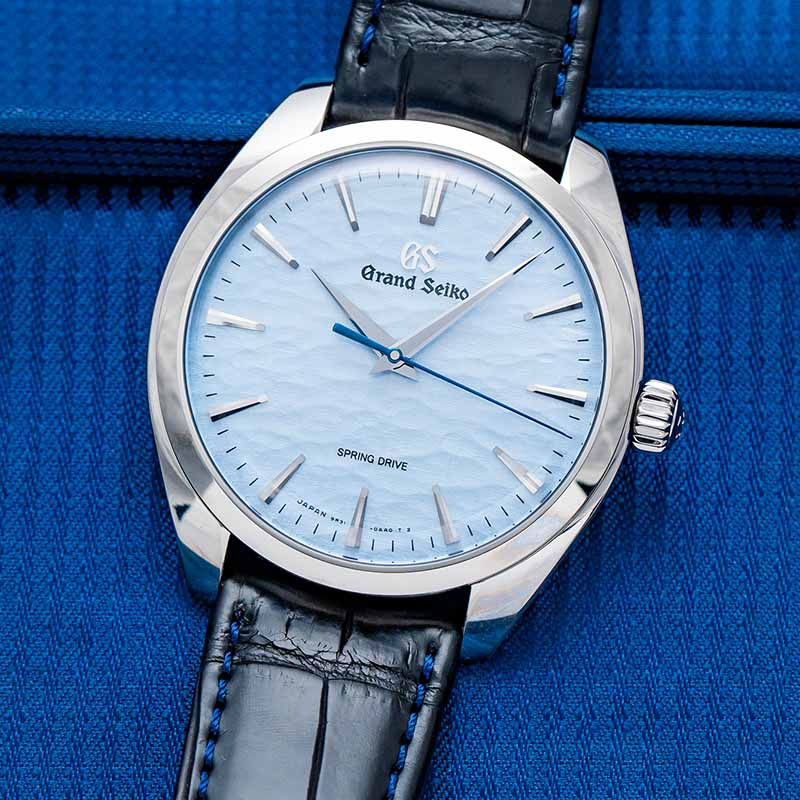
Grand Seiko Evolution 9 Spring Drive SLGB003 (Spring Drive)
Grand Seiko’s Spring Drive movement feels like a revelation because it blends the best of
mechanical tradition with the precision we usually associate with quartz, yet it does this
without a battery. At its heart, a conventional mainspring supplies power just like in a classic mechanical watch, but instead of a balance wheel ticking away, Spring Drive uses Seiko’s patented Tri-Synchro Regulator to brake and control that energy smoothly and continuously. This ingenious system lets the seconds hand glide effortlessly around the dial, creating a motion that’s quietly hypnotic and technically exceptional. There is simply nothing else in watchmaking quite like the Spring Drive. The technology fuses mechanical craftsmanship, electronic regulation, and quartz-level precision into a single, revolutionary movement.

The new Spring Drive Caliber 9RB2 has earned the brand’s Ultra Fine Accuracy (UFA)
designation because it’s regulated to ±20 seconds per year. It features in the Grand Seiko Evolution 9 Spring Drive SLGB003, making it one of the most precise mainspring-driven wristwatch movements available today. To put that in perspective, we can look at a typical mechanical or automatic movement, which is specified to roughly ±20 seconds per day, and even Rolex’s chronometer standard, which sits at ±2 seconds per day. Grand Seiko’s previous best, the Spring Drive 9R65, introduced in 2004, clocked in at about ±15 seconds per month. The leap to ±20 seconds annually represents a seismic improvement and showcases how far Spring Drive technology has evolved. The SLGB003 in high‑intensity titanium features a beautifully textured dial inspired by the frost‑covered landscapes surrounding Grand Seiko’s Shinshu Watch Studio. (Price: $11,400.)
Omega Speedmaster Super Racing (Co-Axial Master Chronometer)
The Omega Speedmaster Super Racing is the first Speedmaster to feature Omega’s
Spirate™ System, a new approach to hairspring design and regulation that pushes
chronometric accuracy further than anything the brand has ever done before. Rather than relying solely on conventional balance regulation, Omega’s Spirate System uses an
advanced silicon balance spring and an eccentric adjustment mechanism on the balance
bridge, enabling incredibly fine rate adjustments. The result is the Co‑Axial Master
Chronometer Calibre 9920, which earns a certified accuracy of 0/+2 seconds per day, a
remarkable improvement even on Omega’s already stringent 0/+5 seconds per day
standard.

The Super Racing has a 44.25 mm stainless steel case and a honeycomb‑pattern black dial with bold yellow accents that give it a heap load of presence and personality, nodding to Omega’s historical Speedmaster lineage and its racing heritage. The ceramic tachymeter bezel, yellow Super‑LumiNova, and even the striped seconds hand reinforce the watch’s sporty, track-ready character, albeit in a very practical way. (Price $13,100.)
Rolex Day-Date 40 Everose (Superlative Chronometer)
Rolex shows that high-end craftsmanship and exceptional timekeeping precision can go
hand in hand, delivering watches that are as accurate as they are iconic. Every Rolex
movement is first tested by COSC to meet official chronometer criteria, but Rolex then tests the fully assembled watch in its own labs to simulate real‑world wear. That in‑house testing guarantees precision of ‑2/+2 seconds per day, roughly twice as strict as COSC’s
requirement. Technologies such as the Parachrom hairspring, the Chronergy escapement, and rigorous waterproofing and self‑winding tests help Rolex achieve this performance. The green seal and five‑year guarantee signal that a watch meets these elevated standards.

The Rolex Caliber 3255 has a 70-hour power reserve, outperforming its predecessor, and is found in the Rolex Day-Date 40 Everose, one of the most elegant of Rolex watches with a price tag to match. It’s a modern classic that pairs Rolex’s proprietary 18k Everose gold with the brand’s signature fluted bezel and a rich slate ombré dial that shifts from lighter centre tones to deep charcoal at the edges. (Price: $51,600.)
At the end of the day, watchmaking is a story of ambition and precision, whether mechanical or quartz. Mechanical movements celebrate craftsmanship, heritage, and the joy of engineering a mainspring and escapement into perfect rhythm, while quartz pushes the boundaries of accuracy to levels once unimaginable. Yet brands like Grand Seiko, Omega, Rolex, and Citizen blur these lines, creating movements that combine artistry with near-scientific precision, from examples like the V.F.A. and Spring Drive to Spirate-regulated Speedmasters and the Caliber 0100. Ultimately, these watches show that timekeeping is as much about innovation, precision, and scientific mastery as it is about tradition.


Be the first to leave a comment
Log in or to leave a comment