




Short on Time
What is a Co-Axial Movement? More specifically, what is the now-famous Co-Axial Escapement that has become a standard feature on most all Omega watches? In short, it's both a radical concept by one of the modern era's most revered watchmaking geniuses and the culmination of a Swiss watch brand's longtime dedication to improving watchmaking accuracy. Here is the story of Omega's co-axial movements.
Early Omega Movements

While it is best known these days for its signature watch models, like the Speedmaster “Moonwatch” and the James Bond-worn Seamaster, Omega has also been a pioneer in movement-making since nearly the beginning. The company was founded in 1848 by 23-year-old watchmaker Louis Brandt (with family, above) in the Swiss village of La Chaux-de-Fonds. Originally called La Genérale Watch Company, and eventually renamed Louis Brandt et Fils after Brandt’s sons joined the business, it originally produced key-wound pocket watches from parts supplied by local artisans, After the growing company moved from La Chaux-de-Fonds to the more bustling town of Bienne, in the Swiss Canton of Bern, it pioneered a series of industrial watchmaking techniques and also began making its own in-house movements. The first one, called the Labrador, launched in 1885 in a now-legendary series of pocket watches. Nearly a decade later, in 1894, came the company’s chef d’oeuvre, the 19-ligne Omega Caliber, which was notable at the time for its enviable accuracy, its use of a crown rather than a key to wind the mainspring, and its construction using interchangeable components. The Omega caliber’s design enabled any watchmaker in the world to service it — an industrial practice that would become standard in the industry in years to come.

Naming the movement “Omega” was no fluke: it was regarded at the time as the pinnacle of the company’s horological expertise, and positioned as the ultimate watch movement the industry had yet seen — the endpoint of a years-long quest for excellence in timekeeping. Brandt watches outfitted with the caliber eventually were all marketed under the sub-brand “Omega,” and the entire company changed its name to Omega when it was reorganized in 1903. By that point, the Omega watch company was a world leader in watchmaking, employing more than 800 and making more than 200,000 watches annually.
Like many other Swiss watchmaking companies over the turbulent decades of the 20th Century, Omega eventually moved away from making its own movements, becoming part of a larger conglomerate (in this case, the Swatch Group) with production facilities shared among various brands (primarily, the movement-making giant ETA). But as the 21st Century dawned, and the high-end mechanical watch was emerging from decades of quartz dominance, Omega became one of many heritage Swiss firms to re-establish the vertical integration that it once claimed, and the prestige that now came with it.
The Standard: Explaining the Lever Escapement

There have been several inventions, since the advent of the wristwatch in the 1800s, designed to regulate the flow of energy released from a movement’s mainspring. The most lasting of these, and the one still employed in a majority of mechanical watches today, is the lever escapement, invented by British watchmaker Thomas Mudge in 1754. It is named for the small, fork-shaped lever situated between the escape wheel and the balance, which has two jewels, one on each tip of the forked end. Driven by a jewel on the balance wheel, this lever flicks back and forth, alternately locking and unlocking the wheel, whose teeth slide along the surface of lever’s receding jewel (i.e., its “impulse face”) to create the force that keeps the balance oscillating. This cycle of locking, unlocking, and continuous impulses keep the energy flowing and the watch running.
This type of escapement has many advantages; there’s a reason it’s still common in the 21st century. It allows the balance wheel to swing freely for most of its cycle, requiring only small pushes to generate energy. Its construction is relatively durable, making it resistant to shocks, and it is both inexpensive to mass produce and easy to service.
The downside to the lever escapement is the friction created by all those tiny surfaces sliding and rubbing against each other, which over years of operation will create wear and tear in the components. This is why a movement with the traditional lever escapement requires lubrication with oils every so often to keep it running optimally. In recent times, watchmakers have developed technologies with an eye toward solving or at least alleviating the lubrication problem — the most significant of which is the adoption of silicon components — but none that have changed the nature of the escapement itself.
Who was George Daniels, Inventor of the Co-Axial Movement?

More than two centuries after Mudge’s invention of the lever escapement, another British watchmaker, George Daniels, had the bold temerity to try to improve upon it. Born in Sunderland in North East England, Daniels (1926 - 2011) developed an interest in horology during his stint in the army during World War II, occasionally fixing timepieces for his fellow soldiers in the East Yorkshire Regiment. In 1947, he began his career in earnest, as a watch repairer at Magill’s Jewelers in Edgware, a northwest London suburb, and eventually opened his own watch repair and cleaning shop in 1960, also in London. Daniels, who’d learned and trained for years at horology night classes during his employment at Magil’s, completed his first self-made pocket watch in 1969, the first of many accomplishments in the field of watchmaking that were still on the horizon.
The most historic of these came in 1974, during an era that traditional mechanical watchmaking was on the wane, threatened with obsolescence and even extinction by the rise of quartz technology at the beginning of that decade. American industrialist and watch collector Seth G. Atwood commissioned Daniels to create for him a timepiece that would “fundamentally improve” a mechanical watch’s performance. Daniels, an admirer of pioneering horological inventors like Abraham-Louis Breguet, envisioned an escapement that would work free of the friction that had plagued various such inventions throughout history. It used two wheels on one axis — an escape wheel and a co-axial wheel — stacked atop one another and rotating at the same speed in opposite directions. The smaller wheel interacts with a lever to deliver energy indirectly to the balance, via the larger wheel which delivers energy to the balance directly. To eliminate the sliding friction of the lever escapement, Daniels’ mechanism used three pallets to separate the impulse from the locking function. The balance wheel is thus allowed to oscillate freely at a precise rate and there is no need, at least theoretically, for lubrication, since the pallet stones aren’t sliding over the escapement gear.

The co-axial escapement (so named for its two wheels on one axis) was ingenious in that it incorporated technical concepts from both the ubiquitous lever escapement and older inventions, like the detent escapement, used in 18th and 19th Century marine chronometers. The latter was prized for its almost friction-free operation but fell out of favor due to its fragility; when an impact jarred the balance wheel, the movement would stop, unlike the lever escapement, which was designed to self-restart after an impact. Daniels, who enlisted the aid of another English watchmaker, his friend Derek Pratt, in the development of the co-axial concept, also brought some historical influence to bear in its creation. German-American watchmaker Charles Fasoldt was the first to patent an escapement with co-axially mounted twin wheels and triple-pallet lever design in 1865. And the legendary Breguet had dabbled with an oil-free design with two geared escape wheels even earlier, with his so-called “natural escapement” in the early 1800s.
The Co-Axial Movement Finds a Home: Daniels Meets Omega
Daniels installed the co-axial escapement in one of his personal watches in 1976. Appropriately (as it would turn out), the watch was an Omega Speedmaster Mark 4.5, equipped with Caliber 1045. That watch is now on display at the Omega brand museum in Bienne. It would be quite a few years, however, before Daniels managed to interest any large watchmaking company in his historic invention, the first real advance in escapement technology in literally centuries. The intrepid English watchmaker began travelling from his home in the U.K. to the watchmaking centers of Switzerland, sometimes accompanied by Pratt, to pitch the co-axial escapement, for a long time with no success. Part of the reason for this, undoubtedly, was simply a byproduct of the difficult times the Swiss watch industry was experiencing in the 1980s and early ‘90s. The Quartz Crisis was still in full swing and investing in any new type of mechanical movement, especially one that had yet to prove capable of being produced at scale, may have seemed unwise.

Rolex and Patek Philippe were among the prestigious watch maisons that Daniels approached during this period, but neither they nor any of the unnamed other brands were ultimately interested in producing it. Patek’s Research and Development workshop did make a prototype co-axial movement in 1981 (one year after Daniels obtained a patent for his version in 1980), placing it inside a Nautilus watch, but eventually abandoned any notion of taking this idea further. By the mid-1990s, however, interest in mechanical watches was once again emerging in the industry and Daniels’ reputation among a new generation of aspiring watchmakers, as well as savvy watch enthusiasts and collectors, brought renewed attention to his signature invention. Omega — as we’ve seen, a company with a history of boldness on the technical side — was the brand that finally pulled the trigger on acquiring the rights to the co-axial escapement. It was the latest in a long line of visionary moves by Nicolas G. Hayek, Sr., then the head of the Swatch Group that owned (and still owns) Omega SA, and it would help define that brand’s identity in the new millennium that was fast approaching.
Omega's Modern Era: Watches with Co-Axial Movements

The first watch to be mass-produced with a co-axial movement inside arrived in 1999. The Omega De Ville Ref. 5931.81.00, a limited edition of 999 pieces in gold, marked the debut of Caliber 2500, which used the tried-and-true, automatic ETA 2892-A2 as its base and was optimized with this first commercialized version of Daniels’ co-axial escapement. (ETA, like Omega, was by this point part of the Swatch Group) This version of the movement (technically designated Caliber 2500A) featured a 48-hour power reserve and was certified as a chronometer by COSC. It was short-lived in production, as there were issues with shock protection. Omega continued to evolve and improve upon subsequent versions, replacing the ETA base movement with one from Frédéric Piguet, a prestigious Swiss movement maker that had also been absorbed into the Swatch Group (and today is part of sister brand Blancpain). Calibers 2500B, 2500C, and 2500D, all built on that Frédéric Piguet base, eventually gave way, in 2007, to Caliber 8500, the first Omega in-house movement built from the ground up to incorporate the co-axial escapement.

Caliber 8500, which also boasted 60 hours of power reserve in two mainspring barrels and a 25,200-vph frequency (adjusted from the 28,800 vph of the base caliber for reasons of precision), proved to be a watershed for the Omega brand. The original movement, which made its debut in a watch called the De Ville Hour Vision (below), spawned several offspring and jump-started the use of co-axial escapements throughout the watchmaker’s entire portfolio of movements. Caliber 8520, which followed Caliber 8500 in 2008, was smaller in dimension and suited for Omega’s ladies’ watches.That same year, Omega began using balance springs made of magnetic-resistant silicon, ushering in the enhanced version of the 8500, the 8601/8602, which added an annual calendar function to accompany the new cutting-edge balance spring.
The first Omega chronograph movement with a co-axial escapement was Caliber 3313 in 2002, built on the same Frédéric Piguet base as the later generations of the three-handed 2500 series. Following up the in-house Caliber 8500 (technically, designed by Omega and assembled exclusively for the brand by ETA), Omega released its first in-house, co-axial chronograph movement, Caliber 9300, in 2011 — the same year that George Daniels died. That movement, which included a silicon balance spring, two barrels, and a column wheel with vertical clutch, made its debut inside a modern version of the classic Speedmaster Moonwatch Chronograph and also inside a chronograph version of the Seamaster. Today, Caliber 9300 finds a home inside, among other models, the Speedmaster Dark Side of the Moon (below).

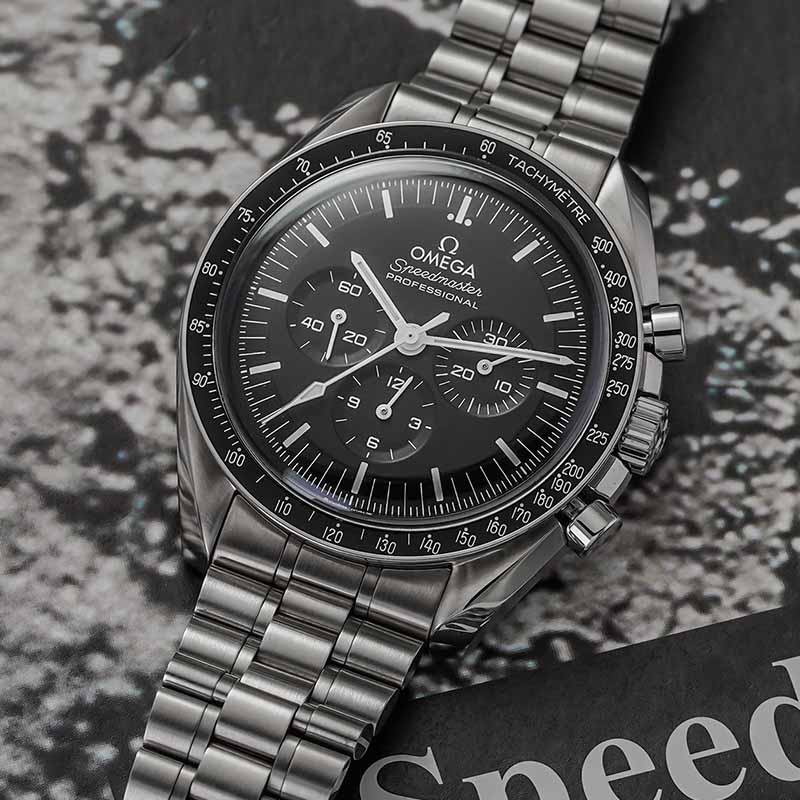
By 2015, when Omega introduced its new Master Chronometer certification, Omega had already expanded its repertoire of in-house co-axial movements throughout the majority of its collection, ensuring that George Daniels’ historical invention would play a key role in the brand’s identity going forward. In the decade that has followed, Omega movements have increasingly carried the designation “Co-Axial Master Chronometer” — incorporating all of the friction-free advantages of the co-axial escapement as well as a host of criteria demanded by METAS, the Swiss Institute of Metrology, which include an industry-leading magnetic resistance to 15,000 gauss and a daily accuracy between zero and 0.5 seconds, stricter than the COSC specifications adhered to be many other chronometer-certified timepieces. Most recently, Omega updated the one movement that it had barely changed since the 1960s — the manually wound Caliber 1861 beating inside the Speedmaster Professional "Moonwatch" — with a Co-Axial Master Chronometer version, called Caliber 3861. In 2021, after debuting in an anniversary limited edition, that movement became standard in the core Moonwatch line.

Other than Omega, the watchmaker that took a chance on the concept more than a quarter-century ago and has since become the only brand to mass-produce it, only Daniels’ protegé, the esteemed British watchmaker Roger Smith, uses co-axial technology in his eponymous, bespoke timepieces, likely as a tribute to his mentor. And while a handful of watch brands — most notably, Tudor — have begun to dip their toe into the waters of the METAS Master Chronometer certification pioneered by Omega, the co-axial movement appears to be quite solidly established as a hallmark of Omega alone, and a reminder of the venerable Swiss brand’s long history of revolutionizing watchmaking, inside and out. You can learn more over at omegawatches.com


Be the first to leave a comment
Log in or to leave a comment