







































Short on Time
Digital watches — at least, those of the electronic variety — have only been around for just over half a century at this point, which is a relatively brief moment in the totality of watch history. Nevertheless, they have exerted in that time an outsized influence on the technological and design evolution of the watch industry as well as on the overall culture. As the term “vintage” has been widely interpreted these days to describe any object more than 20 years old, here is our list of the 10 most important “vintage” digital watches (including a handful of worthy analog-digital models). And good news for fans of their retro style: many of them still live on in some form today.
[toc-section heading="Breitling Emergency (1995)"]

Introduced in 1995, the Breitling Emergency is literally a watch that has saved lives. The first watch with a built-in micro-transmitter that operated on an international air distress frequency, enabling a pilot to contact search-and-rescue teams after an emergency or crash landing. In 2015, after the original had racked up many notable exploits, Breitling launched the second-generation Emergency II, which added a dual-frequency personal locator beacon (PLB), that can both issue alerts as well as guide rescuers to the wearer’s location by accessing a network of satellites and ground receiving stations. The analog-digital display, powered by Breitling’s thermocompensated SuperQuartz movement, offers an array of indicators including 12/24 hour times, alarms, multilingual calendars, a 1/100-second chronograph, and an end-of-life indicator for its rechargeable battery; all this, of course, is in addition to the built-in antenna that activates the PLB, which can be deployed by a screwed-down knob in the lower right of the titanium case. Make sure you’re really in trouble before activating it, as the FCC, which monitors the frequencies, does not take kindly to their misuse.
[toc-section heading="Bulova Computron (1976)"]

Bulova, which had helped pioneer the electronic era of watchmaking with the groundbreaking Accutron technology back in the 1960s, presented its first all-digital timekeeper, the Computron LED, in the 1980s. The watch is notable for its unusual, trapezoidal gold-toned case with a digital LED readout of the time angled on its side, a style known to some as a “driver’s watch,” since it enables a driver with his hands on a steering wheel to check the time without tilting the watch or taking his hands from the wheel. The angled layout also eliminates the glare that makes other LED watches difficult to read under direct sunlight. The Computron features an “on-demand” display of the time and the date, both operated by a single command button, which helps conserve the watch’s battery life when it’s not in use. Bulova reintroduced the Computron as part of its vintage-inspired Archive collection in 2019.
[toc-section heading="Casio F91W Digital Sport Watch (1989)"]

A somewhat prototypical predecessor to the famous G-Shock, Casio’s ubiquitous F91W was released in 1989 and at one point was the most sold watch in the world, at 3 million units produced annually. It still speaks to legions of fans with its rectangular resin case, multifunctional digital display face, and ribbed, waterproof resin strap. The watch’s three buttons operate a 1/1000-second digital chronograph with split times, alarms and time signals, and auto calendar functions, along with an illuminating night light. Pressing the button on the right side of the lightweight case for five seconds brings up the model’s anti-counterfeit “Easter Egg:” the name “CASI0” briefly appearing on the screen in digital text.
[toc-section heading="Casio CA53W Black Data Bank ‘Calculator’ Watch (1988)"]

A touchstone of the digital-driven 1980s more popularly known as the Calculator Watch, the CA53W found its way back into the pop cultural conversation in recent years when it was worn by Bryan Cranston as chemistry teacher-turned-drug-kingpin Walter White in the TV series Breaking Bad. One of the more ubiquitous vintage digital watches, it remains a cult classic with retro nerd appeal, its defining feature being the eight-digit calculator function that enables addition, subtraction, multiplication and division operations right on the tiny LCD screen. Its rectangular black resin case with reticulated strap resists water pressure to 50 meters. With its black miniaturized keyboard, the watch’s front face calls to mind early cell phones and Blackberries — appropriate, as this humble Casio model, with its range of functions that include stopwatches, multiple time zones, and alarms in addition to the calculator, anticipated the rise of the smartphone and, eventually, the smartwatch.
[toc-section heading="Casio G-Shock DW-5000 (1983)"]

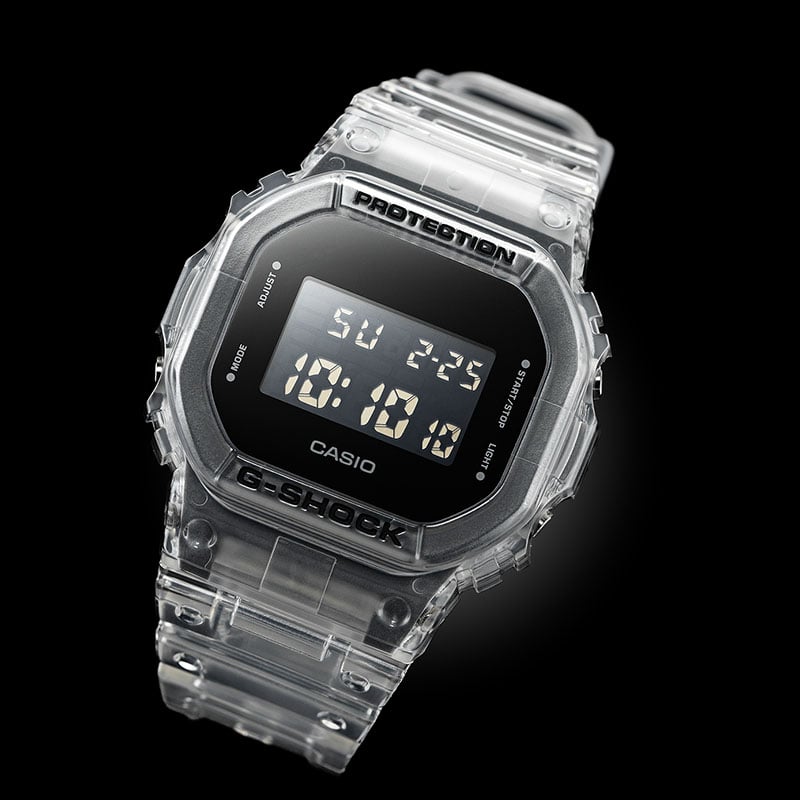
You really can’t have a list of important vintage digital watches without a G-Shock, and the DW-5000, released in 1983, is the granddaddy of all G-Shocks. Its rectangular-cased, digital-display design has been a mainstay since its early '80s release and, with its black resin case, was an early forerunner of the black-on-black trend that would take a firm hold on the luxury end of the watch world years later. The classic gray field of this model’s LCD dial frames the compact readout of time, date, and running seconds. Like most all watches in G-Shock’s extensive DW5600 family, its durable resin case boasts a 200-meter water resistance and its digital functions include a 1/100-second stopwatch, countdown timer, multi-function alarm, a full calendar accurate to 2099, and an electro-luminescent backlight with afterglow.
[toc-section heading="Citizen Aqualand (1985)"]

Citizen Watch Co., which made Japan’s first waterproof wristwatch, the Parawater, in 1959, also released the first quartz-powered dive watch equipped with a digital depth gauge in 1985. It was called the Aqualand, and most would agree that it set the stage for many advancements to come from Citizen in the area of analog-digital timepieces. The depth gauge, in fact, was just one of an array of dive-friendly features including depth measurement, dive time measurement, maximum depth memory, an electronic log to store data from previous dives, and even an alarm that would alert a surfacing diver if he was ascending too rapidly. The original Citizen Aqualand — which lives on in a more traditional analog design in the current collection — is regarded by many diving enthusiasts as the last electronic watch specifically designed for diving before such devices were made obsolete by the rise of the dive computer in the later 1980s. Citizen paid tribute to the pioneering model with the 40th Anniversary limited edition, pictured above, in 2025.
[toc-section heading="Girard-Perregaux Casquette (1976)"]

In 1976, at the height of the quartz and digital dominance of the watch industry, one of the oldest and most traditional Swiss watch maisons, Girard-Perregaux, introduced a timepiece that captured the era’s horological zeitgeist, with an avant-garde tubular LED display for the time and an angular sidestepped case that brought to mind a 1970s’ muscle car. The watch, which Girard-Perregaux resurrected as a limited edition in 2022, was nicknamed the “Casquette” and it had a relatively small production run of 8,200. The original was available in steel, gold-plated steel, or brown Macrolon plastic, while the new edition had a case and bracelet made of lightweight, hypoallergenic, scratch-resistant ceramic, with titanium used for the caseback and pushers. The quartz movement developed for the “2.0” version powers an LED time display of hours, minutes, seconds, day, and date viewable on demand via the pushers. As a clever bonus feature, the indications also include a “secret date,” programmable by the owner, that can be used as a reminder of a special occasion like an anniversary.
[toc-section heading="Hamilton Pulsar/American Heritage PSR (1972)"]

Hamilton Watch Company, founded in Lancaster, PA, gave the world the first mass-produced LED digital watch, the Pulsar P1, in 1972. At the time, it was considered anything but cheap and practical: its case and bracelet were in 18K solid gold, rand the watch sold at retail for a steep $2,100,(over $16,000 today) — almost double the cost of a gold Rolex Day-Date. Its initial exclusivity made the Pulsar a hit among A-List celebrities of the era, and the model secured its pop cultural legacy when a Pulsar P2 2900 LED watch was worn on screen by Roger Moore as James Bond in the opening scene of Live and Let Die. That moment of cinematic immortality ushered in the era of digital watches for the Bond franchise that would last into the 1980s, longer than the original production run of the Pulsar itself. Hamilton released a modern, upgraded version in 2020, the Hamilton PSR, which is a tribute to the original. Available in stainless, gold PVD, and black PVD versions, the PSR offers 100 meters of water resistance, a substantive stainless-steel case and matching three-link bracelet, and a unique sapphire crystal protecting the LED display.
[toc-section heading="Seiko T001-5019 ‘TV Watch’ (1982)"]

While Seiko, more than any other watch brand, pioneered the use of quartz technology in watchmaking, most of its most classic and influential models are of the analog variety. A handful of exceptions can be found thanks to the predominance of Seiko watches in the James Bond movies throughout the ‘70s and ‘80s. The most memorable is the long-discontinued T001-5019 “TV Watch,” worn by Roger Moore in 1983’s Octopussy. It was a technical first for the Japanese watchmaker, which was equipped with a receiver that could receive UHF and VHF television broadcast signals and broadcast their images on a tiny LCD screen (just 1.2”). The watch required a great deal of other accessories to perform its duties, including a receiver/tuner pocket unit, two AA batteries, and a set of headphones, and it quickly proved impractical for most users, leaving production shortly after it debuted. However, the version of the TV Watch in Octopussy is still talked about: in keeping with the ethos of this era of Bond, it was used for both play (Bond using the screen to ogle the cleavage of an attractive female assistant at Q’s lab) and work (using it to retrieve reconnaissance images from a camera mounted on a hot air balloon in the final battle scene).
[toc-section heading="Timex Ironman (1986)"]

Despite its origins as a watch for sports and fitness, the Timex Ironman is regarded as one of the top “tech geek watches” and important vintage digital watches of the 1980s and ‘90s. (It was also famously spotted on the wrist of former President Bill Clinton before he began dabbling in higher-end timepieces.) The original Ironman from 1986, which doubled the water-resistance of its predecessor, the Triathlon, to 100 meters, is very similar to the model still sold today and still popular with law enforcement and military officers. The Ironman is now water-resistant to 200 meters (twice the rating of the 1980s watch) and features a large LED display for its various functions, including stopwatch with lap and split times, countdown timers, Indiglo night light, daily and weekend alarms, and training-friendly devices for runners, including a 99-lap counter and a 30-lap memory recall. More trivia: like the far more expensive and iconic Omega Speedmaster, the Timex Ironman is one of the few watches certified by NASA for use on space missions.
Shop this Article
You May Also Like



Get your watch from TeddyBaldassarre.com and get 0% interest for up to 24 months available on select brands. Checkout with Affirm and spread your payments over 3 to 36 months. Learn More


0 Comments