Your Shopping Cart
Qty
Price
Receive 5% Off Your First Order. Now Shipping to Germany.
Receive 5% Off Your First Order. Now Shipping to Germany.
Receive 5% Off Your First Order. Now Shipping to Germany.
Receive 5% Off Your First Order. Now Shipping to Germany.
Adding a personal touch to your gift is easy! At checkout, enter the recipient's info in the shipping address section and we’ll include this note in the order.
You are currently shipping to and your order will be billed in USD $
You are currently shipping to and your order will be billed in USD $
We go through all the parts of a watch case, dial, movement, and strap or bracelet
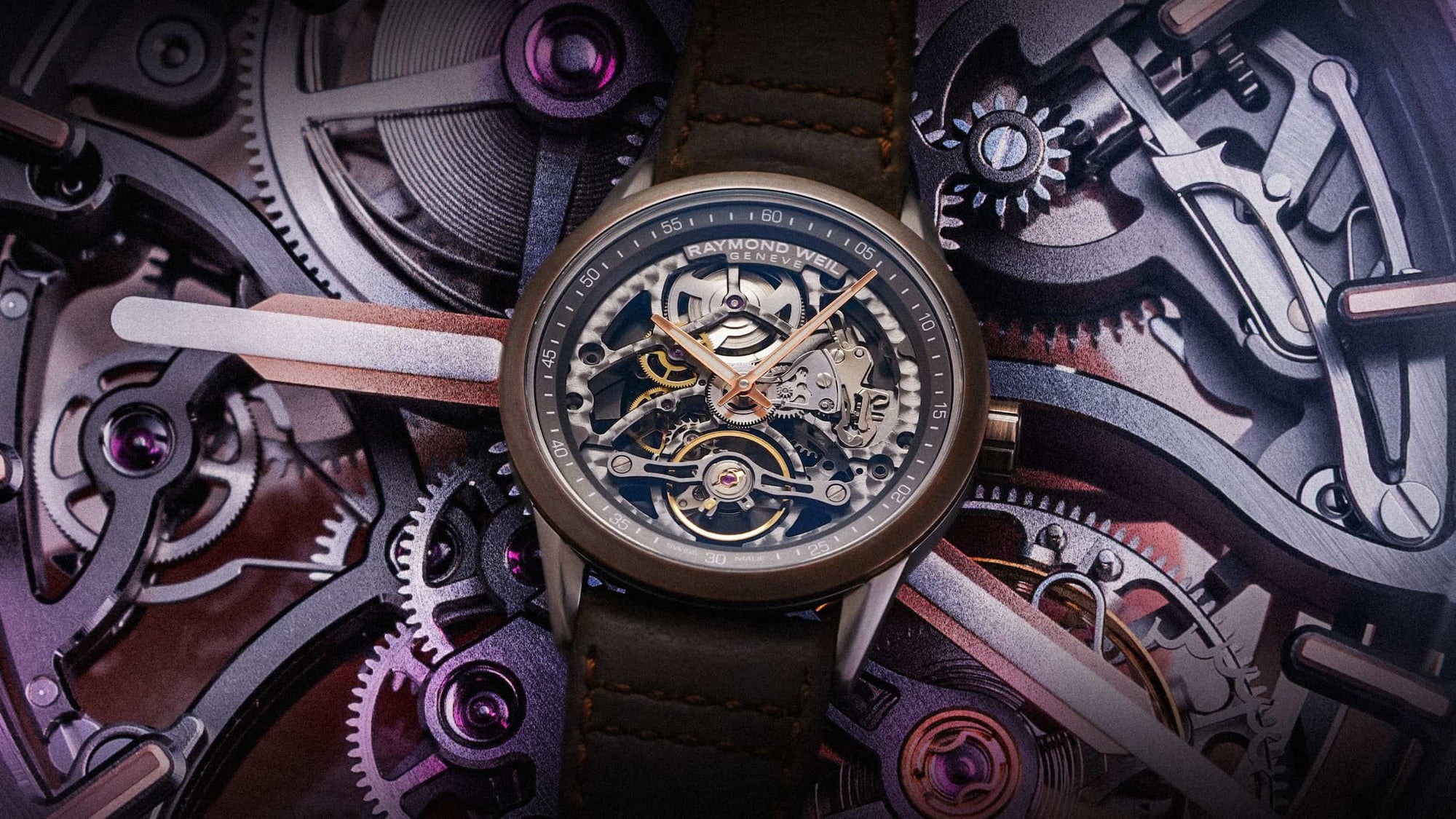
If you're new to the watch appreciation game and anxious to engage in discussions, debates, and diatribes with fellow aficionados who have been into the hobby longer, you may have hesitated for one important reason: nailing the proper terminology. "What are all the parts of a watch called, anyway?" you may have asked yourself in moments of doubt. Never fear: we've assembled a primer below on all the important parts of a watch and what they do.
[toc-section heading="The Watch Case"]

The case is the outer shell of the watch, comparable to the chassis of a car. While a handful of cases are milled from a single block of metal (and called “monobloc”), most of them consist of three main parts, the caseback, case middle or casebody, and bezel. Cases can be made of a wide variety of materials, including but not limited to: plastic, resin, stainless steel, titanium, bronze, ceramic, various types of gold, and other precious metals such as platinum.Cases that combine different materials for their parts (i.e., a steel casebody and a gold or ceramic bezel) are referred to as “two-tone,” “bi-metal,” or “bi-material.”
[text-media heading="" text="The most traditional watch cases are round though watchmakers have used a variety of other shaped cases, some of which have become iconically associated with certain brands and models. These include cushion-shaped (“coussin”) cases, such as on the Panerai Luminor and Piaget Polo; square and rectangular cases, such as on the Cartier Tank and Jaeger-LeCoultre Reverso; and tonneau, or barrel-shaped cases, as on many Richard Mille models. The bezel is the front piece of the case (often but not always ring-shaped) that frames and secures the crystal. Bezels can be made of the same material as the casebody and/or caseback but also can be made of a contrasting material." image="https://cdn.shopify.com/s/files/1/0278/9723/3501/files/Case-Parts-Of-A-watch.gif?v=1766157036" caption="" media="left"]Bezels can be either stationary or rotatable; the latter type is generally designed for a utilitarian purpose and printed with a scale that can be used in concert with the watch’s hands to make calculations. Divers’ watches, like the Blancpain Fifty Fathoms above, usually include a lockable bezel that rotates in one direction and carries a 60-minute scale, for the purposes of setting dive times and avoiding inadvertently changing it by rotating the bezel in the wrong direction.

GMT watches feature a 24-hour scale on their bezels that can indicate a second time zone with the use of an extra hand on the dial. Many chronograph watches, like the Rolex Daytona and Omega Speedmaster, include a tachymeter scale on their stationary bezels that can be used with the stopwatch function to calculate speeds for sports like auto racing. A handful of pilot’s watches, most notably the Breitling Navitimer, include a slide-rule-printed bezel that rotates in both directions to assist a pilot in figuring out fuel consumption, distance traveled, and descent rates, among other factors in flight. [text-media heading="" text="The lugs, or horns, are the extensions of the case that connect it to the strap or bracelet. The lug width is the measurement of distance between the two lugs that determines the width of the strap or bracelet. Like the main case, lugs are usually designed with utility and comfort in mind, ergonomically curving to match the contours of a wearer’s wrist. The lugs of modern wristwatches are descended from the makeshift ones of the early 20th century, used to convert existing pocket watches for wrist wear. These lugs were usually made of wire and soldered to the case." image="https://cdn.shopify.com/s/files/1/0278/9723/3501/files/Lugs-Parts-Of-A-Watch.gif" caption="" media="right"] The crystal (sometimes just called the "glass") is the clear covering over the dial, framed by the bezel, which protects the dial from dust, water, and other irritants. Nowadays, most watch crystals are made from sapphire glass, which is particularly hard and scratch-resistant. Watchmakers often apply nonreflective coating on one or both sides of a sapphire crystal to aid in the legibility of the dial in bright conditions. Before sapphire became common, watchmakers made crystals from other materials, including acrylics such as plexiglas and hesalite, as well as mineral glass. (The modern Omega Speedmaster "Moonwatch," above, still offers a hesalite crystal on the version of the watch that is closest to the original from the 1960s.) Over the last several decades, more and more watches have installed sapphire crystals in the back as well as the front of the case. These “exhibition casebacks” are intended to show off the beauty of the movement inside.
[toc-section heading="The Watch Dial"]

The dial is, quite simply, the face of the watch that’s designed to deliver all of its information — from simple hours and minutes to an array of complex indications on the most complicated types of watches. Dials can be digital (as in your basic G-Shock DW5000-C) or analog, i.e. using hands, numerals and markers to show the time and other indications. For the purposes of this article, we’ll focus on analog dials, which are more traditional and more common. An analog dial’s hands are its most basic indicators. The hour hand rotates around the dial once every 12 hours; the minute hand, every hour; the seconds hand, once per minute. The hour hand and minute hand are generally designed to be distinct from each other in size, and occasionally in shape; the seconds hand is most often thin and unobtrusive to reading the time on the other two hands. To dig a bit deeper into terminology, the collection of central hands on a watch is referred to as the handset, and the weighted end of the seconds hand that does not point to the outer track is called the counterweight.
[text-media heading="" text="The hands point to hour markers and a minute track on the outer border of the dial. Hour markers can be numerals (either applied or printed directly on the dial’s surface) or indexes, i.e. non-numerical shapes and forms, often bar-shaped, like those of the Audemars Piguet Royal Oak; round; or a combination of both. Hour numerals can be Arabic (1 to 12) or Roman (I to XII). A very select handful of watches use dials that combine Arabic and Roman numerals; these rare birds are known as California Dials, though there appears to be no clear consensus as to why. "image="https://cdn.shopify.com/s/files/1/0278/9723/3501/files/Markers-Parts-Of-A-Watch.gif" caption="" media="left"][text-media heading="" text="Subdials (aka registers) are the miniature dials on the main dial that display various types of information in analog form. Some of the indications that can appear on subdials include the running seconds (aka small seconds) on watches without a center-mounted seconds hand); the date (on a 1-31 scale and a tiny hand); chronograph readouts for elapsed hours and/or minutes (alternatively called totalizers); and other calendar indications such as the day, month, and leap year. A watch dial with two subdials is called bicompax; a dial with three subdials is called tricompax. A watch dial that displays the minutes with a central hand, and the hours and seconds on separate subdials, is called a regulator dial."image="https://cdn.shopify.com/s/files/1/0278/9723/3501/files/Subdials-Parts-Of-A-Watch.gif" caption="" media="right"]
[toc-section heading="Crown And Pushers"]

The crown is the knob-like device that is used to wind a watch by hand and also to set the time and other indications. Usually mounted on the right side of the case, the crown is connected to the movement by a stem that protrudes through a drilled hole. Sports watches, whose cases tend to be more water-resistant, often design the crown so that it screws down securely into the case to secure this tiny opening against penetration by water or other environmental hazards like dust. Different operations via the crown, like setting the time on the hands, setting the date, GMT hand, moon-phase, etc., are often accomplished by pulling the crown to different positions and/or rotating it in different directions. Many crowns are fluted on their sides for easier gripping by fingertips, and some — particularly on early pilots’ watches and modern models that emulate their style such as IWC's Big Pilot's Watch— are extra-large as well, designed to be used by hands in thick aviators’ gloves.
Pushers, found regularly on chronograph watches like the Hamilton Intra-Matic, as well as on some calendar and multiple time-zone watches, are the little buttons in the sides of the case that are used for operations like stopping and starting a stopwatch function as well as returning its hands to zero; quickly advancing a date or moon-phase to the next increment; or moving a GMT hand on a dual-time watch or the interior dive-scale bezel on a compressor-style dive watch.
[toc-section heading="The Movement"]

To continue the automotive analogy from above: if the watch's case is the chassis, the movement is its engine — the miniature machine inside the case that makes the whole thing run. Movements can be either quartz, i.e., battery-powered, or mechanical. Mechanical movements are either hand-wound or self-winding (“automatic”). Quartz movements are the most accurate and the cheapest to mass-produce, whereas mechanical movements are not as accurate, and more expensive, but more traditional and more evocative of watchmaking as an art, which is a large part of their appeal to collectors. Some watch manufacturers make their own movements, whereas others purchase them from outside specialists like the Swiss companies ETA and Sellita.


Wristwatches are mounted on either a strap or a bracelet that fastens them to the wrist. Straps are made of materials like leather, rubber, or cloth, or a combination of these. Hublot, for example, makes “fusion” straps that combine an upper layer of leather with an interior layer of rubber. The buckle adjustment holes in the strap are used to adjust the fit to the wearer’s wrist size, and the loops, called “keepers,” help keep the strap in place without dangling. Most leather straps are constructed of two or more layers and held together by stitching, which is either “tone-on-tone” (the thread used for stitching matches the color of the leather for a monochromatic look) or “contrast” (the stitching is in a different highlight color that stands out). A NATO strap is a style of military-inspired one-piece strap, made of nylon or some other fabric, that loops under the watch’s case and through its spring bars to hold it securely in place on the wrist.
Bracelets are made of metal, usually the same metal as the case, and are made up of links that can be individually removed by a watch repairer to resize a larger bracelet to fit an individual’s smaller wrist. An integrated bracelet is one that flows seamlessly into the case without nestling into the space between lugs; in other words, the case is designed so that the lugs and the first link of the bracelet are essentially one and the same. Famous examples of this type of bracelet include the Audemars Piguet Royal Oak and Patek Philippe Nautilus and their various stylistic descendants, such as the Tissot PRX.
[text-media heading="" text="Bracelets are made of metal, usually the same metal as the case, and are made up of links that can be individually removed by a watch repairer to resize a larger bracelet to fit an individual’s smaller wrist. An integrated bracelet is one that flows seamlessly into the case without nestling into the space between lugs; in other words, the case is designed so that the lugs and the first link of the bracelet are essentially one and the same. A Milanese or “beads-of-rice” bracelet is made from metal wires woven into a mesh pattern. Deriving its name from a technique perfected in 19th-century Milan, this type of bracelet (which, to some, actually qualifies more as a strap) is known for being smoother, more supple, and easier to adjust to the wrist because it’s not made up of links."image="https://cdn.shopify.com/s/files/1/0278/9723/3501/files/Milanese-Bracelet-Parts-Of-A-Watch.jpg" caption="" media="right"][text-media heading="" text="Straps and bracelets fasten to the wrist with buckles or clasps. The simplest type, used only on straps, is a pin buckle, aka a tang or ardillon buckle, in which one end of the strap slips through it and is held in place by a pin that is fitted into one of the adjustment holes. A deployant clasp, used more often on metal bracelets, unfolds into thirds to allow the wrist to slip through the bracelet’s opening and then locks into place with a hook-type latch. Some deployant clasps are operated by side-mounted push-buttons for easier access, and others also include a “foldover” part that snaps over the main clasp to hold the watch more securely in place. A butterfly clasp — which consists of two metal hinges that unfold like wings and snap together on the underside of the clasp to give the bracelet a seamless look, is the most invisible type of closure."image="https://cdn.shopify.com/s/files/1/0278/9723/3501/files/Tudor-FXD-GMT.jpg" caption="" media="left"]This guide should give you all the information you need to be more educated and well-versed about the parts of a watch. We hope you enjoyed it and learned something!
Create an account to share your thoughts, contribute to discussions, and connect with other watch enthusiasts.
Or Log in to leave a comment
We just redirected you to the best site experience based on your location. If you still want to go to the previous country, you can select it in the international menu.
Register to be the first to receive a notification when this item becomes available.
You've been subscribed! We’ll reach out once the product becomes available.
You've got great taste. This product may require a special ordering process. Fill out the form below and a member of our sales team will reach out to you for next steps.
You've been subscribed! We’ll reach out once the product becomes available.
Due to distribution arrangements in other locations, certain brands cannot be sold or shipped outside the United States or to other specific areas. To find an authorized dealer near you, use the locator tool on the brand’s website. We apologize for the inconvenience.
Shop What's in Your MarketShop By BrandYou've got great taste. This product may be available to try on in our Westlake, Ohio Boutique. Fill out the form below and one of our Sales Advisors will reach out to confirm your appointment










































1 Comment
1