




Short on Time
How much do you really know about the watches that have been to outer space? Timekeeping has always been an essential element of space exploration, and the shared history of both pursuits has been a fascinating one, with milestones that go far beyond that quintessential moment that an Omega Speedmaster landed on the moon (as significant an accomplishment as that was). Read on to discover the most historic watches that have been to space, and how and why they got there.
First Watch in Space: Pobeda 34-K ‘Space Dog’ Watch

Photo: SovietWatchStore.com
When we discuss watches that set milestones in the history of space travel, we tend to focus on human accomplishments. However, there was at least one watch that made it to outer space before the first human being ever got there. In March 1961, Russia, then the Soviet Union, launched the Sputnik mission, whose sole passengers were a life-sized human mannequin and a dog named Chernushka (“Blackie”). Strapped to the brave canine’s leg was a vintage Russian-made mechanical watch called a Pobeda 34-K, containing a 15-jewel manual-winding movement chosen for its uncommonly robust, oversized, “hermetic” case. Otherwise, the watch was classically mid-century minimalist in its design, with large Arabic numerals and a 6 o’clock small-seconds subdial. Dog, dummy, and watch all returned safely after a successful orbit of the Earth, kicking off a new, exciting era for space exploration and the timekeeping instruments necessary for its success.
First Watch Worn by a Human in Space: Yuri Gagarin’s Sturmanskie

On April 12, 1961, Russian cosmonaut Yuri Gagarin famously became the first man to orbit the Earth in the Vostok 3KA space capsule. The feat was a propaganda victory for the Soviet Union in its Cold War with the United States and other Western nations. It kicked off the Vostok program of manned space flights that continued until 1963 as well as the now-legendary Space Race between the U.S. and Russia. The historic company that made the watch, which had been known as the Chistopol Watch Factory, subsequently changed its name to Vostok (Russian for “East”) in honor of this accomplishment.

Photo: SovietWatchStore.com
Gagarin’s watch was small by today’s space-watch standards, just 33mm in chrome-plated brass, with an ivory-colored dial bearing a Soviet red star at 6 o’clock and radium-based lume coating the hands and markers. Inside was a Russian-made 17-jewel manually wound movement, and the watch was worn on a simple, rugged leather strap. “Sturmanskie” still exists as the name of a watchmaking company in Russia today, and it makes re-editions of this historic model that remain wildly popular.
First Swiss Watch in Space: John Glenn’s Heuer 2915A Stopwatch

NASA, the United States space program established in 1958, responded to the U.S.S.R’s opening Space Race gambit, the 1957 launch of the Sputnik satellite, with Project Mercury, the nation’s first human spaceflight program. Spanning from 1958 to 1963, Mercury’s most iconic moment came on February 20, 1962, when astronaut John Glenn became the first American to orbit the Earth, in the spacecraft Friendship 7.

The watch that Glenn wore during this mission was not actually a wristwatch at all, but a hand-held stopwatch that had been modified with an elastic strap so it could be worn over thick astronaut gloves. It was a Heuer 2915A “Long Range” stopwatch, with a ⅕-second chronograph function and a large onion crown at 12 o’clock. Made by the Swiss company then known as Heuer (and today known as TAG Heuer), the watch became the first Swiss-made watch to fly in space and today resides in the Smithsonian National Air and Space Museum.

Breitling launched its now-iconic Navitimer in 1952, and it quickly established itself as a favorite watch among pilots of all types — commercial, military, private hobbyists, and even astronauts, many of whose ranks had been drawn from the world of military aviation. One of these astronauts was Naval aviator Scott Carpenter, the commander of another Mercury Program mission, Mercury-Atlas 7, which launched on May 24, 1962. Carpenter, who wore a Navitimer throughout his previous career as a Navy pilot, approached Breitling and NASA about creating an “astronaut” version of the classic Navitimer — one with a bigger rotating bezel that could be grasped by heavier gloves and whose hour hand would traverse a 24-hour scale once per day, rather than a 12-hour scale twice, all the better for an astronaut in space to keep track of what time of day it was back on Earth. Breitling obliged, and Carpenter wore the watch, later dubbed the Navitimer Cosmonaute, on the 1962 mission aboard the Aurora 7 space capsule. The Navitimer Cosmonaute is still in the lineup today as a somewhat niche version of the popular pilot’s chronograph.
First Omega Watch in Space: Omega Speedmaster CK2998

Another iconic Swiss watch born in the 1950s, Omega’s Speedmaster, has become indisputably the watch most associated with the U.S. space program and its many milestones.The Speedmaster, launched in 1957 originally as a race car driver’s watch, found one of its most significant evolutions in the Ref. CK2998 model, which was worn by astronaut Wally Schirra on the Sigma 7 mission (aka Mercury-Atlas 8) of the Mercury program, which began on October 3, 1962. The watch was Schirra’s own, having not undergone any of the official testing and certification of future NASA-issued Speedmasters. This reference, released in 1959, was notable for its black, aluminum tachymeter-scale bezel and Alpha-shaped hands replacing the “Broad Arrow” hands of earlier generations.

Schirra orbited the Earth six times during the spaceflight while wearing the watch; the Ref. CK2998, outfitted with the manually wound Caliber 321, gave way to the more familiar 'Moonwatch' versions shortly thereafter, but Omega has resurrected its design in a modern homage piece fittingly dubbed “First Omega in Space.”
First Watch Flight Qualified by NASA: Omega Speedmaster Ref. ST 105.003

Photo: Sotheby's
Omega followed up the CK2998 in 1964 with the Ref. ST 105.003, the model that would play perhaps the second-most significant role in the collection’s spacefaring history. Differentiated aesthetically from the “Moonwatch” by its straighter lugs and dearth of crown guards, but also containing Caliber 321, this was the watch that astronaut Ed White wore on his milestone space walk (above) on June 3, 1965 as commander of the Gemini 4 mission. Project Gemini was NASA’s second human spaceflight program, succeeding Mercury and preceding the Apollo missions that ultimately landed humans on the moon. Also in 1965, NASA was deep into its search for a wristwatch that it could issue as mission-specific gear to astronauts.

The Omega Speedmaster reference worn by White was one of four watches submitted by watch companies to undergo a rigorous regimen of tests to determine their mission-readiness for space flights and the difficult conditions they’d encounter on them. (Ten companies in total were contacted, and only four actually submitted timepieces: Omega, Rolex, Longines-Wittnauer, and Hamilton.) Under the direction of NASA engineer James H. Ragan, who oversaw the competition, all the watches were subjected to wide fluctuations in temperature, pressure and gravity that simulated the expected conditions on the lunar surface, as well as a punishing series of shocks and impacts and the rapid acceleration and deceleration that they would encounter in a space launch. When the results were tallied, on March 1, 1965, the Omega Ref. 105.003 emerged as the winner (it was also the unanimous favorite of the astronauts who’d been given all three qualifying watches to wear), becoming the first and only watch “flight qualified for manned space missions by NASA.”
First Automatic Watch in Space: Glycine Airman Ref. 376.11

Another milestone, courtesy of a lesser known but historically important Swiss watchmaker, occurred in 1965. Glycine, which was founded in 1914, released its most famous watch, the aviation-styled Airman, in 1953. The watch was worn by U.S. military pilots during the Vietnam War and featured the very first rotating 24-hour GMT bezel to track two time zones. (Rolex’s legendary GMT-Master, which debuted one year later, introduced the more common, bicolor version of this innovative design.) Astronaut Charles “Pete” Conrad owned an Airman, which had a 36mm steel case and a self-winding, hacking-seconds A. Schild movement, and wore it on two missions during the Gemini program: Gemini 5, in August 1965, and Gemini 11, in September 1966, where the watch became, respectively, the first automatic watch worn in space and the first automatic watch exposed to the vacuum of space. (The Omega Speedmaster and Breitling Navitimer both had manually wound mechanical movements at the time.)
First Watch on the Moon: Omega Speedmaster ‘Moonwatch’ Ref. ST015.012

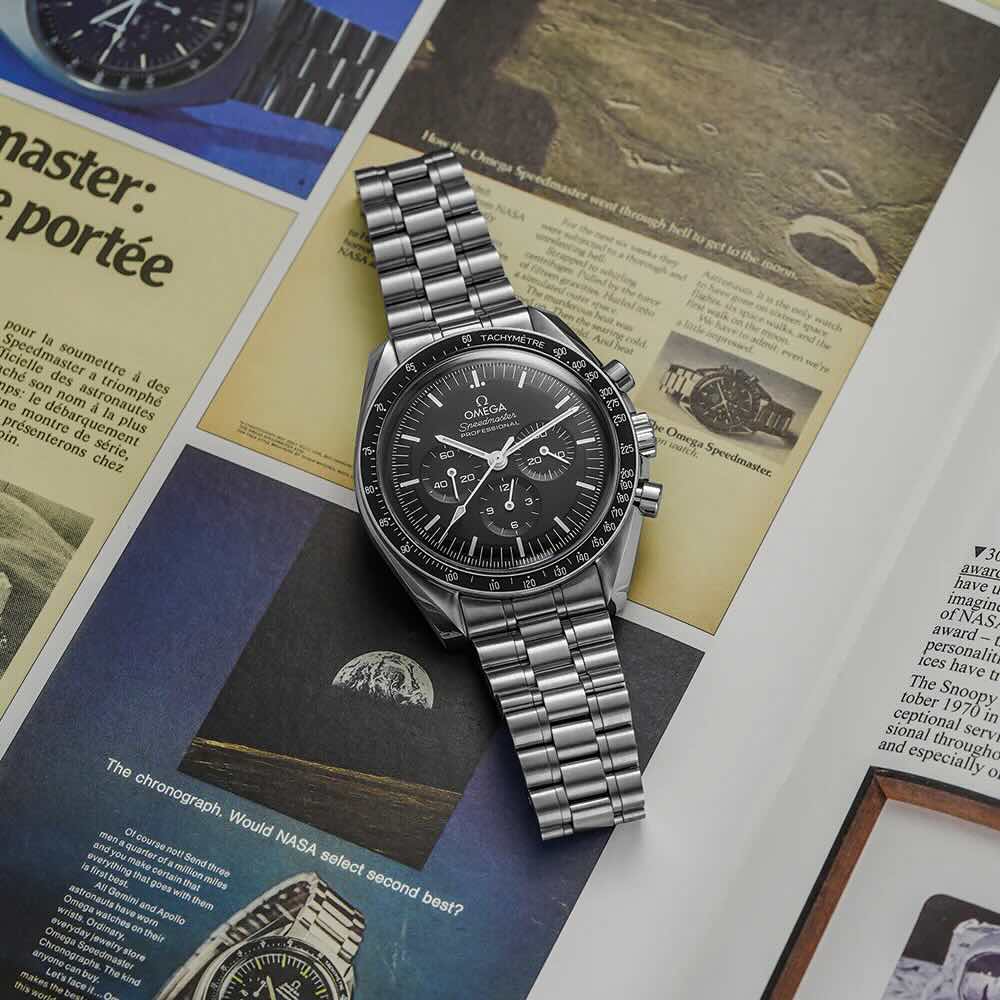
The Omega Speedmaster reference that aced NASA’s testing gauntlet was actually discontinued by 1966 and superseded by the now-famous Ref. ST105.012, whose 42mm case featured an asymmetrical build, with crown guards and wider-set chronograph pushers on the right side. This is the watch that was issued to the crew of the Apollo 11 mission in July 1969, the fifth of NASA’s Apollo program, which included Commander Neil Armstrong, Command Module pilot Michael Collins, and Lunar Module pilot Edwin “Buzz” Aldrin” (above).

The Omega Speedmaster entered the annals of history on July 21, 1969, the culmination of the Space Race, when Aldrin stepped onto the surface of the moon while wearing it on his gloved wrist. After the crew returned to Earth, and the subsequent advertising blitz by Omega touting its watch’s spacefaring cred, the Speedmaster’s reputation as the Moonwatch was secured, and its original identity as a racing watch left in the lunar dust. The contemporary version of the watch, still the indisputable flagship of Omega’s entire collection, is more or less identical to the one that Aldrin rocked on the Apollo 11 mission more than 50 years ago, with a Hesalite crystal over the tricompax dial, luminous hands and markers, and the trendsetting tachymeter-scale bezel that speaks to the Speedy’s origins as a watch for auto racing. It’s even equipped with a modern version of the hand-wound movement that powered the original, Omega Caliber 1861.
First Rolex Watch in Space (Rolex GMT-Master Ref. 1675) and the First Omega Silver Snoopy Award

The Apollo program continued beyond the historical accomplishment of landing the first men on the moon. NASA launched six subsequent crewed space flights to the moon, the final one, Apollo 17, returning to Earth in December 1972. But it is the infamous Apollo 13 mission, launched on April 11, 1970, that would be the most historically significant. The mission, which is dramatized in the 1995 movie Apollo 13, was the third space flight bound for the moon but experienced a potentially fatal equipment failure along the way: an exploding oxygen tank crippled the service module that provided life-sustaining functions to the crew, made up of Commander James A. Lovell, lunar module pilot Fred Haise, and command module pilot Jack Swigert.

The original lunar landing mission had to be aborted, and the explosion had thrown the spacecraft dangerously off course. With time running out, Lovell executed a risky maneuver to ensure a safe landing: a fuel burn of precisely 14 seconds’ duration that would reorient the spacecraft to a safe angle for a return to Earth’s atmosphere. The onboard clock had malfunctioned, so Swigert’s NASA-issued Speedmaster was pressed into service to time the crucial interval for the burn. The desperate gambit was successful, and the crew managed to return safely to Earth on April 17, earning Omega the first “Silver Snoopy” award (it was named after the character created by Charles M. Schulz, a major space-program booster) for meritorious service to the space program, and kicking off a series of highly collectible “Silver Snoopy” Speedmaster editions in the decades since.

Photo: Bonhams
While it was Swigert’s NASA-issued Speedy that played the pivotal role in Apollo 13, the other watch he was wearing on that historic flight, owned by the astronaut himself, has also garnered a fair amount of enthusiast attention: a “Pepsi-bezel” Rolex GMT-Master Ref. 1675, which Swigert wore while helping his fellow crew members design a makeshift “mailbox” to filter carbon dioxide from the lunar module. Upon his safe return home, Swigert sent a photo of the watch and a note to then-Rolex CEO Rene-Paul Jeanneret, indicating that it had been flown to the moon. Swigert’s watch, the first Rolex in space, is now in Rolex’s private collection in Geneva. And this wouldn't be the last time an astronaut wore a GMT-Master on a moon mission: In February 1971, Edgar Mitchell wore the same reference on the Apollo 14 mission, making it the first Rolex watch to reach the lunar surface.
First Privately Owned Watch on the Moon: Original Bulova Lunar Pilot

Bulova Watch Company, founded in New York in 1875, had played a noteworthy role during the Space Race, from the 1950s to the ‘60s. The company, at the time headed by American war hero General Omar Bradley, established a partnership with NASA through which it provided precision instruments and timekeeping devices equipped with Bulova’s signature Accutron tuning-fork technology. These instruments were used by NASA astronauts on no less than 46 space missions, and a Bulova Accutron clock remains in the moon's Sea of Tranquility to this day, placed there by Buzz Aldrin in 1969 during the moon landing. The Apollo 15 mission two years later, from July to August 1971, made its own kind of history thanks to its mission commander, Colonel Dave Scott, wearing a prototype watch from Bulova in addition to his officially issued Omega watch.

Bulova provided Scott a customized, one-of-a-kind chronograph wristwatch for the mission, the fourth Apollo expedition to land on the moon. The watch, essentially the prototype for today's Lunar Pilot models, was specially engineered for lunar conditions, with a case built to withstand drastic changes in pressure, temperature, atmospheric conditions, and gravity. Scott, the seventh man to walk on the moon and the first to drive the Lunar Rover, brought along the Bulova as the backup timekeeper to his Speedmaster, and actually ended up wearing it on the moon after the crystal on his NASA-issued Speedmaster, according to records, had popped off. Scott’s Bulova watch thus became the first privately owned watch ever to visit the moon — all mission-worn Omegas, of course, being the property of NASA. The one-of-a-kind timepiece went up for auction in 2015, fetching $1.3 million and inspiring the modern, successful Lunar Pilot collection. Unlike the original, which was powered by a mechanical movement, the Lunar Pilot watches contain Bulova’s proprietary high-frequency 262-Hz “Precisionist” quartz calibers.
First Automatic Chronograph in Space: Seiko Ref. 6139 'Pogue'

Automatic chronographs were a relatively recent addition to the world of mechanical watches, the first of them appearing in 1969. With some exceptions, Omega has steadfastly stuck with a manually winding chronograph movement in its Speedmaster Moonwatches for NASA, leaving the field open for other makers to claim the title of first automatic chronograph wristwatch to fly to the cosmos. For a long time, the Sinn 140, from German tool-watch maestro Sinn, was believed to be the first, worn by German astronaut Reinhard Furrer on NASA’s Skylab D1 mission (above) in October 1985. But more recent research has unearthed what appears to be an earlier claimant to the title, a Seiko Ref. 6139-6005/6002, now nicknamed the “Pogue” for the astronaut who wore it on the Skylab 4 mission from November 1973 to February 1974, Colonel William Reid Pogue.

The original Seiko “Pogue,” which has recently been resurrected as a special edition in the Japanese brand’s Prospex Speedtimer series (above), carrying a solar-powered quartz movement, was equipped with one of the world’s first available automatic chronograph movements and it sported a vibrant, unusual (and very ‘70s) color scheme with a red-and-blue “Pepsi” bezel and a bright yellow dial. The fact that Pogue essentially smuggled this personally owned, non-NASA-authorized watch onto the mission as a trusty backup timer could account for its remaining relatively unknown for so long in the history of space-worn timepieces.
First Watch Qualified for Russian Cosmonauts: Fortis Official Cosmonauts Chronograph

Fortis, a Swiss watch brand founded in 1917, had dipped its toe in making spaceworthy watches as early as 1962, when it produced the Spacematic AR models, some of which were mission-tested by astronauts in that era before NASA officially adopted the Speedy as official gear. Its most significant contribution to the space-watch genre came in 1994: the Official Cosmonauts Chronograph, which was the first watch officially tested and certified by ROSCOSMOS, the post-Soviet Russian Space Agency, for the nation’s space missions. The original watch (which was succeeded in 2003 by the current 42mm B42 version), was 38mm in diameter and equipped with a now-rare Lemania 5100 self-winding chronograph caliber. It was worn by cosmonauts on missions aboard the International Space Station (ISS) and on Russia’s own MIR space station, from its debut in 1994 to 2003, when it was replaced in its official duties by the B42 version, with an ETA Valjoux 7750 movement, which at 42mm is intended to be easier for heavy cosmonaut gloves to handle. Fortis remains the official supplier to ROSCOSMOS to this day, and the B42 Official Cosmonauts Chronograph is essentially Russia’s answer to the Omega Speedmaster. The most legendary story about the watch and its toughness? On one ISS mission, a Russian cosmonaut used it as a makeshift hammer to pound a loose rivet back into its place during routine maintenance.
First Watch Made to Wear on Mars: Omega Speedmaster Marstimer X-33

Omega’s Speedmaster X-33 Mastimer, which debuted in 2022, was developed in a partnership between the Swiss luxury watchmaker and NASA’s counterpart in Europe, the European Space Agency (ESA). Its 45mm case in grade 5 titanium contains the specially developed thermocompensated quartz movement, Caliber 5622, whose array of indications, in analog-digital style, include an MTC function that tracks the solar date and time of Mars at Earth’s prime meridian, taking into account the length of a Martian day, which is 39 minutes longer than an Earth one. Also included is a solar compass that can find true north on both Earth and Mars — a very useful function for the astronauts who will eventually wear the watch, and a cool talking point for the vast majority of wearers, who can snap one up here on Earth. The anodized aluminum bezel and the dial’s second hand pay a colorful tribute to the Red Planet with their red hematite coloring, reminiscent of the distinctive dust on Mars’ planetary surface.
First British Watch on the Moon: Bremont Supernova Chronograph

Space travel, which had been relatively dormant for several decades, appears to be on the rise again in recent years, with the establishment of the U.S. Space Force as a new branch of the military and private companies like Jeff Bezos’s Blue Origin and Elon Musk’s SpaceX entering the arena of pioneering the cosmos. Watchmakers, as they have throughout the Space Age, have answered the call for timekeepers for this new 21st-Century era of spacefaring. Britain’s Bremont announced in 2026 that it has partnered with Astrolab, the U.S.-based designer of space vehicles for operation on the moon and Mars, to incorporate its recently launched Supernova Chronograph into the Astrolab FLIP (Flex Lunar Innovation Platform) Rover vehicle that is slated to fly to the moon on the Astrobotic Griffin-1 mission in the summer of 2026. The Supernova Chronograph, equipped with a Swiss-made automatic movement and designed and assembled at The Wing, Bremont’s manufacturing facility outside London, thus becomes not only the first British-made watch on the moon, but also the first watch to take permanent residence there, integrated into the rover’s chassis.
First Watch Designed for Astronaut Gloves: IWC Pilot's Venturer Vertical Drive

IWC Schaffhausen, a Swiss watchmaker renowned for its pilot’s watches, also entered the arena of space travel in 2026 with its first tool watch engineered specifically for human spaceflight, developed in a partnership with Vast, a Long Beach-based developer of commercial space stations. The Pilot’s Venturer Vertical Drive (Ref. IW328601) has a case made of lightweight zirconium oxide ceramic and IWC’s proprietary Ceratanium material and features a cleverly designed patent-pending rotating bezel system geared toward easy use by the heavily gloved hands of astronauts: all the watch’s functions can be controlled through the bezel, while a rocker switch on the side of the case enables the wearer to switch functions. The system eliminates the need for a crown, which can be too small for gloved hands to grip. The “Vertical Drive” in the watch’s name refers to the efficient clutch system that transmits the bezel’s motion to the winding stem; the automatic movement, Caliber 32722, can also be wound the old-fashioned way, by the motions of the wearer’s wrist, and stores a mission-friendly 120 hours of power. The watch is designed to display a reference time, in both 12 and 24-hour formats, as well as a second time zone via the hour hand, which can jump in one-hour increments. The watch, mounted on a thermally insulated FKM rubber strap, has undergone rigorous testing to acquire spaceflight certification from Vast, and is sure to play a role in the building and staffing of Haven-1, slated to be the first commercial space station.


1 Comment
Log in or to leave a comment
That is a wonderful review. As the proud owner of a Snoopy Omega, watches in space is a topic I never get tired of learning about. However, I miss the information about the watches worn by the Chinese taikonauts.
Log in or to reply