




The Blancpain Fifty Fathoms, revered as one of the first and most influential modern divers’ watches, is today the cornerstone of Blancpain’s collection. Its original tool-watch design and robust build have been reinterpreted in multiple sizes, materials, and complications that have helped establish the Fifty Fathoms as an undisputed luxury object. This contemporary collection has largely been built upon several key models in the Fifty Fathoms’ half-century-plus of history (albeit a history once interrupted, and nearly totally derailed, by the 1970s-’80s Quartz Crisis). Here we showcase the five most important vintage Blancpain Fifty Fathoms watches and examine how some of them have been reworked for the modern era.
Original Blancpain Fifty Fathoms (1953)

Of course, it is the very first Fifty Fathoms, from the seminal year of 1953, that remains the most historic and impactful in terms of design. Its genesis began with then-Blancpain CEO Jean-Jacques Fiechter, an avid diving enthusiast who had long wanted to develop a watch that would be ideal for his hobby. He got the chance when Captain Robert Maloubier, a French naval officer, approached Blancpain to design a reliable, mission-ready timepiece suitable for elite naval divers to wear. The watch that emerged, designed with the input of Maloubier and his team members, was a true original: Its 42mm steel case (exceptionally large for the time) water-resistant to 91.45 meters, or 50 fathoms, the maximum depth recommended for scuba divers. Its dial was black and its numerals were luminescent for greater legibility underwater. It was the first divers’ watch with a self-winding movement, the first with an antimagnetic case, and the first to employ the patented, double-sealed crown that Fiechter had developed.

Most notably, the Fifty Fathoms was the first watch to include a lockable bezel with a dive-time scale that rotated in only one direction. (Other early, influential genre pioneers, like the Rolex Submariner that emerged around the same time, still had bidirectional bezels.) This practical and potentially life-saving innovation prevented a diver from accidentally jarring the bezel in the wrong direction for an inaccurate reading of how much time he’d spent underwater and thus miscalculating how much oxygen he had left in the tank. The first Fifty Fathoms (which had no official reference number but was identified by its movement as Ref. 2642) was famously worn by Jacques Cousteau in his award-winning undersea documentary, The Silent World, and some of the earliest models were even co-branded as “Aqua-Lung” editions courtesy of the relationship between Blancpain and the scuba-gear brand founded by Cousteau and his partner Emile Gagnan.
Blancpain Fifty Fathoms MIL-SPEC (1957)

Photo: Sotheby's
In 1957, Blancpain updated the design of the Fifty Fathoms at the behest of a new military client, the U.S. Navy, and for this version, Jean-Jacques Fiechter added yet another layer of underwater functionality. These watches, now exceedingly rare, added a “water-tightness indicator” on the dial, a small round disk whose color changed from white to red in its upper half if it was exposed to water or humidity — a failsafe measure to alert a wearer in the event that any moisture had penetrated the case. This indicator became a standard feature on dive watches contracted by U.S. military units, leading to the MIL-SPEC 2 standard for subsequent naval dive watches.

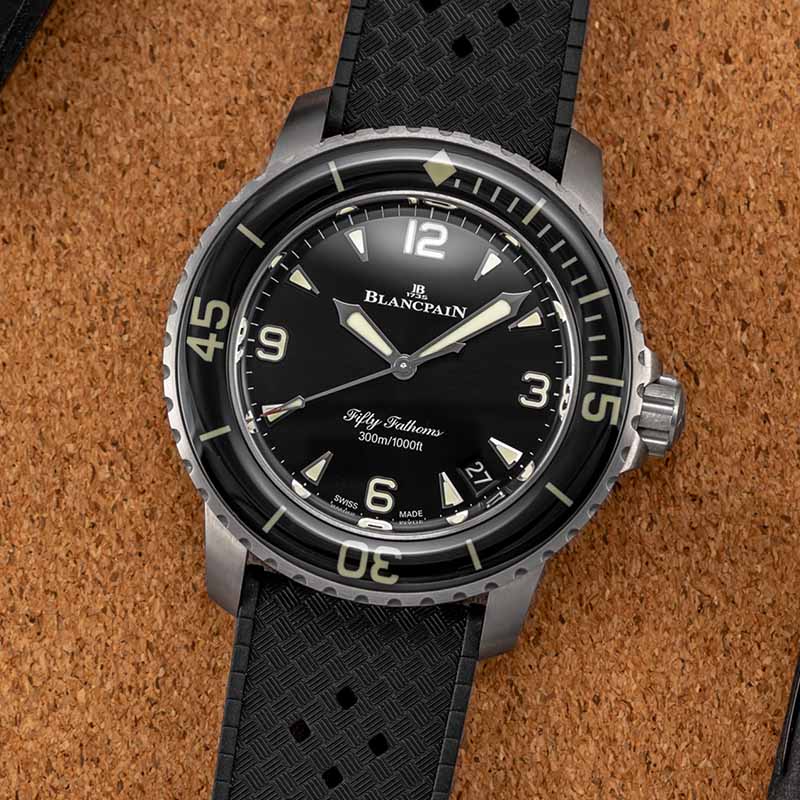
The original 1957 MIL-SPEC editions were sized around 41mm in stainless steel, with a thickness around 13mm and a plexiglass crystal over the dial. Inside the case was the “Rotomatic” Caliber R.570, with 17 jewels and Incabloc shock protection, protected from magnetic fields inside a soft-iron dust-cover caseback. For the 60th anniversary of this landmark release, in 2017, Blancpain launched the “Tribute to MIL-SPEC” edition of the modern Fifty Fathoms (above), around the same dimensions as the originals, with modern upgrades like a sapphire insert for the dive-scale bezel and the in-house automatic Caliber 1151.
Blancpain Fifty Fathoms Bund 'No Rad' (1960s)

Photo: Sotheby's
The Fifty Fathoms proved popular enough with navy divers in France and the U.S.A. that other nations got in line to order the watches for their own elite underwater combat teams. One was Germany’s Bundeswehr (armed forces), which ordered a very specific, now-collectible version of the Fifty Fathoms for its Kampfschwimmer commando units in 1960. The watch’s dial was a variation on those developed for the MIL-SPEC editions adopted by the U.S. navy: instead of the moisture-indicating disk at 6 o’clock, the so-called “No Radiations” or “No-Rad” Fifty Fathoms had a colorful red-and-yellow trefoil badge at the same position. The badge was a universal, visual shorthand that assured the watch’s wearer that its dial was not treated with potentially dangerous radioactive luminous paints (such as Radium and Promethium) that earlier military tool watches had adopted. It touted as a virtue the watch’s adherence to the military’s “T<25” mandate that the dial’s lume carried less than 25 millicures of Tritium, the milder radioactive isotope that superseded the ones mentioned above. Blancpain even added a small “T<25” notation on the dial, under the 5 o’clock position on the minute track.

The watches had a self-winding A. Schild 1700 movement, behind a screwed caseback engraved with “BUNDESWEHR” and a 12-digit NATO stock number. Some of the most desirable models for collectors are mounted on Bund straps, named for their origins in German military watch design, notable for their protective leather pad under the main strap that cushions the watch case and shields the wearer’s wrist from extreme heat or cold. In 2021, Blancpain issued a limited re-edition of the No-Rad model (above), sized at a period-appropriate 40.3mm in diameter and containing Blancpain’s ultra-thin, in-house Caliber 1151, which provides a four-day power reserve that the watch’s original wearers would have envied.
Blancpain/Tornek-Rayville TR-900 (1963)

Photo: Sotheby's
One of the most important historical versions of the Fifty Fathoms had an entirely different brand name, and model name, on the dial. The convoluted backstory of the Tornek-Rayville TR 900 watch, worn by U.S. Navy divers on recon missions during the Vietnam War, is more thoroughly detailed in this article, but to summarize: Blancpain sought to secure itself a lucrative U.S. military contract during the 1960s, but “Buy American” laws at the time disqualified the company as a supplier, even though it had supplied Fifty Fathoms watches to American clients previously. A Blancpain distributor named Allen Tornek hit upon the idea of rebranding the Blancpain watches under the name “Tornek-Rayville” (his surname plus a phonetic anagram of “Villeret,” where Blancpain was headquartered) and adding just enough American parts to qualify under the law. Made from 1964 to 1966, and distinguished by the dials’ moisture indicator disk adopted from the earlier MIL-SPEC editions (along with luminous elements made from a mildly radioactive substance called Promethium-147, which led the military to dispose of many of them after they were returned from service members), these watches are extremely rare today. Military history buffs will note that Blancpain Tornek-Rayville watches, equipped with the automatic Caliber AS 1361, were worn by the U.S. Navy’s UDT (Underwater Demolition Team), the precursor of today’s Navy SEALs.

The “Tornek Rayville” branding, which Blancpain abandoned back in the 1960s, has made a comeback courtesy of watch entrepreneur Bill Yao, who had previously founded the tool-watch brand MKII. In 2010, Yao acquired the brand name and launched the new version of Tornek-Rayville — unconnected to Blancpain and with a heavy emphasis on a reissued version of the most legendary model, the aforementioned TR-900, which the brand has dubbed the TR-660 (above).
Blancpain Fifty Fathoms Bathyscaphe (1956)

Three years after the Fifty Fathoms debuted, predominantly targeted at military and professional customers, Fiechter turned his company’s attention to a civilian-targeted model, the Fifty Fathoms Bathyscaphe, which debuted in 1956. The watch took its name from the legendary undersea vehicle invented by Swiss oceanographer Jacques Piccard, which launched in 1953, the same year as the original Fifty Fathoms watch. The Bathyscape edition offered a more streamlined, stylish, “skin diver” aesthetic than its tool-oriented predecessor, with a steel case that came in at a modest 34.5mm in diameter, with straighter lugs and a slimmer profile. Its dial was more minimalist, in black or sunburst gray, with distinctive blocky hands, geometric hour markers, and (on the earliest models) a prominent numeral 12. Its Bakelite bezel was also cleaner and simpler, minus the glossy finish of the original’s. The movement inside the first generation was an automatic A. Schild caliber, though later iterations like the MC4 models also used manually wound mechanical movements like the AS 1187.

In 2013, the Bathyscaphe made its triumphant return as not only a vintage-inspired tribute piece but as the foundation for an entire subfamily of the Fifty Fathoms, today encompassing multiple materials and complications. The core three-handed models (as above), which took direct inspiration from models of the 1960s, debuted in 43mm and 38mm cases. They have the same distinctive handset as their predecessors, along with a 4:30 date window, simple geometric hour markers, and a luminous orientation dot on the bezel. Further cementing the modern Bathyscaphe as a 21st-century timepiece is its bezel’s use of Liquidmetal, an amorphous metal alloy that bonds with the ceramic insert to enhance its scratch resistance; and the in-house Blancpain Caliber 1315, which brings a 120-hour power reserve to the table.




Be the first to leave a comment
Log in or to leave a comment