






































Short on Time
Rolex crowns, like pretty much every other element of a Rolex watch, say a lot about the style of timepiece that they’re attached to. Each one has an intriguing visual language all its own in addition to a very specific technical purpose. In this article, we decipher the somewhat complex codes of the various types of Rolex crowns.
[toc-section heading="What is a Crown on a Watch?"]
Used in the context of describing a watch’s parts (as opposed to referring to Rolex’s “coronet” logo) a crown is the knob-like device that is used to wind a watch by hand and also to set the time and other indications. Usually mounted on the right side of the case, the crown is connected to the movement by a stem that protrudes through a drilled hole. Different operations via the crown, like setting the time on the hands, setting the date, GMT hand, moon-phase, etc., are often accomplished by pulling the crown to different positions and/or rotating it in different directions. Many crowns, including those used by Rolex, are fluted on their sides for easier gripping by fingertips, and some — particularly those on early pilots’ watches — are extra-large as well, designed to be used by hands in thick aviators’ gloves.

For a purpose-built dive watch, and other tool watches exposed to excessive moisture, a crown requires another functional element: the ability to screw securely into the case to protect the interior parts against penetration by water and other environmental hazards like dust and mud. Fortunately, Rolex has been leading the way on the waterproofing of wristwatches for a century now, starting with the development of its signature Oyster case.
[toc-section heading="The Rolex Oyster Case"]
From nearly the beginning of the era of wearable timepieces, watchmakers had been vexed by the issue of protecting their inner workings from water and moisture, and Rolex founder Hans Wilsdorf was determined to be the one to meet the decades-long challenge. In 1926, Rolex ushered in the modern era of water-resistant watches with the introduction of the first Oyster case (below). Named after the bivalve mollusk that inspired its two-part, clamping “shell” design, the case combined a threaded, hermetically sealed caseback and a crown that screwed securely into the side for a water resistance never before achieved in watches.Notably, the screw-down crown of the original Oyster case used metal gaskets — shaped rings to seal the junction between two surfaces — to help secure the case’s watertightness.

While it was undeniably an industry-leading advancement, the Rolex Oyster case still had room for improvement. It was Rolex’s major competitor, Omega, which introduced O-ring gaskets made of rubber In its first Seamaster watch in 1948. Developed for the World War II-era watches that it produced for British military divers a few years before, Omega’s pioneering waterproof technology centered around the use of these gaskets, the type used in submarines, to seal the crown and case against leaks. These gaskets proved to be more reliable than the metal and shellac versions that watchmakers, including Rolex, had been using at the time, and set the Seamaster — envisioned as a waterproof gents’ dress watch rather than a tool — on its eventual path to becoming a full-fledged divers’ watch.
[toc-section heading="Rolex Twinlock vs. Triplock Crowns"]
As nearly every watch history buff worthy of the name knows, Rolex revolutionized the watch industry, and delivered the most optimized version yet of its Oyster case construction, with the launch of the Submariner in 1953. This historic model, Ref. 6204, was the world’s first divers’ watch that was waterproof to 100 meters and it also marked the debut of the Twinlock winding system. In this construction, the screw-down crown and its stem (below) utilized two rubber O-ring gaskets, one in the crown and one in the tube, to prevent water from penetrating the case. (The original Oyster case from 1926 used a rubber gasket only for the threaded caseback, not for the crown, which used gaskets made from metal.) This patented, double-sealed system revolutionized the waterproofing of watch cases, but it was only the first step toward an even more secure system that debuted more than a decade later: the Triplock crown.

As explored in more detail in this article, Rolex continued pursuing extremes in water resistance long after its Submariner model had become established as an industry icon. The first Rolex Sea-Dweller (Ref. 1655), introduced in 1967 but not available to the public until 1971, had a nearly identical design to the Submariner but, from a technical standpoint, was a substantial upgrade. Aimed at professional divers that plied their trade at great depths inside a pressurized diving bell, breathing a mixture of hydrogen, helium, and oxygen that sustained them for prolonged periods underwater, the watch boasted a water resistance rating of 500 meters (1,600 feet), substantially more robust than the Submariner’s 200-meter rating. Its major innovation was a built-in helium release valve in the case, designed to automatically release built-up helium atoms from the pressurized underwater where the watch would be worn, which could penetrate the case and cause its crystal to pop free. This gas-expelling device, which Rolex patented, was the first of its type on a commercially sold watch. Along with this impactful invention came the newest generation of watertight crown protection, a design that Rolex called Triplock.

In comparison to the Twinlock that preceded it, the Triplock (above) used a thicker, threaded case tube and four (rather than two) rubber O-ring gaskets — one surrounding the outside of the winding tube, the second inside the crown compressed against the case tube, the third and fourth inside the case tube wrapped around the winding stem. The result is three sealed zones to the Twinlock’s two. Triplock crowns are also larger than Twinlock crowns, by a full millimeter or more in height. As this design ensured even more secure watertightness for the case, it was later adopted by the core Submariner models (which evolved over the years to increase their own waterproof rating to the modern standard of 300 meters) as well, starting around 1977.

In its collection today, Rolex uses both the Twinlock and Triplock crown systems. Which model uses which crown is dependent on that model’s stated waterproof rating as well as its place on the spectrum between dressy and sporty. Most watches rated to 100 meters are equipped with a Twinlock crown; these include classic dress watches like the Datejust, Day-Date (aka “President”), and Oyster Perpetual, as well as sportier tool-oriented timepieces like the Explorer (above), Air-King, Milgauss, and Sky-Dweller. For its more high-performance Professional models, the Crown turns to the more robust Triplock. On this list are all modern Rolex dive watches — the Submariner (300 meters), Sea-Dweller (1,220 meters), and Deepsea (3,900 meters). Also equipped with a Twinlock are several popular sport-luxury models rated to 100 meters, including the GMT-Master II, Cosmograph Daytona, and Yacht-Master. (If you’re wondering about the recently launched Perpetual 1908, which doesn’t use an Oyster case and is waterproof to just 50 meters, it has a simple push-pull crown rather than either of Rolex’s screwed security crowns.)
[toc-section heading="Markings on Rolex Crowns: What Do They Mean?"]

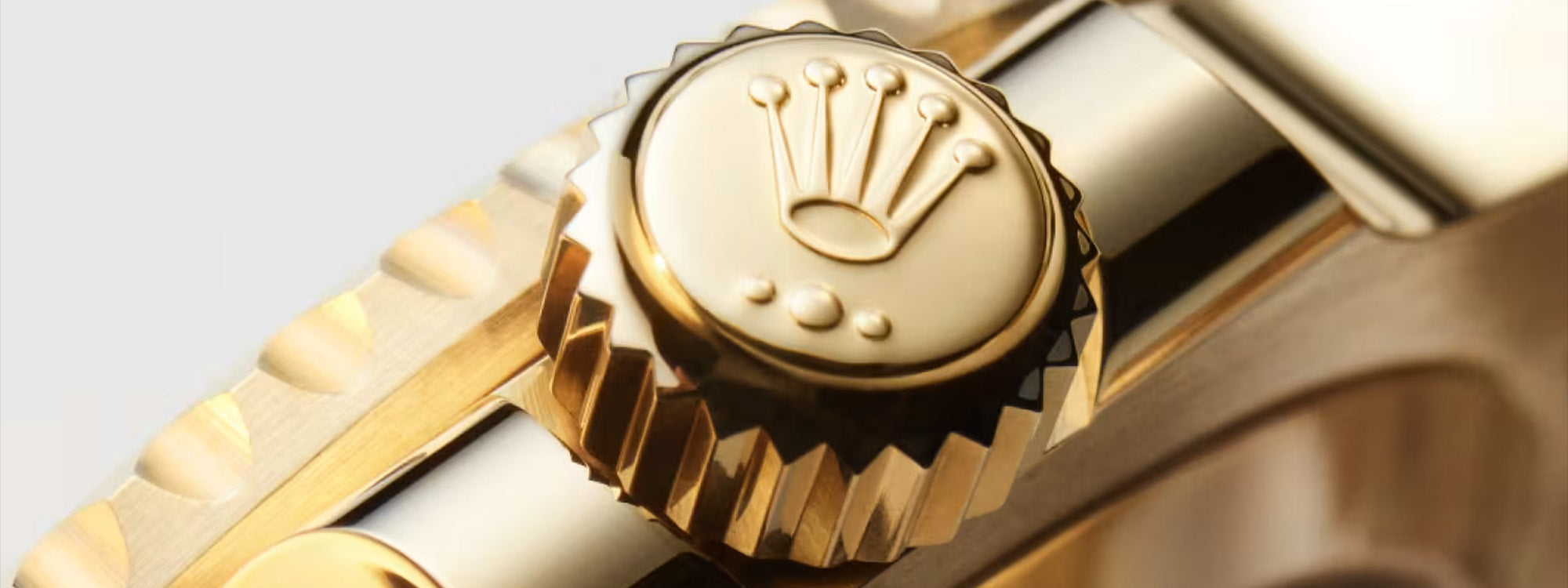
Once you’ve deciphered whether your Rolex watch has a Twinlock or a Triplock crown, the next element you’ll want to figure out is the meaning of the somewhat esoteric markings accompanying the five-pointed Rolex coronet emblem on the crown’s surface. In short, they’re visual indicators of two factors: the aforementioned Twinlock or Triplock system and the material used for the watch’s case. A watch in 904L stainless steel (which Rolex calls “Oystersteel”) with a Twinlock crown will have a small dash under the Rolex coronet (as above), while the same watch in gold will have two dots under the coronet instead. If the watch is a two-tone combination of steel and gold (or, as Rolex calls it “Rolesor”), s steel-and-white-gold model will have the dash and a steel-and-yellow-gold one will have the double dot. For some reason, a platinum Rolex with a Twinlock crown has one dot on the crown's surface, not two.

Watches with Triplock crowns are a bit easier to spot, as nearly all of them (whether in steel, gold, or even platinum) feature three dots directly under the Rolex emblem, albeit slightly different in arrangement based on the material — three same-sized dots for steel; two small dots on the side, larger one in the middle for gold; larger dots on the side, smaller dot in the middle for platinum. The only exception is for the very few Rolex watches made from the brand’s RLX titanium (so far, that’s just one Deepsea model and one Yacht-Master), whose Triplock crowns have a short dash between two dots. As in just about every other area of watchmaking, the Crown's — ahem — crowns are distinctive to the brand yet indisputably influential across the industry.
You May Also Like



Get your watch from TeddyBaldassarre.com and get 0% interest for up to 24 months available on select brands. Checkout with Affirm and spread your payments over 3 to 36 months. Learn More


0 Comments