






























Short on Time
Germany’s Nomos has been a participant in Watches & Wonders, the world’s premier exhibition for the luxury watch industry, for only two years, but the independent brand has already made quite a splash. In 2024, Nomos had the halls in Geneva’s Palexpo buzzing with the introduction of no less than 31 all-new colorways in its Tangente 38 Date series. One year later, the company arguably stole the entire show, at least for a plurality of the attending watch media, with the unveiling of a single headliner piece, the Club Sport Neomatik Worldtimer.

The watch, initially offered in two regular-production models and six limited editions (details on those below) was the first use of the globetrotter-friendly world-time complication in Nomos’ everyday-wear Club Sport collection. Even weighed against releases from heavyweights like Rolex (which debuted the Land-Dweller at the same event), Cartier, Patek Philippe, and Tudor, among many other boldfaced names, Nomos’s watch — with its new world-time movement, Caliber DUW 3202 — was perhaps the most universally lauded new model of the 2025 exhibition, finding its way to numerous “Best of” lists, including several from our own team. Here (after some background for those new to the brand and its collections) is what all the buzz is about.
[toc-section heading="A Bit of Nomos History"]

In January 1990, just two months after the Berlin Wall came down, Roland Schwertner, a photographer and tech-savvy entrepreneur from Düsseldorf, founded Nomos (a name derived from the Greek god of law) in the East German town of Glashütte. Before World War II, and the subsequent Cold War that partitioned Germany into two nations, the town, outside of Dresden in the state of Saxony, was a world center of watchmaking. The foundation of Nomos — along with the revival of historical brands like A. Lange & Söhne and the evolution of the conglomerate known as Glashütte Original into a luxury watchmaker — was a milestone moment in the rebirth of Glashütte’s watchmaking heritage in the newly reunited Germany. Nomos, then as now, holds a unique spot among the country’s watchmaking firms, renowned for its watches’ clean, modernist aesthetics as well as their relatively accessible price points. A Nomos watch is a much more entry-level option for a budding enthusiast than anything from either of the above-mentioned brands.

As a member of Germany’s Deutscher Werkbund, an association of artists, architects, designers, and industrialists established in 1907, Nomos is a champion of the Bauhaus style of minimalist, functional design. This devotion has been evident since the earliest Nomos watches, which hit the market in 1992. The four models that debuted that year — the Tangente, Orion, Ludwig, and Tetra — are still important anchors of the brand’s expanded collection today. Originally, all Nomos watches used hand-wound mechanical movements outsourced from Switzerland, based on the ETA/Peseux Caliber 7001; today, nearly all of them contain the brand’s own proprietary movements. Nomos watches with “neomatik” in their names, like the Worldtime model we’re examining here, contain descendants of the brand’s first self-winding movement, the Epsilon.
[toc-section heading="Nomos Club and Club Sport Collections"]

With the original four Nomos product families well established (and revered for their dressy, understated simplicity), Nomos started exploring sportier territory with the launch of the Club collection in 2007, following it up shortly thereafter with the even more robust Club Sport models. Club watches are identified by their round cases with wide bezels; bold applied Arabic numerals on the dials (reminiscent of the typography on U.S. Highway signage, the brand says) and relatively thick pointed hands with luminous coating. While the extra robustness compared to the dressier Nomos models is relatively subtle in the aesthetics, it is pronounced in the construction: the original Club models, with the manual-winding Alpha Caliber, are water-resistant to 100 meters, more than three times the depth rating of the “core four” models.
Most Club Sport models, equipped with the Neomatik Caliber DUW 3001 and mounted on steel bracelets, have increased this rating to 200 meters, and in some instances even 300 meters. The bracelets on the Club Sport, among the few to be found in Nomos’ modern portfolio, have a combination of polished and satin finishes and are equipped with quick-change spring bars.Now encompassing Club, Club Sport, and the entry-level Club Campus families, the Nomos Club series has become a popular mainstay of the brand’s portfolio, and a launchpad for some of its most creative colorways.
[toc-section heading="The First Nomos Worldtimer: Zurich Weltzeit"]
The Club Sport Neomatik Worldtimer has made such an impact on the enthusiast community since its debut, less than a year ago, that it’s worth pointing out that it’s not actually Nomos’ first foray into the world-time complication. That would be the new model’s more austerely designed and still cult-favorite predecessor, the Zurich Weltzeit. The name, of course, is German for “world time,” and with the release of this model in 2011, humble Nomos, which hadn’t made many watches with any indication more complex than a date calendar, proved it could achieve a higher level of horological complication without sacrificing its streamlined aesthetic.

The Zurich Weltzeit’s case is in stainless steel and measures 39.9mm in diameter and 10.85mm thick (large for Nomos, but relatively modest for a world-timer), with a galvanized white dial. On that dial, two faceted hands indicate the local time while a disk at 3 o’clock shows the time in 24-hour format with a red pointer. A pusher above the crown advances the city ring between the outer track and the dial’s center to reveal the times in the 23 other time zones outside the wearer’s home time. Nomos’ in-house DUW 5201, with its proprietary “swing system” escapement (more on which in the “Movement” section below), does its duty inside. The watch, mounted on a Horween leather strap and available with either a galvanized white (above) or a midnight blue dial, remains in the collection as the more genteel option for world-traveling wearers.

The Club Sport Neomatik Worldtimer, despite being the newer model, offers a much greater variety of color options as well as a much more robust overall character. At its initial release, Nomos offered two regular-production models with predominantly blue or silver dials, plus six limited editions in a variety of other distinctive executions inspired by adventure and travel — ochre-and-terracotta “Canyon,” golden-beige “Dune,” blue-gray “Glacier,” olive-green “Jungle,” red-toned “Magma,” and anthracite-black “Volcano.” Before its first year on the market came to a close, Nomos added three more “Night Navigation” editions, each designed to evoke the vibe of urban nightlife — the turquoise-toned Trace, orange-tinted “Grid,” and the model featured here, the dark-olive-dominant “Vector.”
[toc-section heading="Nomos Club Sport Neomatik Worldtimer Review"]
Case:

The three-part stainless steel case of the Club Sport Neomatik Worldtimer is just a touch larger than that of the Zurich Weltzeit, at 40mm in diameter, but is also substantially thinner, at only 9.9mm. This slender construction makes it one of the world’s thinnest watches with a world-time complication. The case’s water resistance of 100 meters — twice that of the Zurich's case — places it firmly within the Club Sport collection, which spun off from the parent Club family in 2019, albeit on the shallower end of the range, as other models boast an even more robust 200-meter rating.

On the right side of the case, above the fluted crown at 2 o'clock, is the push-button that controls the rotating city ring around the dial. Nomos has equipped the screw-down crown (the Zurich has a simple push-pull crown) with a red safety ring around the crown tube, an easy visual indication to the wearer as to whether the crown is safely secured into the case. The curving lugs extend the watch's wrist real estate to 48mm lug-to-lug and connect it to a three-link bracelet whose array of brushed and polished finishing echoes those of the case. The sapphire crystal over the dial is slightly domed, subtly blue-tinted, and treated on both its outer and inner surfaces with antireflective coating.
Dial and Bezel:

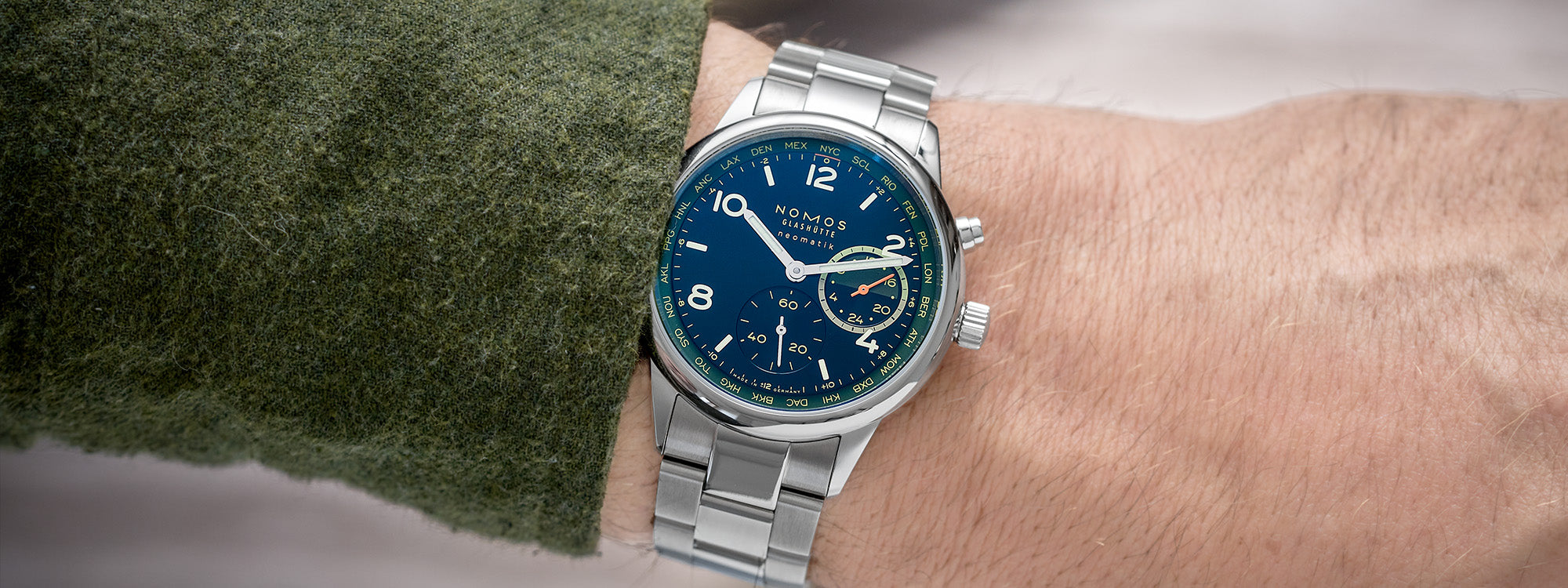
Bearing a combination of airport codes and city abbreviations, the city ring that borders the dial’s outer edge, used in concert with the numbered chapter ring just within its circle, enables easy viewing of the current time in any of the world’s 24 major time zones. Pressing the push-button advances both the ring and the hour hand for a very user-friendly quick change of the local time; the hand will jump to the proper hour indicated by the city indicated above 12 o’clock while the minute hand will remain stationary.

In addition to the outer city ring, each dial has a small seconds subdial at 6 o’clock and an additional 24-hour subdial at 3 o’clock, bordered by a bicolor day-night ring. The latter subdial continues to display the time in the wearer’s home time zone after the main hands are adjusted to the time in a different venue. (Again, very user-friendly.)

On this “Vector” edition pictured here, the combination of dark olive green, yellow, and off-white is designed to resemble an airplane cockpit instrument panel at night. The large, legible Arabic numerals at 12, 2, 4, 8, and 10 o’clock and the intermittent baton indexes are all coated with blue-green-glowing Super-LumiNova that amplifies the look when the watch is worn in dark conditions. The rhodium-finished, pencil-shaped hour and minute hands are also luminous-treated, while the small hand on the 24-hour subdial is painted a bright orange that is also quite legible in low light.
Neomatik Movement:
The movement making its debut in the Neomatik Worldtimer editions, Caliber DUW 3202, is significant in several respects. It is only the third in Nomos’s series of in-house self-winding movements, and its world-time function is fully integrated into the main caliber rather than added onto it with a module (as was the case with the Zurich Weltzeit’s Caliber DUW 5201).. Because of this construction, the movement is uncommonly slender in profile, at just 4.8mm thick — as Nomos pointed out in its original release, thinner than the passport that a world traveler wearing this watch would tote on his or her journeys.

Caliber DUW 3202 (the initials stand for Deutsche Uhrenwerke or “German Clockwork”), which can be witnessed through a sapphire window in the watch’s screw-down caseback, holds a 42-hour power reserve and is equipped with the aforementioned and very innovative Nomos Swing System, an in-house-developed escapement noteworthy for its tempered blue balance spring and a balance bridge fixed with screws on both ends. It also features plentiful decorative finishes, including traditional Glashütte striping on the plates and the rotor; this new world-time movement also stands out with its golden globe motif in the rotor’s openworked center.

Perhaps all of the elements of the Club Sport Neomatik Worldtimer covered up to this point — in-house movement with easy-to-use functionality, robust build, widely wearable sizing, eye-catchingly creative color choices — would have been enough to make it an appealing package to many. But when one considers the price of admission to this international horological party — just $5,190 for the core models in steel, and an even $5,000 for the handful offered on leather straps — it becomes even more enticing. It is without a doubt one of the most attainable world-time watches on the market and, in terms of aesthetics, one of the few that speaks to nearly every type of enthusiast. Learn more at www.nomos-glashuette.com.
Shop this Article
You May Also Like



Get your watch from TeddyBaldassarre.com and get 0% interest for up to 24 months available on select brands. Checkout with Affirm and spread your payments over 3 to 36 months. Learn More


0 Comments