





































Short on Time
Watches with California dials are among the most niche products in the industry, with a relatively vague history that somehow only adds to their mystique and quirky appeal. If you’re not familiar with the California dial — or if you are already a convert and simply curious about where in this day and age you can find these rare birds — read on as we attempt to answer all of the expected queries about the style, starting with the most basic, namely:
[toc-section heading="What Exactly Are California Dials?"]

Photo: Sotheby's
A California dial is generally recognized as a watch dial with a combination of Roman numerals, Arabic numerals, and non-numeral indexes to mark the hour positions. On most examples, the layout is fairly consistent: Roman numerals in the top half of the dial, from 10 o’clock to 2 o’clock; Arabic numerals in the bottom half, from 4 o’clock to 8 o’clock; baton-shaped or rectangular-dash indexes breaking up the numerals at 3, 6, and 9 o’clock; and an inverted triangle marking the 12 o’clock position. A few watchmakers, like Germany’s Nomos Glashütte in its Club Campus models, have chosen to stray from this formula a bit, putting the Arabic numerals in the top half and Roman numerals in the bottom half. Other variations include the less-common “Semi-California” dial, which uses the triangle at 12 o’clock and indexes at the 15-minute markers but opts for only Arabic numerals at the other positions.
[toc-section heading="Who Made the First California Dials, and Why?"]

Photo: Phillips
While there is still no full consensus on how this type of dial came to be called California (though we delve into the likeliest scenario in the next section), identifying its originator is a bit more straightforward. It should come as no surprise to many that Rolex, a watchmaker that is credited with so many other industry firsts, also produced the first California dial, as early as the 1930s, and filed a patent for it (Brevet #221643) in 1941. Rolex referred to it in contemporary advertisements not as a California dial but as an “error-proof radium” dial — the thinking being that its oddball combination of large hour markers and hands — both coated at the time with radium — would be easy for any wearer to read the time in the dark, or underwater. (“High visibility dial” was another term in usage at the time.) Rolex used the “error-proof” dial on many of its “bubbleback” Oyster watches in the 1940s, and some of these vintage pieces still make it to the auction market today. Rolex also manufactured the first watches for the Italian firm Officine Panerai, which supplied them to Italy’s naval divers during World War II, and some of those watches, starting around 1944, carried the “error-proof” dials. Panerai, which today makes its own watches at its own Swiss atelier, still makes some timepieces that resurrect the style (albeit mostly in very limited editions), while Rolex hasn’t made one since the early 1950s.

Photo: Sotheby's
[toc-section heading="Why Are They Called California Dials?"]
While they had been around since the ‘40s, “California Dials” didn’t acquire that name until the 1970s, several decades after the style had largely fallen out of favor. As hinted above, there are several theories as to how that nomenclature came about, but the one that has gotten the most traction centers around the resurgence of interest in vintage watches in the latter half of the 20th Century and the cottage industry of restoring these watches’ dials that sprung up in — you guessed it — California. The most well-known of these dial refurbishers was the Kirk Rich Dial Company of Rancho Cucamonga, which built much of its business on such dial restorations and which is still strongly associated with the style today.

Photo: Bonhams
Unfortunately, the term “California” was for quite some time used as a pejorative in the vintage-watch and watch-restoration community, essentially synonymous with “fake.” This is because there were, inevitably, some refurbishers (surely not all of them based in the Golden State) who were unscrupulously replacing old dials with newer ones that artificially inflated the watch’s value — making a Tudor into a Rolex, for example, or replacing a plain Patek Philippe dial with a Tiffany-branded one. Nowadays, with a much savvier watch-enthusiast community in general, such counterfeits are less common, and “California Dial” is almost universally recognized as a specific style rather than a reference to inauthenticity.
[toc-section heading="What Watch Brands Make California Dials Today?"]
Since its earliest incarnations in the late 1930s and ‘40s, the California-dial watch has always been a niche product, and that is more true than ever today. Very few large brands make them, and those that do tend to do so in limited numbers, as the demand for this very retro, quirky design comes from a very specific cohort of collectors. Here are some of our favorites from the past several years; some are available at retail now, while a handful of others are limited editions only to be found on the secondary market.
Alpina Alpiner Extreme Automatic California

Price: $2,110, Case Size: 41mm x 42.5mm, Thickness: 11.5mm, Lug Width: 16mm, Water Resistance: 200 meters, Crystal: Sapphire, Movement: Automatic AL-525 (Sellita SW200 base)
Alpina’s Alpiner Extreme Automatic California, unveiled in 2025, offers two distinct dial colorways meant to evoke the Swiss brand’s outdoor-exploration roots. Both feature the cushion case of the Extreme series, measuring 39mm x 40.5mm and just shy of 12mm thick, with vertical brushing on the bezel and mirror polishing on the chamfered edges, mounted on sturdy rubber straps. The degradé dials, in classic California style with a Roman-numeral top half and Arabic-numeral bottom half, are executed in either a sunburst orange-to-brown hue evoking a Pacific horizon sunset, or a pine-green treatment calling to mind the foothills of the Alps — the mountain range that inspired the brand at its outset. A date appears discreetly at 3 o’clock, Alpina’s triangle logo appears in red just beneath the 12 o’clock triangle, and the hands and markers are coated with beige Super-LumiNova. Inside the watch, behind a sapphire caseback window, the Sellita-based automatic Caliber AL-525 provides a 38-hour power reserve.
Benrus 3061 GT Watch

Price: $1,800, Case Size: 39.5mm, Thickness: 9.95mm, Lug Width: 20mm, Water Resistance: 100 meters, Crystal: Sapphire, Movement: Automatic ETA 2824
Benrus is an American watch company, founded in 1921, known chiefly for the military watches that it produced exclusively for U.S. armed forces during the Vietnam War. The company relaunched in 2020 after a long hiatus and has revived many of its cult-classic pieces, including this California-dial model that reimagines a 1968 watch worn by legendary actor Steve McQueen. Its “Highland Green” dial draws its inspiration from the signature paintjob of the Ford Mustang GT Fastback, which McQueen famously drove in the classic car chase scene through the streets of San Francisco in the movie Bullitt (there’s your California connection). Inside the circle of hour markers is an inner “ton-sur-ton” 24-hour scale identifying the model as a classic field watch, and the seconds hand is shaped like the speed indicator on the dashboard of the Mustang from the film. The 39.5mm stainless steel case contains the automatic ETA 2892, packing a 42-hour power reserve, and it’s mounted on an orange leather strap.
Fears Brunswick 40 Topper Edition

Price: $3,900, Case Size: 40mm, Thickness: 11mm, Lug to Lug: 46.5mm, Lug Width: 20mm, Water Resistance: 100 meters, Crystal: Sapphire, Movement: Automatic ETA 2824-2
One of the oldest family-owned watch companies in Britain, Bristol-based Fears’ current management represents the sixth generation of the eponymous founding family. After closing its doors during the 1970s’ Quartz Crisis, the company started its second life in 2016 when founder Edwin Fears’ great-great-great grandson relaunched the company at Britain’s Salon QP watch fair. Among the current firm’s highly collectible limited editions are its collaborations with California-based Topper jewelers, characterized by 40mm cushion-shaped cases and California dials. Fears makes the signature lancet-style hands at its workshop in the U.K. and coats them with blue-glowing X1 Super-LumiNova. The dials are in highly polished white enamel or black lacquer, with applied diamond-cut numerals. The Swiss-made ETA 2824-2 automatic movement inside has a rotor that’s been customized with the brand’s hallmark “Bristol Flower” motif, and the watch is delivered on an alcantara-lined calf leather strap.
Isotope Hydrium California

Price: $1,569, Case Size: 40mm, Thickness: 12.9mm, Lug to Lug: 48mm, Lug Width: 22mm, Water Resistance: 300 meters, Crystal: Sapphire, Movement: Automatic La Joux-Perret G101
Established in 2016, Isotope Watches operates out of the town of Henfield, England and makes its watches in Switzerland. Its founder, Jose Miranda, takes inspiration from revolutionary watch concepts like the IWC Pallweber and Gérald Genta’s early jumping-hour watches, as well as the designs from the Art Deco “Streamline Moderne” era. This influence is evident in pieces like the Hydrium California, a dive watch that takes cues from those early Rolex and Panerai models with their “error-free” faces. The 316L steel case has a bead-blasted finish for an aged, vintage effect, and the unidirectional 120-click diver’s bezel is similarly understated in design, with only five-minute increments. The matte black dial features the Isotope logo in red, alongside the red star from the California state flag, a subtle reference to the unusual dial layout. Inside the 300-meter water resistant case is a self-winding movement from La Joux-Perret, with a 68-hour power reserve and a customized soigné finish.
Nomos Club Campus

Price: $1,960, Case Size: 38.5mm, Thickness: 8.5mm, Lug to Lug: 48.9mm, Lug Width: 20mm, Water Resistance: 100 meters, Crystal: Sapphire, Movement: Manually wound Alpha
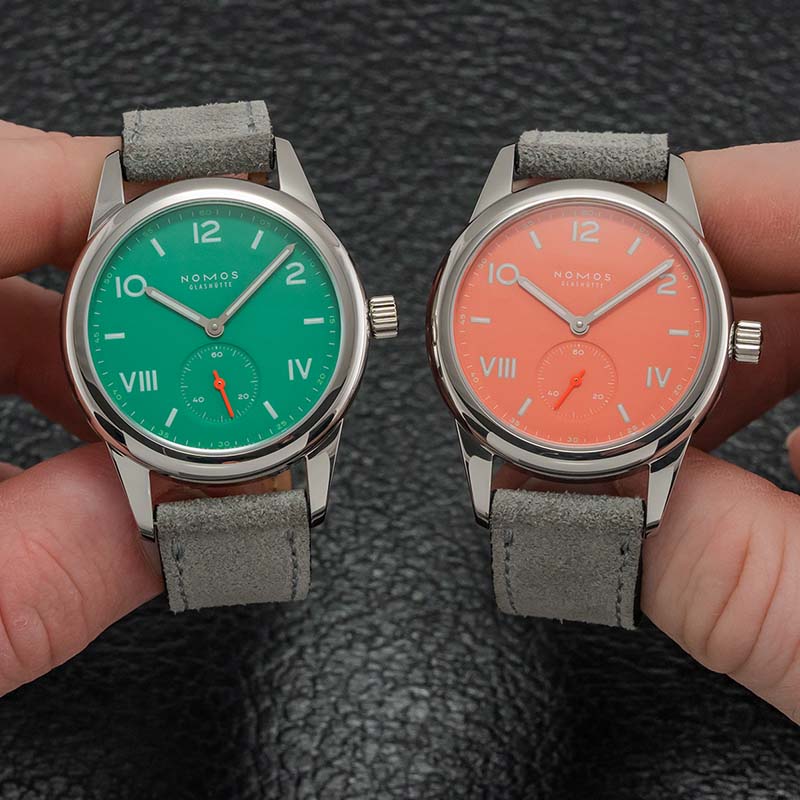
Nomos, a German brand whose models are prized for their Bauhaus minimalism and dressy elegance, introduced the sportier, more robust Club collection in 2007 and spun off the Club Campus series 10 years later as a more entry-level family of timepieces Club Campus watches are noteworthy for their streamlined, no-nonsense aesthetic and for their use of a “California” dial — in this case, a slightly off-kilter version in which the Arabic numerals occupy the top half of the dial and the Arabic numerals, the bottom. The seconds tick away on a subdial at 6 o’clock with a bright orange hand. Club Campus models offer two sizes (36mm and 38mm) and contain the manually wound Alpha calibers. Members of this Club collection are hot among younger watch enthusiasts not only for their very tempting price proposition but for their array of eye-popping colorways — Blue Purple, Cream Coral, Electric Green, and Future Orange (pictured), to name just a few.
Panerai Radiomir California PAM01349

Price: $12,900, Case Size: 45mm, Thickness: 16.1mm, Lug Width: 27mm, Water Resistance: 100 meters, Crystal: Sapphire, Movement: Manually wound P.5000
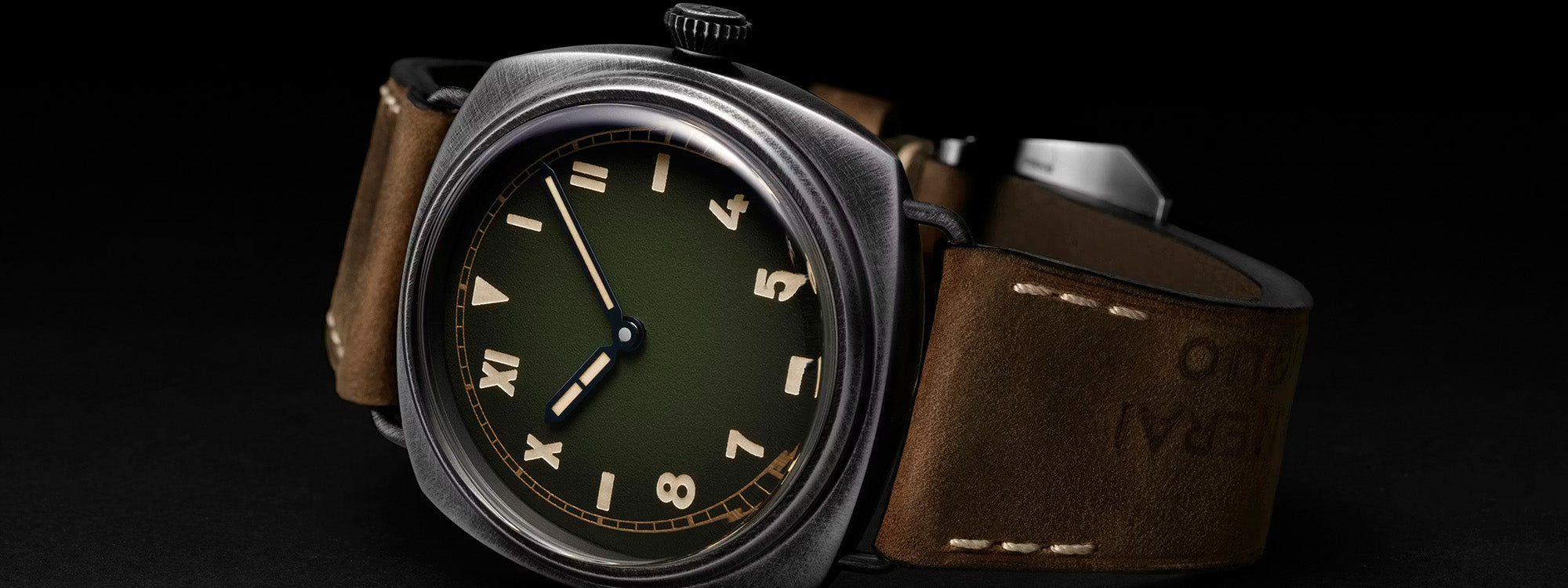
As noted above, Panerai was one of the very first watchmakers to utilize the “error-proof” dials now called California, and the Florentine-Swiss maison is appropriately one of the brands that is keeping the vintage style alive today. The Radiomir California (Ref. PAM01349) is in many ways a throwback to Panerai’s earliest wartime dive watches, with its cushion-shaped case made of Brunito steel, an alloy treated by hand with a special PVD to achieve a worn, “antiquated” look on its surface. The case measures a hefty 45mm (though Panerai’s previous California-dial editions were even larger, at 47mm) and features the period-appropriate wire lugs and cone-shaped crown, the latter a standard feature on Panerai watches before the now-familiar patented crown-lock system was invented for the Luminor. The sandwich dial of this boutique-exclusive piece is dark green, with beige-tinted indexes and metallic blue hands. A sapphire window in the caseback reveals the in-house, manually wound P.5000 caliber, whose impressive eight-day power reserve is touted in an engraving on the movement’s large mainplate.
Serica Ref. 6190 California

Price: $1,209, Case Size: 38mm, Thickness: 10.4mm, Lug to Lug: 46.5mm, Lug Width: 20mm, Water Resistance: 200 meters, Crystal: Sapphire, Movement: Automatic M100 COSC
Paris-based indie brand Serica was founded in 2019 in a collaboration between the watch blog “Les Rhabilleurs'' (specifically its former editor, Jérôme Burgert) and the WM Brown Project, established by sartorial expert and A Man & His Watch author Matt Hranek. In 2023, following up the company’s hand-wound 4512 models, Serica released the 6190 Field Chronometer series, notable for their understated dimensions, military-influenced aesthetic, and chronometer-certified movements. The California version features a 37.7mm steel case with a 10.4mm thickness (more slender than its predecessors), aided by a flat-top brushed bezel and lugs that have been carefully chamfered. The water resistance remains a respectable 200 meters. The unusual handset (wide arrow hour hand and skyscraper-shaped minute hand) sweeps over a 1940s-style California dial with white-printed outer track. The COSC-certified, Swiss-made Soprod M100 caliber stores a 42-hour power reserve, and the watch fastens to the wrist with a steel Bonklip bracelet, another stylish shoutout to the ‘40s.
Shop this Article
You May Also Like



Get your watch from TeddyBaldassarre.com and get 0% interest for up to 24 months available on select brands. Checkout with Affirm and spread your payments over 3 to 36 months. Learn More


0 Comments