







































Short on Time
Watches with enamel dials rarely fail to impress with their exquisitely finished surfaces, their impressive durability, and a level of artisanal craftsmanship that might not even be readily apparent to the naked eye but somehow elevates the entire timepiece to a higher level of luxury. Enamel dials — which are made by fusing finely ground, colored glass powders onto metal substrates through repeated firings in a kiln at high temperatures — are still fairly rare in the watch world, and almost (but not entirely) impossible to find below a certain echelon of pricing, Often, as in some of the limited editions below, an enamel dial is one essential component of a timepiece that combines several notable elements, including elite or unusual case metals, high-complication movements, or any number of special features. Here are 10 watches with enamel dials that have caught our eye over recent years.
[toc-section heading="A. Lange & Söhne Cabaret Tourbillon Handwerkskunst"]

Price: 315,000 euros at release, Case Size: 29.5mm x 39.2mm, Thickness: 10.3mm, Crystal: Sapphire, Water Resistance: 30 meters, Movement: Manually wound Caliber L042.1
In 2008, German haute horlogerie house A. Lange & Söhne brought a technical upgrade to the tourbillon — an 18th century invention originally designed to shield a watch’s balance from the ill effects of gravity — that was both subtle and substantial. The Saxon brand’s Cabaret Tourbillon featured the first tourbillon movement with a stop-seconds function. Lange’s manufacture Caliber L042.1 is designed to enable the oscillating balance inside the tourbillon cage to be reset to the precise second by pulling the crown, which triggers a complex lever mechanism that pivots a movable V-shaped spring onto the balance wheel rim, stopping the balance instantly. The arresting spring is shaped to ensure the correct amount of pressure on the balance regardless of the cage’s position, and the mechanism preserves the potential energy of the stopped balance spring so that it can restart instantly after the crown is pushed back in. Lange revived the Cabaret Tourbillon in 2021 as a limited edition in its exclusive, artisanal Handwerkskunst collection; that watch (pictured) has a rectangular platinum case and a white-gold dial with a hand-enameled, textured lozenge pattern.
[toc-section heading="Blancpain Villeret Traditional Chinese Calendar"]

Price: $107,200 (2026 edition), Case Size: 45.2mm, Thickness: 15.1mm, Lug width: 23mm, Crystal: Sapphire, Water Resistance: 30 meters, Movement: Automatic Blancpain Caliber 3638
Starting in 2012, Blancpain started annually celebrating the Chinese new year with special enamel-dialed editions from its elegant Villeret collection. Like Blancpain’s other calendar watches, it indicates the date with a serpentine hand and features a moon-phase in a 6 o’clock subdial. The other calendar displays, on subdials at 12, 3 and 9 o’clock and an aperture at 12 o’clock, are all keyed to the ancient, traditional Chinese calendar, which differs from our Gregorian calendar in several significant ways. Unlike the latter, which uses the solar day as the base unit of time measurement, the Chinese calendar is a solar calendar that uses the lunar cycle’s 29.53059 solar days as its base unit and sometimes needs an entire leap month of either 29 or 30 days to preserve its symmetry with the cycle of the seasons. Simply, a year with a leap month (13 lunar months) is longer than a traditional solar year and a year without one (12 lunar months) is shorter (explaining why the date of the Chinese New Year varies a bit each year). The ingeniously designed watch (pictured is the 2025 “Year of the Wood Snake” edition) incorporates cosmic and mythological elements — the 12 Zodiac signs,; the five elements; and the so-called 10 “heavenly stems.” Each day is divided into 12 rather than 24 units (corresponding with the 12 zodiac animals), meaning that one Chinese hour is equivalent to two of ours. All of these elements are recorded and displayed on the grand feu enamel dial — with a subdial at 12 o’clock for the double-hours and their symbols, a window above it with the current year’s zodiac sign, and a yin-yange symbol at 3 o’clock for the elements and stems.
[toc-section heading="Breguet Classique Souscription 2025"]

Price: $59,400, Case Size: 40mm, Thickness: 10.8mm, Lug width: 21mm, Crystal: Sapphire, Water Resistance: 30 meters, Movement: Manually winding Breguet Caliber VS00
The Breguet Souscription pocket watch from the late 18th century was historic not only for its simplified, single-handed time display, but also for the revolutionary marketing concept behind it — essentially, a “crowd-funded” watch for which a prospective customer (or “subscriber”) would pay a portion of the cost up front to help pay for the watch’s manufacture. Last year, as part of Breguet’s 250th anniversary, that two-centuries-plus-old timepiece was resurrected as a wristwatch. The Classique Souscription 2025, outfitted with the manually wound in-house Caliber VS00 and debuting in a proprietary “Breguet gold” case,, has a dial finished in pristinely white grand feu enamel, echoing the look of those 18th-century pocketwatches. The vintage-look Arabic hour numerals, the chemin de fer minute track, and the Breguet signature at 12 o’clock are all executed in petit feu black enamel for a sharp contrast. The single, center-mounted, hour-and-minute hand is in flame-blued steel and curved by hand to sweep perfectly over the dial. The movement, made of gilded brass, offers up its own aesthetic charms from behind a sapphire pane in the back of the 40mm case, including a special vintage-appropriate guilloché treatment called Quai de l’Horloge.
[toc-section heading="H. Moser & Cie. Endeavour Perpetual Calendar Tantalum"]
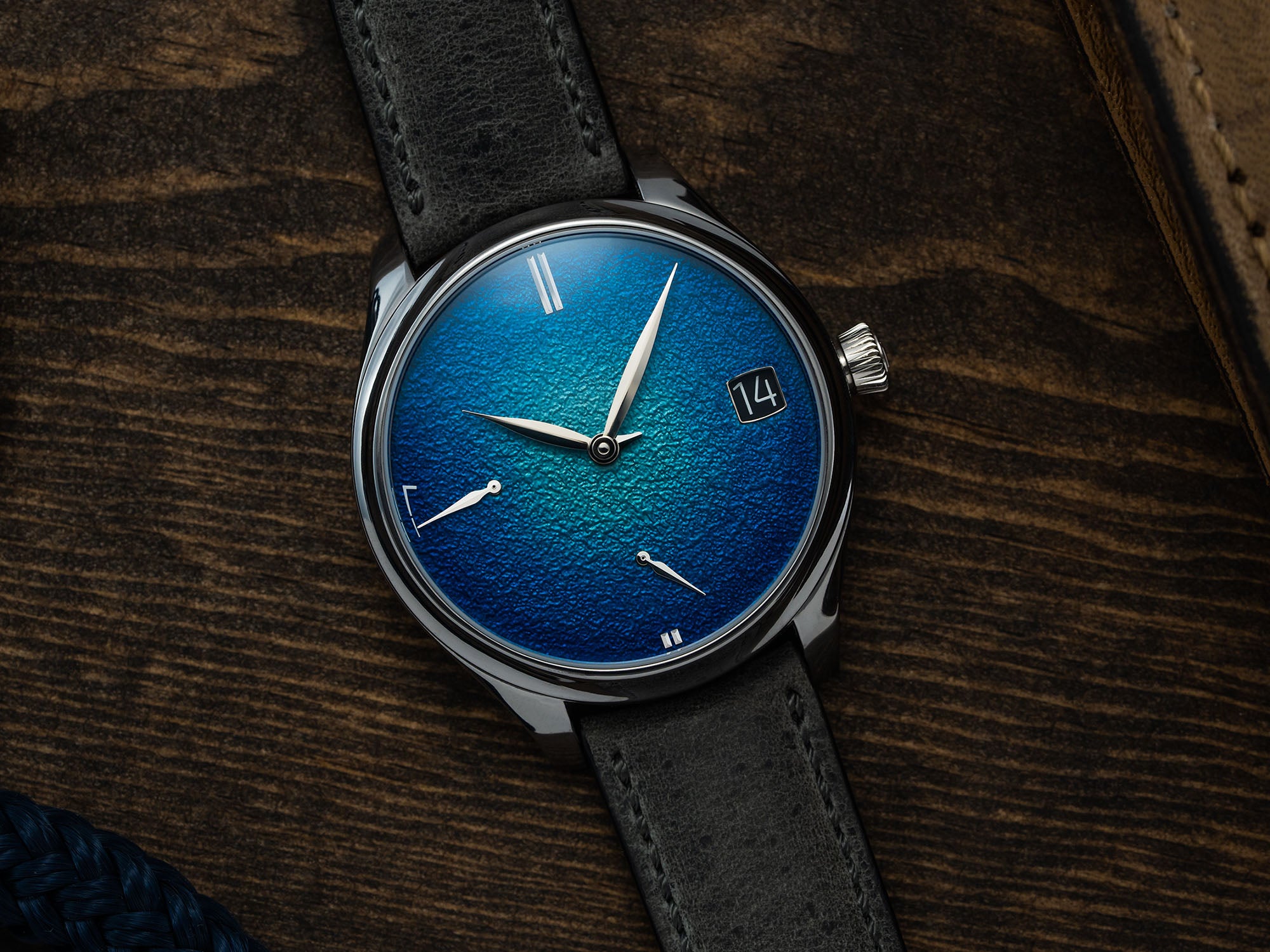
Price: $82,500, Case Size: 42mm, Thickness: 13.1mm, Crystal: Sapphire, Water Resistance: 30 meters, Movement: Manually wound HMC 800
H. Moser & Cie, founded in 1828 and relaunched in 2005, has garnered acclaim for its highly streamlined, minimalist aesthetic as well as its impressive technical acumen; both are on display in the watch that arguably defines the brand, its Perpetual Calendar, whose subtly complex design has been adapted into several variations since its debut. One of the most noteworthy is the Endeavour Perpetual Calendar Tantalum Blue Enamel, which offers the rare combo of a tantalum case (Moser’s first) and an “Abyss blue” fumé dial executed in enamel with an eye-catching hammered texture. “Minimalist” barely begins to describe the dial, which achieves its unique look through a grand feu enameling process: two leaf-shaped central hands for hour and minute, small seconds at 6 o’clock, date at 3 o’clock, and subtle analog power reserve indicator at 9 o’clock, along with a double index marker at 12 o’clock for orientation. An additional, tiny center-mounted hand keeps track of the month on the same scale as the hours. Inside,the manually wound Caliber HMC 800 stores a weeklong power reserve while tracking the hour, minute, month, day, date and leap year, the latter of which can be read on the back of the movement through the sapphire caseback.
[toc-section heading="Jaeger-LeCoultre Master Ultra Thin Moon"]

Price: $11,100, Case Size: 39mm, Lug width: 21mm, Crystal: Sapphire, Water Resistance: 50 meters, Movement: Automatic Jaeger-LeCoultre Caliber 925
The historic Swiss “watchmaker’s watchmaker," Jaeger-LeCoultre is loaded with savoir faire on both the technical and decorative ends of high horology, and both are on display in the Ultra Thin Moon Enamel, a limited edition of 100 pieces. The dazzling blue enamel dial has a guilloché finish whose texture is achieved through engine-turning the dial material by hand before the translucent enamel is applied. Made entirely in-house by skilled artisans, the dial’s central talking point is the moon-phase display, with a polished white moon, which shares the 6 o’clock subdial with the small seconds display. The ultra-thin, automatic manufacture Caliber 925/2 ticks inside a similarly slender case (just 10.04 mm thick, at a diameter of 39 mm), tallying up a power reserve of 70 hours and showing off its luxurious finishes behind a sapphire caseback.
[toc-section heading="Louis Erard Excellence Email Grand Feu II"]

Price: $4,290, Case Size: 39mm, Thickness: 12.25mm, Crystal: Sapphire, Water Resistance: 50 meters, Movement: Automatic Sellita Caliber SW261-1
Independent watchmaker Louis Erard unveiled its Excellence Émail Grand Feu II in 2022, shortly after the watchmaker’s revival as a purveyor of artisanal timepieces at attainable prices. Émail, for the non French-speakers out there, refers to enamel, not electronic communications, while grand feu (literally “big fire”) refers to the specific type of enamel used for the elegant dial, in which fine powders, one for each of the colors used in the dial’s ensemble, are fired in a kiln at 800 degrees Celsius to achieve a long-lasting brilliance; in this model, it’s the gleaming white of the dial, the bright blue of the hour markers and Roman numerals and the rich red of the 12 o’clock numeral. Also distinguishing the dial of this 99-piece limited edition are Louis Erard’s signature “tree” hands and the delicate Roman hour numerals. The steel case measures 39mm and houses an automatic Caliber from Sellita.
[toc-section heading="Omega Seamaster Aqua Terra World Time Master Chronometer"]

Price: $10,900 (steel), Case Size: 43mm, Thickness: 14.12mm, Lug width: 21mm, Lug to lug: 50.3mm, Crystal: Sapphire, Water Resistance: 150 meters, Movement: Automatic Omega Caliber 8938
Omega added a world-time watch to its elegant Aqua Terra collection in 2017, a model that also marked a rare foray into dial enameling by the brand. The watch’s multi-level dial has an exterior section of sand-blasted platinum-gold alloy with applied yellow-gold indices and a circle printed with the names of world cities in three distinct colors — red for London, aka GMT 0; black for locations with daylight savings times; and blue for non-DST locales. Bienne, Omega’s Swiss hometown, stands in for Paris at GMT +1. The center of the dial is a sapphire disk with a hand-crafted enamel world map as seen from the North Pole and an outer 24-hour ring in day and night color segments. The case, in the same platinum-gold alloy, is 43 mm in diameter, with a wave-edged exhibition caseback that displays the movement, Omega’s self-winding Master Chronometer Caliber 8939. The original watch was limited to 87 pieces, and followed by a non-limited version in steel, which Teddy reviews here.
[toc-section heading="Patek Philippe Golden Ellipse"]

Price: $92,691, Case Size: 34.5mm x 39.5mm, Thickness: 5.9mm, Lug Width: 20mm, Crystal: Sapphire, Water Resistance: 30 meters, Movement: Automatic Patek Philippe Caliber 240
The Golden Ellipse, launched in 1968, is Patek Philippe’s second oldest existing model behind the Calatrava. Its odd elliptical case, combining elements of an oval and a rectangle, took its influence from the “golden mean” of ancient Greek mathematicians and the basis of numerous artistic and architectural masterpieces throughout history. For its 50th anniversary in 2018, Patek launched two new versions of the cult-classic model, one in platinum, the other in 18k rose-gold, each with a svelte wrist profile of just 2.53 mm thick. The enameled white gold dial of the platinum edition, with a hand-engraved, stunningly ornate volute motif, features hands and hour appliqués in either white gold or rose gold. Inside the 34.5mm x 39.5mm case of both timepieces is Patek’s manufacture Caliber 240, an ultra-thin automatic movement with an 18k gold microrotor and a minimum 48-hour power reserve that made its debut in a Golden Ellipse watch in 1977.
[toc-section heading="RGM Pennsylvania Series 801-CE Classic Enamel"]

Price: $13,900, Case Size: 43mm, Thickness: 12.3mm, Lug to Lug: 57mm, Lug Width: 22mm, Crystal: Sapphire, Water Resistance: 50m, Movement: Manually wound RGM Caliber 801
Since founding Lancaster, PA-based RGM in 1992, Roland G. Murphy, a trained watchmaker and former Hamilton Watch Company technical manager, has accomplished many horological feats, including the first high-grade mechanical movement made in the U.S.A. in over 40 years, Caliber 801, in 2008. In his Pennsylvania Series 801-CE model, introduced 10 years later, Murphy places that movement behind a vintage-pocketwatch-style “double sunk” enamel dial, constructed of three separate pieces soldered together and finished in the grand feu process for a gleaming white finish. The dial hosts vintage-style Roman numerals, a railway track minutes scale, and blued Breguet hands, all elements evocative of pocketwatches from a bygone era of American watchmaking. Caliber 801, with its array of old-school horological highlights including classical bridge shapes, hand-polished and blued-steel components; and a seven-tooth winding click system, is on display behind the sapphire caseback.
[toc-section heading="Seiko Presage Multi-Hand Automatic Enamel Dial SPB045"]

Price: $1,100, Case Size: 40.5 mm, Thickness: 12.8 mm, Lug Width: 20 mm, Lug-to-Lug: 47.2 mm, Crystal: Sapphire, Water Resistance: 100 meters, Movement: Automatic Caliber 6R27
Seiko offers several enamel-dial models in its elegant yet affordably priced Presage series, like this Multi-Hand Automatic timepiece that contains the Japanese brand’s Caliber 6R27, with a power reserve of 45 hours. Its artfully arranged dial hosts central hours, minutes, and seconds; a date calendar on a subdial at 6 o’clock; and an arc-shaped power-reserve indicator at 9 o’clock. The stainless steel case measures 40.5 mm in diameter and 12.8 mm and is water-resistant to 100 meters. The enamel dial has been crafted by Japanese master craftsman Mitsuru Yokozawa and his team, who painstakingly adjust the enamel’s thickness to the exact depth required for each level of the dial. The Roman numeral hour markers — inspired by those on a historic Seiko pocket watch from 1895 — are painted onto the dial at least 10 times to achieve their elegant raised relief appearance, and the tips of the leaf-shaped hands are subtly curved to follow the contours of the sapphire crystal, aiding in the case’s slim profile.
Shop this Article
You May Also Like



Get your watch from TeddyBaldassarre.com and get 0% interest for up to 24 months available on select brands. Checkout with Affirm and spread your payments over 3 to 36 months. Learn More


0 Comments