






































Short on Time
You’ve heard of Seiko. By now, you’ve heard of Grand Seiko. But Credor, for many enthusiasts outside of Japan, remains mostly a mystery, despite its connection to both. But for those who are aware of Credor, it represents a Holy Grail of high-horological craftsmanship worthy of its venerated designation as “Japan’s Patek Philippe,” and perhaps no single timepiece represents its signature balance of technical complexity and sublime simplicity of design than the Credor Eichi II.

[toc-section heading="Credor History"]
The legend of Credor began in 1974, when it was launched as a luxury offshoot of parent brand Seiko, initially to produce exclusively precious-metal watches. The name, which became official in the 1980s, is a Japanified version of the French phrase "Crêt D'or," which translates as “pinnacle of gold.” This lofty claim is visualized in the now-iconic triple-peaked logo capped by three stars. Throughout the ‘90s, Credor watches (like Grand Seiko watches, before that sub-brand’s emergence as a separate, independent brand in 2017), were co-branded, with both the Credor and Seiko logos on their dials. Also like Grand Seiko (the first of which was made way back in 1960), Credor products were sold only exclusively in Japan. In the early 2000s, well ahead of Grand Seiko’s more famous coming-out party, Credor became a standalone brand, hosting all of the Japanese watchmaking giant’s forays into haute horlogerie as well as some very impressive high-jewelry timepieces — a marketing necessity, as these watches carried retail prices that could climb well into six figures, a territory that Seiko simply would not have been able to breach with its own mainline brand, which was associated with more affordable, mass-market pieces.

So what is the difference, technically and aesthetically, between Grand Seiko and Credor, both of which were created as upper-echelon (and higher-priced) evolutions of the core Seiko brand? For the most part it comes down to design philosophy: Grand Seiko aims to create watches that master practicality while also projecting a consistent level of luxury — with precision, legibility, and durability as their guiding tenets. Credor watches, by contrast, still shoot for high-horology bonafides but embrace more artistic expression, with less of an emphasis on consistency and strict design codes throughout the line. Credor is also more open to creative collaboration, as in the cult-classic Locomotive timepiece (above) — a watch developed in concert with Royal Oak and Nautilus creator Gérald Genta that would certainly be out of place in the Grand Seiko universe. Also like Grand Seiko, Credor makes watches for multiple different price segments, with some of them priced below $10,000, though these are exceedingly rare outside of Japan.

The watch we’re showcasing here, the Credor Eichi II, was the second watch to bear the name Eichi, the first of which debuted in 2008 (above). It is arguably the first piece under the Credor banner that really caught the attention of an international audience of watch enthusiasts. Like all the most select of Grand Seiko’s masterpieces, they are made at the now-legendary Micro Artist Studio in Shiojiri, located in Japan’s Nagano Prefecture — the flora and fauna of which has inspired many a decorative Grand Seiko dial (and even some special Seiko dials). Opened in 2000, the Micro Artist studio houses a small unit of the most skilled artisans within the broader Seiko watch corporation, who produce a very limited number of pieces per year, all with an exquisite, intricate level of detailing and finishing. Launched in 2014 to celebrate both Credor’s 40th anniversary and the 15th anniversary of the Seiko Spring Drive movement, the contemporary Eichi II collection comprises a series of three models, all in precious metal and all deceptively simple, with a clean, minimalist appearance that belies the intricate level of handiwork at play, both inside and outside.
[toc-section heading="Case and Crown"]

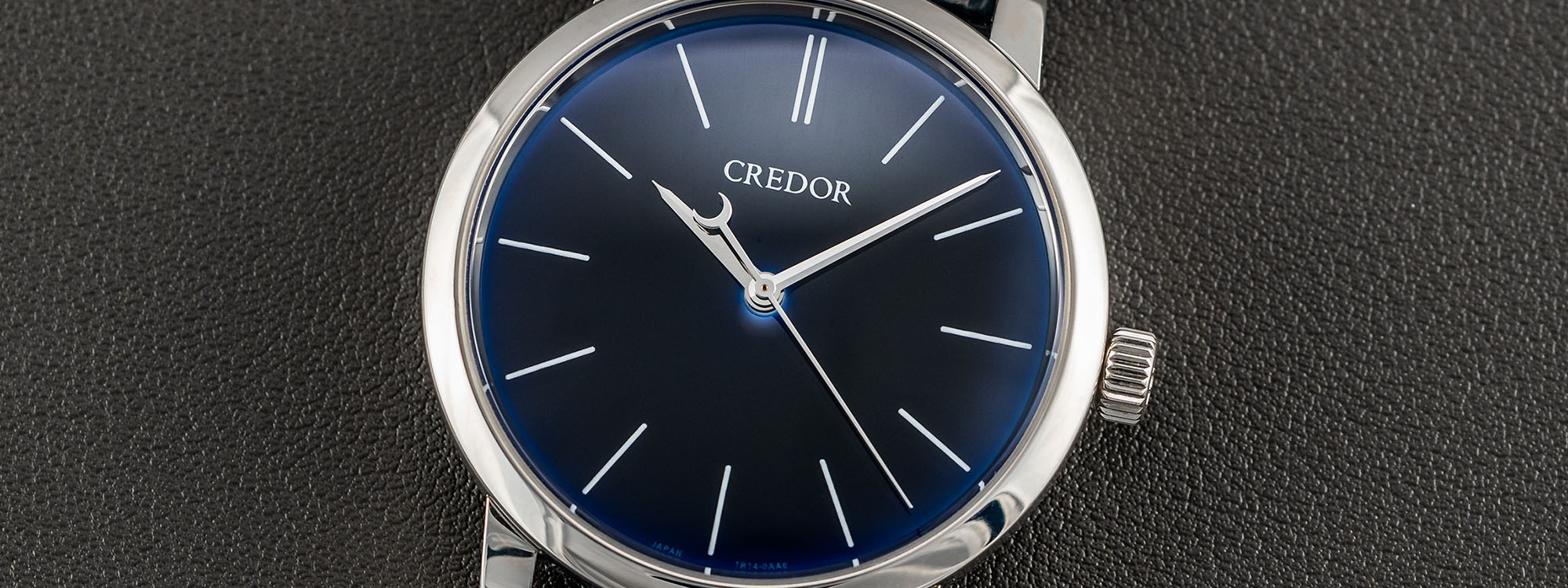
The Eichi II case is a textbook example of the clean, crisp aesthetic of the brand overall, with very wearable dimensions of 39mm in diameter, a thickness of 10.3mm (including the curved sapphire crystal), and a lug-to-lug length of 45mm. (The Credor I was a more understated 35mm in diameter.) Made of either platinum or rose gold, its surfaces are graced with the signature Zaratsu polishing developed by Seiko watchmakers, which creates a gleaming, mirrored effect. (One of the platinum models, Ref. GBLT997, has a Ruri blue porcelain dial, while the other, Ref. GBLT999, has a white porcelain dial; the rose-gold Ref. GBLT998 also sports a white porcelain dial.) The form of this case, with no hard lines and soft, rounded curves, is one of the main hints to the differing philosophy between Credor and Grand Seiko, the latter of which offers many case styles with sharply defined lines and facets.

The wide, sloping bezel frames the dial in a way that calls attention to the exquisite porcelain within its border, by surrounding it with ample brightwork. The crown is signed with the Credor logo in relief against a media-blasted backdrop, and the ribbed texture offers a very pleasant tactile experience. The case resists water pressure to a very pedestrian 30 meters, which is not atypical for this style of dress watch. The lugs are broad and substantial, with the main case featuring a gentle inward slope from the top toward the caseback, which is secured by five screws. The caseback’s outer perimeter receives the same level of polishing as the rest of the case and frames the gorgeous movement ticking behind its sapphire display window.
[toc-section heading="Dial and Hands"]

The main element that differentiates the Credor Eichi II from the original Eichi is patently obvious to anyone comparing the two side by side. The former eschews the power-reserve indicator of the latter for an even cleaner, more minimalist display on the porcelain dial. Also, the dials themselves are now produced in-house rather than sourced from a local artisan, a testament to the growing mastery of the Seiko group of companies.

The dial’s multilayered finish showcases incredible depth and saturation. You won’t find hard edges anywhere, as the surface of the dial slopes gently at the outer edge and near the center where the handset is anchored. This is especially noticeable on the lapis blue “Ruri” version, in which the color becomes lighter at those edges. The dial undergoes multiple layers, which are then fired with an added glaze to create a vibrant reflection. The porcelain is from Nagano Prefecture and is even richer in gloss than those made in the Arita porcelain process, with the glaze developed over a three-year period.

From the pristine lines of the hour markers to the Credor wordmark, and even the tiny print at its base, the dial is entirely hand-painted — an incredible achievement that holds up even under macro lens viewing. According to the artisans in the studio, the technique requires them to use not only a very small brush, but the tip of the brush’s hair to maintain this impeccable artistic precision. The Ruri-dial platinum version of the Credor Eichi II features white markings, while the rose-gold dial’s elements are rendered in charcoal black. The white-dialed platinum version, on the other hand, showcases blue markings that coordinate with the exquisitely heat-blued hands. The aforementioned lack of an extra analog hand for the power-reserve, of course, makes these elements stand out all the more impressively.
[toc-section heading="Movement and Finishing"]

Credor’s Spring Drive Caliber 7R14, the successor to the Caliber 7R88 in the Eichi I, is the real star of the show here, proudly on display behind the caseback window. As a product of the Micro Artist Studio, it’s among the elite group of in-house movements that are made exclusively for Credor and Grand Seiko’s Masterpiece collection. Like all Spring Drive watches that have descended from the first one brought to market in 1999, this one combines mechanical power with quartz accuracy. One aspect of this particular caliber that deserves mention is an entire energy optimization train added to the movement, which is known as the Torque Return System. This innovation aids in the 7R14’s incredible accuracy of +/- 15 seconds per month.

The finishing of this caliber speaks to a bit of that collaborative spirit mentioned earlier, as Credor consulted with the revered independent Swiss watchmaker Philippe Dufour on its decoration. Together they found a way to source a particular type of gentian softwood to mirror-polish the wide bevels. (It is a wood not native to Japan but a local Japanese University found a way to grow it.) The beveled edges of the bridges have surface areas of reflection that can only be achieved by hand. The mainspring barrel is uniquely cut in a floral pattern, with the internal angles also beveled. The bridges are in rhodium-plated brass with a fine-grain lined finish, and the engraved bellflower positioned to the right of the glide wheel indicates the movement's construction within the Micro Artist studio. The polishing continues in the chamfered jewel and screw sinks, adding to the dazzling effect, and the screws are heat-treated. The power-reserve indicator formerly on the dial has been moved to the back of the movement, featuring a heat-blued pointer. This element’s new placement on the Eichi II is surely viewed by many collectors as an improvement.
[toc-section heading="Conclusions and Pricing"]

All in all, the Credor Eichi II will strike many as a prime example of the tenet of addition by subtraction. On the one hand, it is a remarkably plain watch (not unlike the Swiss pieces made by the aforementioned Mr. Dufour), but on the other, its pursuit of purity at the highest level, along with the subtle embellishments that a true enthusiast will take joy in discovering, lends it a cachet that some (not all) aficionados will find irresistible. For those in that camp, the prices range from $49,000 for the rose-gold references to $59,000 (white porcelain) and $61,000 (blue porcelain) for the platinum models. You can learn more about the brand at credor.com
You May Also Like



Get your watch from TeddyBaldassarre.com and get 0% interest for up to 24 months available on select brands. Checkout with Affirm and spread your payments over 3 to 36 months. Learn More


0 Comments