




Short on Time
The 100-year history of the Rolex Oyster case is really, in many regards, the history of Rolex itself, at least when it comes to the Crown’s technical innovations in the pursuit of waterproof watch design. A groundbreaking and indisputably influential invention when it arrived on the scene in 1926, the Oyster has become the core element of Rolex’s modern collection, the foundation for its most popular and historic watch models, and a proving ground for other inventions that have become vital features throughout the brand’s portfolio, like the Cyclops lens, Triplock crown, and helium escape valve. As the Oyster marks its first century on the market in 2026, here is a tour through its most significant milestones.

1926: A Waterproof Breakthrough
Rolex founder Hans Wilsdorf (below) was one of the earliest and most prominent proponents of making wristwatches more waterproof. It was a challenge that had plagued watchmakers for years, ever since pocket watches began fading from common usage in favor of the wrist-worn timepieces that gained wide acceptance in the wake of World War I. Few of the early attempts to secure timepieces against water penetration met with much success; one of the few was the pocketwatch case patented in 1891 by Genevan casemaker François Borgel, which was designed for the movement to be screwed in from the front and for the case to be sealed by a tightly fitting bezel and crystal. In its earliest days, Rolex used Borget’s one-piece case for some of its watches, but Wilsdorf wanted something even more secure and robust.

The result of this quest was Wilsdorf’s 1926 invention, the so-called Oyster case. It proved to be (no pun intended) a watershed for an evolving industry, with an innovative design that combined a threaded, hermetically sealed caseback and a crown that screwed securely into the side of the case for a water resistance never before achieved in watches. It took its name from the bivalve mollusk whose traits it emulated, except that its function was the opposite, with the two “shells” of the case clamping tight to keep water outside, rather than inside. It was the crown mechanism, which added an internal clutch mechanism allowing the crown to thread tightly onto the stem to improve winding capacity, that made the design revolutionary — and the progenitor of many other water-resistant cases to follow.

Interestingly, the first Oyster cases were not round, as we know them today, but octagonal — a decision apparently made to create more surfaces for watchmakers to grip with tools and also an architecture that made it easier for Rolex to secure a patent, which was granted in July 1926.

Photo: Sotheby's
The first Oyster watches, which took their name from the groundbreaking case, were released that same year, and secured their place in history just one year later. On October 21,1927, in what would become the first of many celebrity-driven marketing initiatives over the years, Rolex partnered with Mercedes Gleitze, a British professional swimmer, for a widely publicized campaign. Gleitze wore an octagonal-cased Rolex Oyster watch on a necklace during her first (unsuccessful) attempt to become the first woman to swim the English Channel. The watch was still ticking when she returned to shore, allowing Rolex to tout the waterproofness of its watch in a big way in subsequent advertisements. For Wilsdorf and Rolex, it was only the beginning of many innovations to come.
1931: The First Rolex Perpetual Movements

Rolex watches had already become renowned for their accuracy, having won chronometry competitions as early as 1910, but the original Oyster watches still carried manually winding mechanical movements. Wilsdorf’s other quest — to produce a watch that didn’t require regular hand-winding and thus produced less wear and tear on the crown and winding stem — came to fruition in 1931. His patented, self-winding “Perpetual” movement introduced a weighted mass that swung in a 360-degree arc to wind the mainspring via the motion of the wearer’s arm. It wasn’t the first self-winding, or “automatic” movement in a wristwatch — that would be the one patented by British watchmaker John Harwood in 1923, which had a weighted rotor that swung in a smaller arc — but it was a development that spurred other watch manufacturers to begin adopting the technology in their own products.
1945: The Datejust, a Watch Full of Firsts

It took Rolex more than a decade, however, to combine the robustness of the Oyster case and the convenience of the Perpetual movement into a single timepiece. This was the first Rolex Datejust, unveiled in 1945 — a historical milestone in many regards. It was the first Rolex watch with the now familiar phrase “Oyster Perpetual” spelled out on the dial. The Datejust was also the first to feature the now-ubiquitous date display at 3 o’clock, the first automatic watch with a quick-change function for that date display, and the first to be mounted on Rolex’s now-famous five-row Jubilee bracelet.

Several years later, in 1953, came the first Datejust with the bubble-shaped “Cyclops” lens directly above the date aperture, which magnified the date numeral by a factor of 2.5 for greater legibility at a glance. Rolex filed for a patent on the Cyclops lens in 1952. Legend has it that Wilsdorf came up with the feature after his second wife lamented to him how difficult it was for her to read the date on her watch, and that the idea came to him after a droplet of water fell onto his watch’s crystal over the date window while he was washing his hands in a sink. While not every Rolex watch with an Oyster case incorporates a crystal with the Cyclops lens, Rolex does consider this hallmark invention an official “external feature” of the case assembly. The Cyclops lens would prove to be only one of several milestones that would emerge from Rolex in 1953, all of them packaged in the now-ubiquitous Oyster case.
1953: The Submariner and the Twinlock Crown

Rolex revolutionized the watch industry, and delivered the most optimized version yet of its Oyster case construction, with the launch of the Submariner in 1953. That year, in which the popularity of Scuba diving was on the rise and watchmakers strove to fill the need for watches that could withstand deeper underwater pressures as well as track immersion times, Rolex unveiled the Submariner, which was touted as the first commercial watch that was waterproof to 100 meters — a significant claim, as the Blancpain Fifty Fathoms, which had preceded it to market, was tested only to the 91.44 meters that matched up to its name.

This historic model, Ref. 6204, also marked the debut of the Twinlock winding system. In this construction, the screw-down crown and its stem (below) utilized two rubber O-ring gaskets, one in the crown and one in the tube, to prevent water from penetrating the case. (The original Oyster case from 1926 used a rubber gasket only for the threaded caseback, not for the crown, which used gaskets made from metal.) This patented, double-sealed system revolutionized the waterproofing of watch cases, but it was only the first step toward an even more secure system that debuted more than a decade later: the Triplock crown.
1953: The Explorer: An Oyster Scales Everest

Before that, however, the Oyster case found its way to another significant Rolex watch, also unveiled in 1953: the Explorer, which is known chiefly as the watch that accompanied Sir Edmund Hillary and Tenzing Norgay on their historic expedition to the summit of Mount Everest that same year. The watch that Rolex actually provided for the mission was the “pre-Explorer” Ref. 6098, equipped with the automatic Caliber A296, which was never produced commercially, but the worldwide fame garnered by the successful summit provided all the marketing juice that Rolex needed for the launch of the mountaineering-themed timepiece that it released as its successor, Ref. 6350, the first “official” Rolex Explorer. (Much more detail on the watch and its origins can be found here.)

It was the preceding Ref. 6150 that established the emblematic Explorer dial layout: inverted triangle at 12 o’clock, numerals at 3, 6, and 9 o’clock, Mercedes-style hour hand and pencil-shaped minute hand, and bar indexes at the other hour positions. The Ref. 1016 that followed shortly thereafter is the longest-lasting of the Explorer references, and as of the most recent version in 2021, the Explorer’s Oyster case, which proved as resilient against the harsh cold of the Himalayas as it had against the extreme water pressures of the ocean depths, is once again available in its original 36mm size.
1955: The GMT-Master and the Bicolor Bezel

Just two years later, in 1955, came another now-legendary Oyster Perpetual timepiece, the first Rolex GMT-Master, which, like the Submariner, was both trend-setting and genre-defining. It was the first watch capable of displaying the time in two separate time zones by means of a fourth, central 24-hour hand and a bidirectional rotating 24-hour bezel. The initials in the watch’s name signify “Greenwich Mean Time,” the system of world timekeeping based on the calculation of mean solar time from the Royal Observatory in Greenwich, London. Notably from an aviation history perspective, its dual-time functionality was an innovation devised for, and developed in cooperation with, the original watch’s intended users: pilots for Pan American Airlines, who wanted a tool watch that enabled them to track the time on long-haul and international flights in both their home city, and their flight’s destination city, anywhere in the world.

From the standpoint of the Oyster case’s continuing evolution, this first-generation GMT-Master, Ref. 6452, added a new element: a rotating bezel divided into two equal sectors of red and blue, a clever and eye-catching visual shorthand to identify daytime and nighttime hours on the 24-hour scale. This red-and-blue “Pepsi” bezel would herald other popular colorways with pop-cultural nicknames, like the red-and-black “Coke” bezel in 1983, the blue-and-black “Batman” bezel in 2013, and further iterations that continue to appeal to enthusiasts today.
1956: The Day-Date, Timepiece of Presidents

After the previous several years’ focus on tool- and sport-oriented watches for diving, flying, and outdoor adventure, Rolex released its other famous dress watch, the Day-Date, in 1956. The natural evolution of the well-established Datejust, it was the first wristwatch that displayed both the date (in the now-familiar 3 o’clock position under the Cyclops lens) and the current day of the week (in a curved window above the Rolex logo at 12 o’clock). Its 36mm gold Oyster case had the fluted bezel emblematic of its stylistic predecessor and housed an automatic Perpetual Caliber. The Day-Date is also known as the “President,” a nickname it began earning as early as the 1960s when President Lyndon B. Johnson wore one regularly in office. The watch also claims a historical, if somewhat scandalous, connection to LBJ’s predecessor, John F. Kennedy, who was purportedly given one as a gift by his mistress, actress Marilyn Monroe. The watch in question, with an inscription in its caseback reading, “Jack, with love as always from Marilyn, May 29th, 1962,” was sold at auction in 2005 to an anonymous bidder. The sturdy three-link bracelet that made its debut on the original Day-Date also bears the nickname “President” and remains reserved for Day-Date models and for certain ladies’ Datejust models.
1963: The Daytona and the Most Famous Engraved Oyster Case

Rolex, which had a prestigious history in timing auto racing, became official timekeeper of the Daytona 500 stock car race in 1962, and one year later it released the Ref. 6239 Cosmograph, nicknamed the “Daytona” (though the name had yet to appear on the dial), its now-famous racing-inspired chronograph watch. The watch was notable for its three-register dial and its engraved tachymeter bezel, the latter being the noteworthy addition to the Oyster case, along with the screwed, pump-style chronograph pushers. But one Daytona in particular merits its inclusion among the milestones achieved by the Oyster case.

Actor Paul Newman, who embarked upon a successful second career as a racing driver after starring in the 1969 movie Winning, famously wore a very specific style of Daytona that is now nicknamed for him, and one of the rarest collectible timepieces on the secondary market. The “Paul Newman” Daytona is notable for its off-white-and-black “panda” dial layout, square-tipped hash marks and Art Deco-style numerals. A rare Ref. 6239 Daytona watch actually owned by Newman himself went on the auction block in 2017 and stunned the watch community at the time by fetching a world-record price of $17.75 million; it was distinguished by a personalized caseback engraving requested by Newman’s wife, Joanne Woodward — “Drive Carefully - Me” — which has now entered watch history lore as perhaps the most famous engraving ever applied to the Oyster’s closed caseback.
1967: The Sea-Dweller and the Triplock Crown

By 1954, shortly after the Submariner’s debut, Rolex had already doubled the Oyster case’s industry-first 100-meter resistance to 200 meters, where it remained for many years. But by the end of that decade, the Crown was already working diligently on an even more extreme waterproof construction. Its efforts bore fruit in 1960 with the first Rolex Deepsea, an experimental version of the Submariner with an ultra-thick, Oyster case that was fastened to the hull of the Bathyscaphe Trieste (above), a submersible vehicle that ocean explorers Jacques Picard and Don Walsh piloted into Challenger Deep, the deepest valley of the Mariana Trench in the western Pacific Ocean. The watch, and the Trieste, descended nearly all the way to the bottom to set a world record. The prototype timepiece, believed to be one of only seven ever made, had an ultra-thick steel case with a highly domed sapphire crystal that rendered it water-resistant to an unprecedented 10,000 meters, or more than 35,000 feet, ensuring it was still ticking when the submersible touched the bottom of the Mariana Trench, at 35,797 feet. Today, both the watch and the Trieste are on display at the Smithsonian in Washington, D.C.

From this legendary prototype sprang the Submariner’s even more rugged sibling, the Sea-Dweller, in 1967 (though it wasn’t commercialized until 1971). The original Sea-Dweller Ref. 1665, had a nearly identical design to the Submariner but, from a technical standpoint, was a substantial upgrade. Aimed at professional divers that plied their trade at great depths inside a pressurized diving bell, breathing a mixture of hydrogen, helium, and oxygen that sustained them for prolonged periods underwater, the watch’s Oyster case boasted a water resistance rating of 500 meters (1,600 feet), substantially higher than the Submariner’s 200-meter rating.

In historic Rolex fashion, it also introduced an impactful tool-watch innovation — a helium-release valve built into the case, designed to automatically expel built-up helium atoms from the pressurized atmosphere where the watch would be worn, which could penetrate the case and cause its crystal to pop free. This device, with another Rolex patent, was the first of its type on a commercially sold watch, and along with it came the newest generation of watertight crown protection, a design that Rolex called Triplock.

In comparison to the Twinlock that preceded it, the Triplock (above) used a thicker, threaded case tube and four (rather than two) rubber O-ring gaskets — one surrounding the outside of the winding tube, the second inside the crown compressed against the case tube, the third and fourth inside the case tube wrapped around the winding stem. The result is three sealed zones to the Twinlock’s two. Triplock crowns are also larger than Twinlock crowns, by a full millimeter or more in height. As this design ensured even more secure watertightness for the case, it was later adopted by the core Submariner models (which have evolved over the years to increase their own waterproof rating to the modern standard of 300 meters) as well, starting around 1977.
1970: OysterQuartz and the First Sapphire Crystal

The quartz era of watchmaking began in 1969, with the commercialization of the first watch movements powered by batteries and quartz crystals rather than mainsprings. Rolex was one of a handful of Swiss watchmakers to become an early adopter of the new technology, releasing its first “Oysterquartz” model — the Ref. 5100, aka “the Texan,” powered by the Swiss-made Beta-21 quartz caliber — in 1970. Limited to 1,000 pieces and made entirely of 18k gold, it was Rolex’s most expensive model of that era, and it was also, somewhat quietly, the first to incorporate another exterior element that has become a mainstay of the Oyster case: a sapphire crystal over the dial, a forward-thinking choice in a period when mineral glass was still in common usage. The Oysterquartz models are long discontinued today, though some of their distinctive design elements live on in the recently introduced Land-Dweller, and the sapphire crystal — scratch-proof, double-coated for glare, and often accompanied by the familiar Cyclops lens — is found on all Rolex Oyster Perpetual watches today.
2008: Deepsea, Cerachrom, and Ringlock Construction
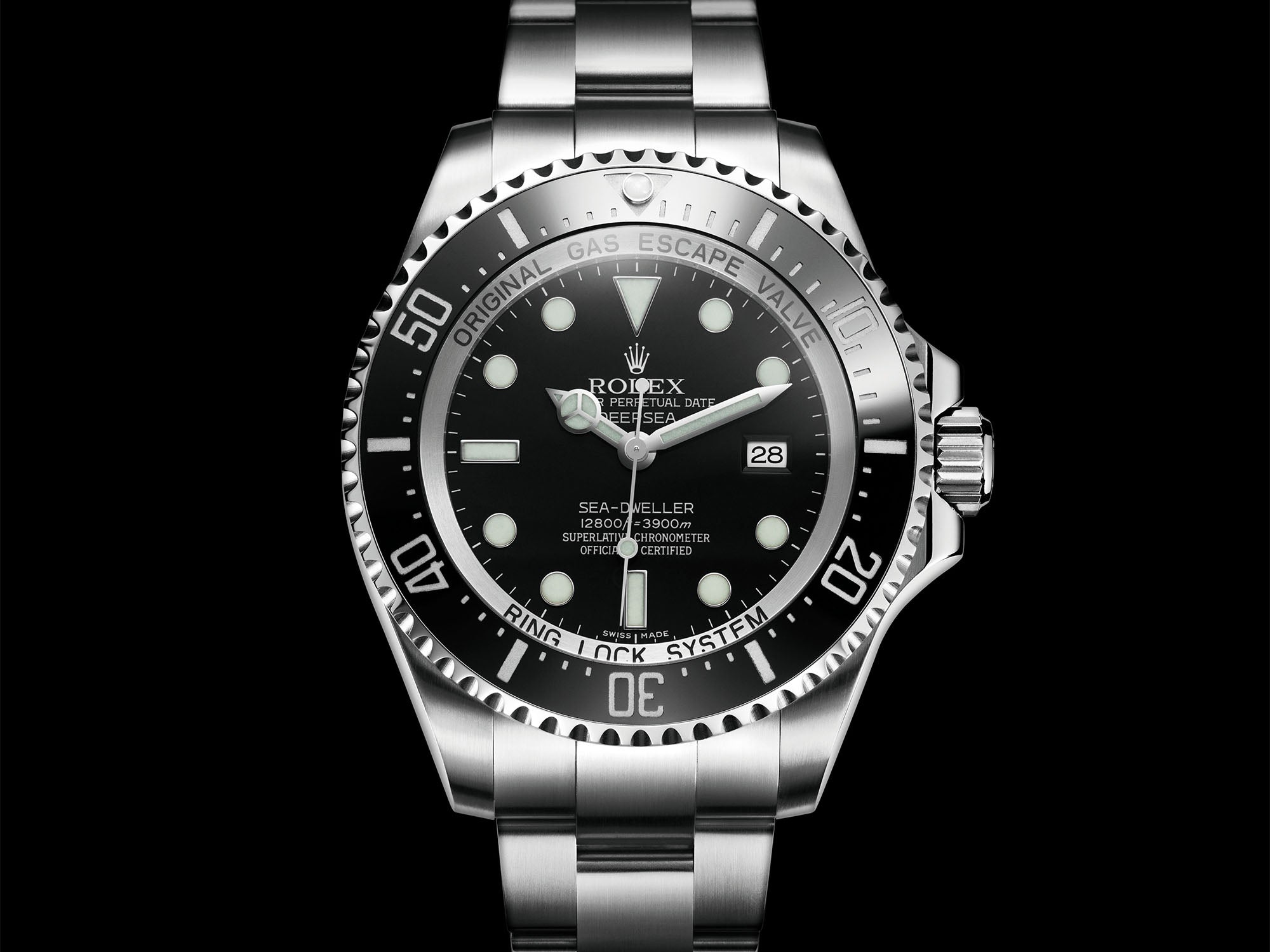
In 2008, Rolex tripled down on the remarkable water-resistance of the Sea-Dweller with the launch of the Sea-Dweller Deepsea in 2008, resurrecting the “Deepsea” moniker of its legendary expedition prototype from 1960. The watch's Oyster case was made of titanium, measured a hefty 44mm in diameter and boasted an unheard-of depth rating of 3,990 meters, or 12,800 feet.

Rolex achieved the model’s relatively modest thickness of 18mm, which included a 5mm-thick sapphire crystal, by incorporating some of the technological advances the brand had introduced into its production in the 21st century, especially the patented Ringlock case construction, which uses a hardened, nitrogen-alloy central compression ring to surround the movement while supporting the crystal and the caseback, and a rotating bezel made of Cerachrom, Rolex’s sturdy ceramic material that it had introduced a few years earlier, in 2005. Inside the historically waterproof case is Rolex’s in-house Perpetual Caliber 3135, a self-winding, chronometer-certified movement that was a mainstay at the time in all of Rolex’s diving watches.
2012: James Cameron, A New Record, and the Deepsea Challenge

More than five decades after the Bathyscaphe Trieste made its historic journey to Challenger Deep in 1960, Rolex played a role in another ocean-diving milestone in 2012. Movie director James Cameron, whose fascination with the undersea world was stoked during filming of his 1997 blockbuster Titanic, made the world’s first solo descent to the bottom of the Mariana Trench inside a one-man submersible called the Deepsea Challenger; affixed to the exterior were three specially developed Rolex Deepsea Challenge prototype watches — two on the vehicle’s hull, one on the end of the robotic arm that it used to gather underwater minerals and other samples for study. The watches all survived the expedition, 10,908 meters down to the ocean floor, unscathed, even though the robotic arm itself sustained damage.

Two years afterward, coinciding with Cameron’s documentary film about the milestone, National Geographic-sponsored mission, Rolex introduced the popular “D-Blue” version of the Deepsea (above) to the market, notable for its gradient blue-to-black dial and the line of bright sea-green text for the model name “DEEPSEA.” In 2023, Rolex upped the ante yet again with the newest version of the Deepsea Challenge, with a hulking 50mm Oyster case (more than 20mm thick) made of Rolex’s proprietary, light-but-robust RLX titanium alloy, which boosted the water resistance to a new-record 11,000 meters (35,800 feet).
2023: A New Frontier in RLX Titanium

Over the years, the Rolex Oyster case has been made of 904L steel (“Oystersteel” in Rolex parlance), various precious metals, and combinations of the two. Except for the Deepsea Challenge model noted above, which is far from an everyday sport-luxury timepiece for most, it has almost never been made in titanium, a metal that is having a moment in the watch world. That changed in 2023 with the release of the latest version of the Yacht-Master, a sport-luxury watch that Rolex first introduced in 1992 and had expanded into a substantial product family since. Used for the model’s 42mm Oyster case, which is distinguished by its bidirectional rotating countdown bezel, RLX titanium is a strong, corrosion-resistant and very lightweight alloy, with a technical satin finish lending it a sleek, subtly grainy texture. The watch’s case is milled from a single block of the material and is enhanced with shiny polished facets that help to frame and elegantly define its broader satin-finished surfaces. The black dial — Rolex calls it “intense black” — has its own grained texture, and the titanium bracelet is fitted with ceramic inserts and equipped with the brand’s Easylink extension system for maximum wearing comfort. Inside beats the reliable and increasingly ubiquitous Rolex Superlative Chronometer Caliber 3235. Are we seeing the next evolution of the Oyster case, or perhaps even early signs of a titanium renaissance for all the Crown’s Oyster Perpetual models? Only the next 100 years will tell.


Be the first to leave a comment
Log in or to leave a comment