




Short on Time
What are the best Tudor watches in the current lineup? It really depends on what type of watch ticks all the stylistic boxes for you — whether it’s a classic diver, a dual-time travel companion, or a racetrack-ready chronograph; a sturdy, outdoorsy timekeeper you can wear on a nature hike, or something elegant and uncomplicated that you can wear to the symphony. Using as our starting point some of the style categories in which Tudor's parent brand Rolex has excelled, here we attempt to home in on the best Tudor watches for each taste.
For The Casually Stylish Diver

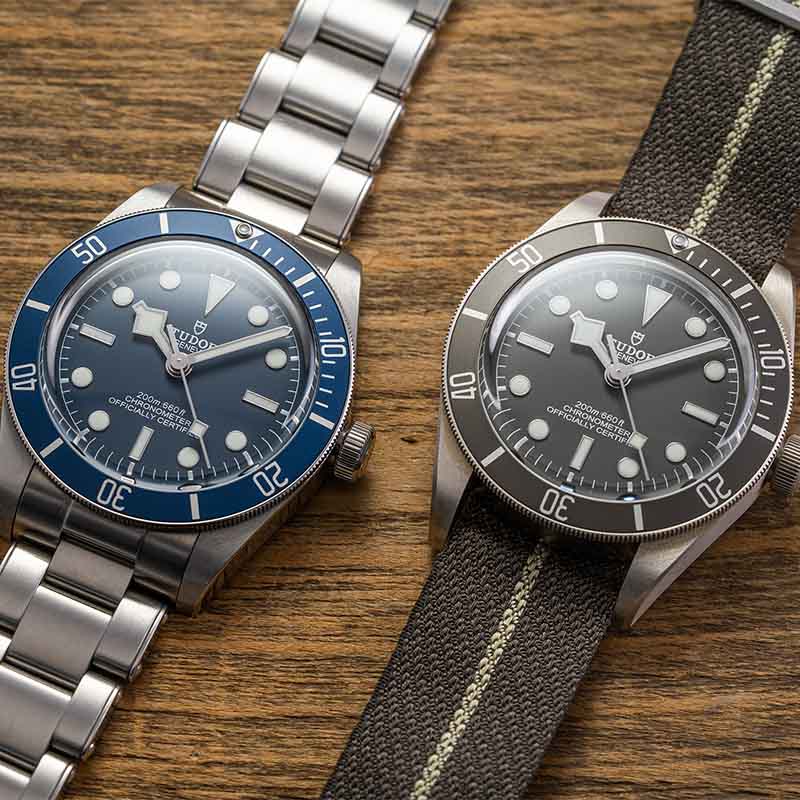
Tudor’s answer to big brother Rolex’s megapopular Submariner series is relatively easy to spot. The Black Bay collection is the undisputed flagship of the 21st-century Tudor lineup and has played a huge role in Tudor stepping out from under Rolex’s substantial shadow to establish an impressive identity all its own. Improbably, It did so by deftly combining elements from earlier Tudor dive watches, most of which were clearly inspired by the Rolex dive watches that preceded them to market. The so-called “snowflake” hour hand that is so emblematic now to the Black Bay family was drawn from the Tudor Submariner Ref. 7016 from 1969 that was famously supplied to the French Navy, whose divers found two distinctly different hands to be beneficial in reading the time underwater.)

The large screw-down crown, with engraved Tudor rose emblem, was introduced on the 1958 "Big Crown" model. The geometrical hour markers — round dots and rectangles, with a dominant inverted triangle at 12 o’clock — are derived from Tudor Submariners on the market in the ‘60s and ‘70s, as is the subtly domed shape of both the dial and the sapphire crystal. The core Black Bay models are 41mm in diameter, powered by the in-house automatic Caliber MT5602, and mostly in stainless steel, with notable outliers like the Black Bay Bronze, with a 43mm bronze case that will patina with age, and the Black Bay Ceramic, an all-black “stealth” model with a matte-black, micro-blasted, monobloc ceramic case, a black-PVD-steel bezel with engraved ceramic dive-scale insert and domed black dial.

For some, the original Black Bay’s 41mm case size is just a little too big. Fortunately, Tudor added a smaller alternative in 2018, in response to growing consumer demand both for more modest case sizes and for greater period authenticity in vintage-style timepieces. The Black Bay 58 not only hit the sweet spot for many contemporary enthusiasts but has also become a bonafide subfamily of the Black Bay, with its own complications and line extensions. Named for the year 1958, in which Tudor released the Oyster Prince Submariner Ref. 7924, the most clear forerunner to the Black Bay, the Black Bay 58 models match that watch’s 39mm case diameter and which has also, since its inception, been equipped with the in-house automatic Caliber MT5402, a movement developed specifically for the series’ smaller case dimensions.

The Black Bay 58 line is also where you’ll find several of Tudor’s rare forays into precious metals, like the Black Bay 58 925, with a case made of silver, and the Black Bay 58 18K, with a case made of (you guessed it) 18k yellow gold.

For The Serious Scuba Diver
The Pelagos has never garnered the enthusiast prestige (or the proliferating line extensions) of the more widely adored Black Bay, but for a diehard fanbase looking for modern deep-sea robustness as well as authentic military lineage, the Pelagos offers more than its share of appeal. At first glance, the Pelagos and Black Bay look strikingly similar to one another; not surprising, as both share the historical Oyster Prince Submariner DNA. The differences are in the details, both aesthetic and technical. Since its initial launch, the Pelagos case has been made of titanium rather than steel. The bezel’s dive-scale insert is made of ceramic, with luminous numerals and markers, rather than aluminum as in most Black Bay models. The Pelagos dial features the same “snowflake” hour and minute hands but uses all-rectangular indexes rather than its sibling’s assortment of circles and rectangles, at every hour marker.

From a diving standpoint, the Pelagos leans much more strongly into tool-watch territory, water-resistant to an impressive 500 meters, as compared to the standard 200 meters of the Black Bay. Accordingly, the Pelagos also includes a helium-release valve for saturation diving, a device Rolex developed back in the 1960s for the first Sea-Dweller and which remains a key element of that watch today. To oversimplify things, one could say that the Pelagos is the Sea-Dweller to the Black Bay’s Submariner.

Tudor has extended the Pelagos family rather modestly, with standout variants like the Pelagos LHD, a watch made for left-handed divers with the crown on the left side of the case; the military-styled Pelagos FXD, with a fixed-lug design that fits only single-pass NATO straps; and, more recently, the Pelagos Ultra, whose extreme water-resistance of 1,000 meters makes it probably the closest Tudor cousin to Rolex’s most robust diver, the Deepsea.
For The Racing Enthusiast

While it’s still technically part of the omnipresent Black Bay collection, the Black Bay Chrono, unveiled to great fanfare in 2017, established its own niche as modern-day Tudor’s first chronograph model — but its similarities with its closest Rolex equivalent, the enduringly popular Daytona, are few. To develop the movement for the watch, Tudor turned not to its parent brand Rolex but to an outside source, fellow Swiss sports-watch giant Breitling. The resulting Caliber MT5813, which uses Breitling’s self-winding B01 movement as a base, features an integrated chronograph powered by a column wheel, a 70-hour power reserve and a COSC chronometer certification.

The stationary bezel on the 41mm steel case has an anodized aluminum bezel insert, inscribed with a tachymeter scale rather than a dive-time scale, bringing this model more into the realm of motorsport than marine exploration (though the screw-down crown and chrono pushers help ensure the same 200-meter water resistance as the diving models). The dials feature contrasting subdial counters at 3 and 9 o’clock and a date window at 6 o’clock. The steel-and-yellow-gold S&G models host champagne-colored dials with black subdials. The complexity of the Black Bay Chrono’s two-register dial has also opened up the field for some creative two-tone colorways, in special editions like the Black Bay Chrono Pink (pink dial, black subdials), the Carbon 25 edition (“racing white” dial, black subdials, blue details), and the “Flamingo Blue” model designed in cooperation with Tudor ambassador and sports legend David Beckham (pastel turquoise dial, black subdials).
For The Frequent Traveler

After the launch of the Black Bay Chrono in 2017, Tudor’s legions of fans were undoubtedly wondering what the brand would do for an encore, complication-wise, in the Black Bay series. The answer came the following year, as Tudor pivoted back to an iconic Rolex model for inspiration. While the Black Bay GMT owes an obvious aesthetic debt to Rolex’s GMT-Master, it also fits firmly within the design language of the Black Bay, with its familiar dial framed not by a dive scale or tachymeter scale but by a bicolor 24-hour ring on which the wearer can read a second time zone thanks to the dial’s additional red GMT hand.

The famous bright red-and-blue “Pepsi” bezel of Rolex’s original GMT-Master is here slightly modified to a more muted indigo-and-burgundy combo. The Black Bay GMT line, powered by the COSC-certified automatic Caliber MT5662, has also added a two-tone S&G edition, with a brown-and-black “root beer” bezel insert, and a “Pepsi” iteration with a white opaline dial. The runaway success of the three-hand Black Bay 58 inevitably prompted a smaller iteration of its dual-time offshoot as well. The Black Bay 58 GMT features the same 39mm steel case size and houses the automatic Caliber MT5440-U inside. The in-house movement boasts both a COSC chronometer certification and a METAS Master Chronometer certification, with a power reserve of 65 hours, just shy of the 70 hours offered by the non-GMT-equipped base caliber.

For the cohort that craves a simpler, more understated travel watch, Tudor offers the Black Bay Pro, which differs from the more colorful GMT models in its use of a stationary, satin-finished steel bezel with engraved numerals for its 24-hour GMT scale. The movement is the same automatic MT5662 that beats inside the Black Bay GMT, but the case is a slightly more modest 39mm and the central hand that points to a second time zone is in yellow rather than red, offering an even greater contrast with the matte black dial (thought Tudor has since expanded the Pro series to include a handful of models with silvered white dials, with black-outlined markers).
For The Outdoorsy Type

Sometimes your ideal timepiece is a simple, rugged, reliable field watch — a style that goes back to the First World War and which to many is embodied most iconically by the Rolex Explorer, around since 1953. Tudor launched its own take on the style, the original Tudor Ranger, in 1967, and reintroduced it in a more contemporary yet still very military-influenced version, called the Heritage Ranger, in 2014. The case dimensions were expanded from the 34mm of the vintage model to 41mm but the matte black, dateless dial with big painted numerals at 3, 6, 9, and 12 were retained, as was the domed sapphire crystal that covers it. Tudor equipped the Heritage Ranger (whose most direct inspiration is the Ref. 7995, discontinued by 1969) with a self-winding movement sourced from ETA, the brand having not yet ramped up its own in-house movement production.

The Heritage Ranger was discontinued in 2020, and replaced with the simpler named Ranger in 2023, now in a smaller 39mm case and containing an in-house movement with a 70-hour power reserve. The Ranger family expanded in 2025, introducing (among other eye-catching versions) a model with a grained-texture “Dune White” dial that evokes desert landscapes. Also, like the Explorer has also done in recent years, Tudor is now offering the Ranger in a more vintage-appropriate 36mm size.
For The Dress Watch Fan

Tudor (and Rolex) founder Hans Wilsdorf introduced the watch that inspired the Tudor Royal way back in 1926. The Royal, which was first called by that name in 1950, is one of Tudor’s dressier watches while still fairly “sporty-chic” in its design, with its fluted stationary bezel and sunray-finish dial with Roman numeral hour markers. The largest iteration of the Tudor Royal, at 41mm, features a day-of-the-week display in an arched window at 12 o’clock and a small date aperture at 3 o’clock, a layout no doubt inspired by the original Day-Date “President” created by Tudor’s parent brand, Rolex. The movement is the ETA-based Caliber T603, with a modest but solid 38-hour power reserve.

While the Royal series will remind many Rolex aficionados of the Crown’s venerable Datejust and Day-Date models, the classically elegant 1926 collection, launched in 2018, may call to mind the even dressier, quieter look of the Perpetual 1908 or its predecessor, the Cellini, while offering an impressive value proposition. In many ways, the 1926 collection defines everyday versatility in a timekeeper, and it’s now available in more than 100 variations, encompassing four case sizes in various materials and a plethora of dial colors and textures.

The 1926 is not only a truly “unisex” model, suited for both gents and ladies, but also the single least expensive watch in Tudor’s catalog, coming in at or just under $2,000 in its most basic iterations. This is largely thanks to its use of outsourced Sellita automatic movements rather than the in-house calibers used in sportier collections like the Black Bay and Pelagos. The fine finishing on the case and bracelet add an extra layer of luxurious refinement that’s nonetheless suitable for daily wear. Recently, the 1926 collection welcomed its first moon-phase model, the 1926 Luna (above), which is an elegant, discreet complication that even Big Brother Rolex doesn't currently have in its lineup.


Be the first to leave a comment
Log in or to leave a comment