







































Short on Time
To serious sport-luxury watch enthusiasts, Omega Seamaster vs. Rolex Submariner is the undisputed main event of purchasing decisions. Both are trailblazers in their genre, with historical cachet galore, and both represent Holy Grails for many collectors entering a higher, more elite echelon of their hobby. In this feature, you'll learn just about everything you need to know about both of these dive watch icons — how they started, why they're famous, and how they stand apart from each other, and every other watch on the market, today.
[toc-section heading="Which Came First?"]

Which of these iconic dive watches was first to the market? Like most every other debate surrounding them, the answer is a little complicated, and depends mostly on what one considers the first “real” Seamaster. The first watch to bear that name debuted in 1948, the 100th anniversary of Omega’s founding, which was a full five years before the introduction of the Submariner. However, that model was not a “dive watch” as we know it in the modern sense; the category didn’t really exist yet.
It was instead marketed as a watch for “town, sea, and country,” a dress watch for gentlemen that was distinguished from its many competitors by its adoption of a new waterproofing system that Omega had developed during World War II. This pioneering technology, which Omega installed in the watches it produced for British military divers, centered around the use of a rubber O-ring gasket, of the type used in submarines, to seal the crown and case against leaks. This type of gasket proved to be more reliable than the shellac and lead versions that watchmakers had been using at the time, and it set the Seamaster on its path to — eventually — becoming a full-fledged divers’ watch.

That transition began In 1955, when diver Gordan McLean wore the Seamaster for a record-breaking 62.5-meter dive off the Australian coast. In 1956, another Seamaster took a polar-route journey across the North Atlantic strapped to the hull of a Douglas DC6. Just one year later, in 1957 — four years after the Submariner debuted — came the first generation of the more familiar “Professional” version of the Seamaster, which was indisputably a true modern divers’ watch.
The Seamaster 300, launched as part of a trio of legendary tool watches, along with the Railmaster and Speedmaster, boosted its dressy predecessor’s water resistance to 200 meters (though Omega was confident that the watch could handle pressures as deep as those at 300 meters, hence the name) and embraced the era’s growing masses of recreational divers. It has remained a pillar of Omega’s lineup ever since, and, as we shall see, has spawned a veritable sub-brand of its own.

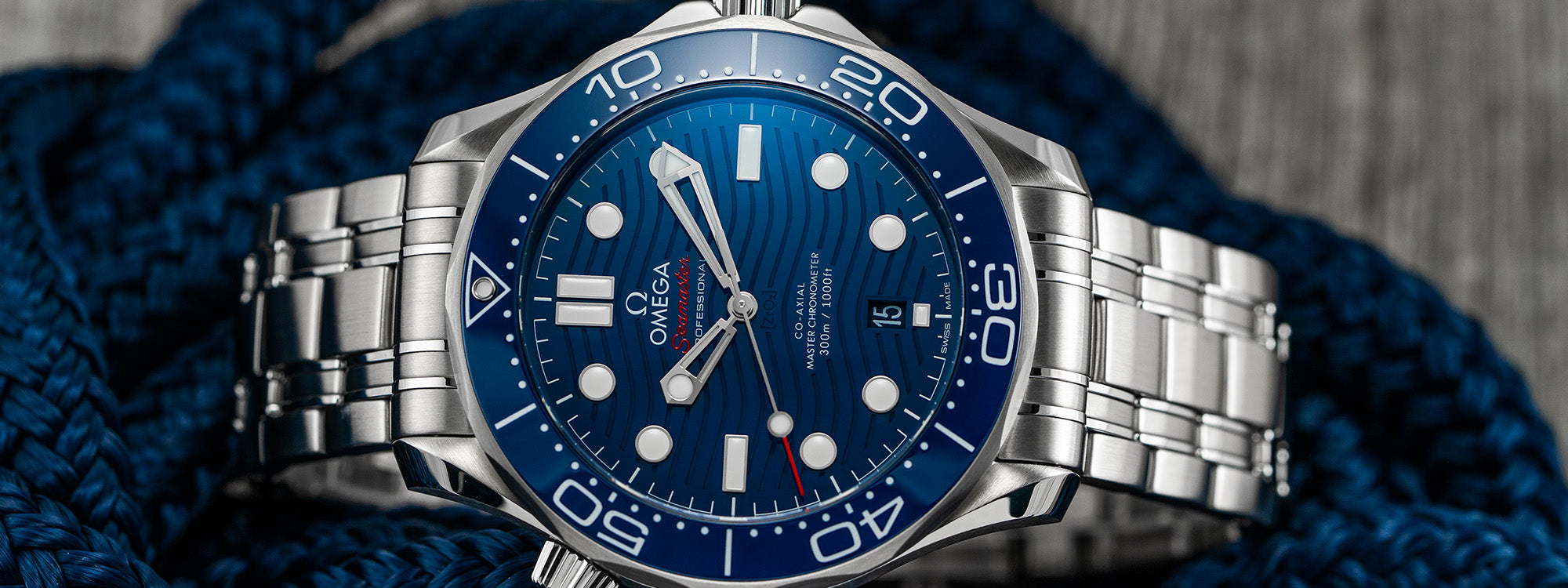
The 1990s saw the addition of the tool-oriented but stylish Seamaster Diver 300M (above), which incorporated a helium-release valve and an appealing wave-pattern dial, and the Seamaster has subsequently expanded into an even more diverse family since then, adding the dressier Aqua Terra line, the more boldly sized Planet Ocean, and even modern revivals of the 1948 and 1957 models, all with modern Omega in-house calibers.

While the first Rolex Submariner followed the first Omega Seamaster to market, it is Rolex that got the jump on Omega, and just about everyone else, by several decades In the industry-wide mission of making watches waterproof. Our modern era of water-resistant case design started in 1926 with the introduction of the Rolex Oyster case. Named after the bivalve mollusk that inspired its two-part, clamping “shell” design, it combined a threaded, hermetically sealed caseback and a crown that screwed securely into the side for a water resistance never before achieved in watches. The following year, in what would be the first of many celebrity-driven marketing initiatives over the years, Rolex partnered with British swimmer Mercedes Gleitze, who famously wore a Rolex Oyster watch on a necklace in her bid to become the first woman to swim the English Channel.

Oyster cases became standard on many Rolex watches in subsequent years, but in the early 1950s, with the popularity of recreational diving reaching a postwar fever pitch and the era of the purpose-built divers’ watch in its infancy, Rolex took its quest for underwater robustness to a new level. The first Rolex Submariner, Ref. 6204, was introduced in 1953 and on the market one year later — predating the Seamaster 300 but sharing the first-generation spotlight with other genre pioneers like the Blancpain Fifty Fathoms. The Submariner has proven to be perhaps the most iconic of all dive watches, its distinctive design emulated far and wide.
It has also given rise to descendants with even more underwater robustness, like the Sea-Dweller, first released in 1967 and equipped with a patented helium-release valve for saturation diving; and the Deepsea, boasting a case water-resistant to a bone-crushing 3,900 meters. Like all Rolex models, the Submariner has evolved over the years in mostly discreet ways (far less radically than the Seamaster, it’s fair to say) and holds its enviable place in the Rolex portfolio as one of the most popular and coveted models in the world.
[toc-section heading="Which Was The Real Watch of James Bond?"]

Comparing the Omega Seamaster and Rolex Submariner, it’s worth noting that part of their shared historical destiny is that both are known widely as James Bond watches. The Submariner claimed the distinction first. In 1962’s Dr. No, the first big-screen appearance of the suave superspy, Sean Connery famously wore a Submariner Ref. 6538 in the starring role of Agent 007 — a watch that has since become famous as the “James Bond Rolex.” Connery’s successor, George Lazenby, also wore a Submariner (along with a Daytona), in his single Bond movie, 1969’s On Her Majesty’s Secret Service. And Roger Moore wore one in several of his 1970s films before Seiko briefly took over the leading role on Bond’s wrist. Rolex’s final appearance as Bond’s go-to watch was in 1989’s Licence to Kill, the second of two Bond films starring Timothy Dalton.
Rolex partisans make a strong case that the Sub deserves the title of “real James Bond watch” due to the fact that none of these watches made it to the screen via product placement deals — and also because Bond’s creator, Ian Fleming, name-dropped Rolex (albeit not specifically the Submariner) in the original novels upon which the films were based.

Omega began its association with the Bond franchise back in 1995, and hence established itself as the only James Bond watch that younger generations of moviegoers have even known. According to Omega, the relationship arose organically, when Lindy Hemming, the Oscar-winning costume designer who came on board for Goldeneye, the first of four movies starring Pierce Brosnan as Bond, decided that an Omega Seamaster would be the ideal watch for the character based on his established history as a British naval officer. Brosnan wore a blue-dialed, quartz Seamaster Professional in Goldeneye and swapped it for an automatic version of that watch for his next three movies.
Daniel Craig continued the tradition of wearing Omega Seamaster watches through his series of films, starting in 2006 with Casino Royale and concluding in 2021 with No Time to Die. Craig became such a fan of the watches that he contributed input on the design of Omega’s most recent Seamaster Diver 300M “007 Edition.” Omega’s official partnership with the Bond films continues, and the longer it goes on, the more entrenched the Seamaster becomes as “the James Bond watch.”
[toc-section heading="Omega Seamaster vs. Rolex Submariner: Modern Comparison"]
Obviously, the Omega Seamaster and Rolex Submariner have a lot of commonalities as well as a significant number of differences. Which one is for you? Here’s a head-to-head comparison of two of the core models — the current Rolex Submariner Date Ref. 126610LV “Starbucks” edition and the Omega Seamaster Diver 300M with steel case and blue dial (basically, the modern version of Pierce Brosnan’s Bond watch).
Case and Bezel:

SUBMARINER:
The first Submariner’s case was relatively modest by contemporary dive-watch standards, at 37mm in diameter. Over the years, both the case’s dimensions and its waterproofness have increased. The current versions of both the (dateless) Submariner and the more common Submariner Date underwent a soft revamp in 2020, with the case diameters bumped upward from 40mm to 41mm, with a thickness of 12.5mm. The main part of the case is forged from 904L stainless steel, a very durable, highly corrosion-resistant alloy that Rolex calls Oystersteel.
The unidirectional ratcheting bezel, which has been a hallmark of the Submariner since 1969 (not from the beginning, as many probably believe) has a knurled edge and includes an insert made of exceptionally scratch-proof Cerachrom (a proprietary ceramic) for the 60-minute dive scale. As of the 2020 revamp, the sapphire crystal sports an antireflective coating on the underside for increased legibility. The crystal also features the now-familiar “Cyclops” magnifying lens over the dial’s date window at 3 o’clock, one of several key elements in the service of maximum legibility. The fluted, screw-down crown uses Rolex’s Triplock triple protection system to ensure the case’s 300-meter depth rating, which the Sub has boasted since 1987.

SEAMASTER:
The Seamaster Diver’s core models use a more standard alloy of stainless steel (316L, common throughout much of the watch industry and still very sturdy and corrosion-resistant) for their case, which measures 42mm in diameter, 13.56mm thick, and 49.9mm lug to lug, a bit larger than the Submariner’s, even after the latter’s recent expansion. The case’s unidirectional bezel has a scalloped edge for easy gripping and a ceramic insert with a white enamel scale to set dive times. Like the Submariner, the Seamaster Diver 300M resists water pressure to 300 meters, a depth rating assisted by the screw-down crown with a relief Omega emblem on its surface.
The Omega model, however, offers an additional element not present on the Submariner: a built-in helium release valve at 10 o’clock on the case middle, which allows the wearer to release built-up helium atoms from the watch in a pressurized environment such as a diving bell during a saturation dive. Rolex was, in fact, the pioneer for this deep-diving feature but has made it a signature of its Sea-Dweller model rather than of the Submariner.
Dial and Hands:

SUBMARINER:
The Submariner dial is virtually unchanged from its earliest iterations in the 1950s. Rolex is big on not fixing what clearly isn’t broken but instead focuses on making small upgrades that keep its watches current in terms of technology. The dial, in its traditional black coloration, is in the “maxi dial” style that Rolex ushered in with the “Kermit” 50th anniversary edition in 2003, with enlarged geometric hour indexes and broader hands. The handset is the classic combo of “Mercedes” hour hand paired with sword-shaped minute hand, along with a thin, lollipop seconds hand. The hands, hour markers, and the large orientation dot at the top of the bezel’s Cerachrom dive scale are all treated with Chromalight, Rolex’s proprietary luminous substance, notable for the bright blue glow it emits in dark conditions (or, as per the watch’s original intended audience, deep underwater).

SEAMASTER:
The Seamaster Diver 300M dial still bears several elements from the famous 1993 reboot that much of the public was introduced to on the big screen a few years later, in Goldeneye. These distinctive touches, reinstituted in a 2018 revamp, include the wave-pattern texture, now executed with laser engraving, and the very idiosyncratic, skeletonized sword hands, wider at their tips than at their base and coated on those tips with green-glowing Super-LumiNova for those dark nights and deep dives. The applied, shaped hour indexes, also luminous-coated, are not that dissimilar to those of the Rolex watch, predominantly composed of thick circles and rectangles.
The major differences here are a double rectangle (rather than an inverted triangle) at 12 o’clock and the placement of the date, displayed more unobtrusively, in a small window at 6 o’clock — and, probably needless to say, not magnified by a domed lens in the crystal. The central seconds hand is a lollipop with a red tip echoing the splash of red on the dial courtesy of the cursive “Seamaster” text below the Omega logo at 12 o’clock. The dial, like the bezel insert, is now made of ceramic.
Movement:

SUBMARINER:
Both the Submariner and Seamaster can claim high-end, in-house engines in their most current versions. The Rolex Caliber 3235 inside the Submariner is the latest and arguably greatest in a long line of movements installed inside the world-famous sport-luxury diver, which began with the automatic A260 in the original 1953 model. The successor to the Caliber 3135 that debuted in 1999, Caliber 3235 (as well as Caliber 3130 in the no-date Submariners) boasts the very latest in Rolex movement technology and patented features.
These include the energy-efficient Chronergy escapement, made of magnetic-resistant nickel phosphorus, a blue Parachrom hairspring, a 70-hour power reserve, and all the other attributes that enable the movement to meet the strict criteria of Rolex’s own “Superlative Chronometer” certification, which ensure an accuracy of +/- 2 seconds per day — double the precision promised by the standard chronometer certification awarded by COSC. Rolex, as per its longstanding, trend-resistant position, does not put this elite-level movement in plain sight, however. It’s hidden by the solid, Oystersteel caseback that screws down securely and can only be removed by a special tool exclusive to Rolex watch repairers.

SEAMASTER:
Omega, by contrast, is not shy about showing off the movement inside the current Seamaster models, impressively placing a sapphire window in the scalloped-edge, wave-patterned caseback without compromising the 300-meter water resistance. Omega’s co-axial Master Chronometer Caliber 8800, a mainstay of the Seamaster 300 and other models across Omega’s collection, features automatic winding, a 25,200-vph frequency, a 55-hour power reserve, and the host of technical specs that make it a Master Chronometer, as per the Swiss Institute of Metrology, or METAS: among them are the industry-leading 15,000 Gauss magnetic resistance that is at least partially owed to the use of a silicon balance spring. All its mechanical talking points aside, Caliber 8800 is just as noteworthy for its high-horology decorations, including Geneva waves in Arabesque on the bridges, an aesthetic hallmark of Omega movements.
Bracelet:

SUBMARINER:
The Rolex Submariner finds a home on the Crown’s iconic Oyster bracelet, the template from which many other three-link bracelet styles have been drawn. Its name comes from its association with the Oyster case, for which the original version of this bracelet served as an extension. Rolex patented the design in 1947 and fitted one on a watch in 1948. Oyster bracelets are recognizable for their wide center links bordered by thinner end-links, which in the earliest versions were riveted. These were phased out in favor of a “folding” style in 1967, which eventually gave way to the modern, solid-link style in 1975 that still endures today. Oyster bracelets come equipped with the accompanying Oysterlock clasp, a triple-deployant metal clasp with a safety-lock mechanism, and Rolex’s Glidelock extension, which enables easy adjustments of the bracelet in increments of 2mm.

SEAMASTER:
Compared to the Oyster, which is ubiquitous throughout Rolex’s Professional collections, the Seamaster’s bracelet is probably more distinctive to this particular watch, as Omega rarely uses it outside the Seamaster family (which of course includes Aqua Terra and Planet Ocean models). Its supple, five-link design creates an eye-catching visual texture, with its polished center links contrasting elegantly with the brushed larger links. The bracelet culminates in a clasp with a push-button deployment system and a hidden divers’ extension with internal mi cro-fit notches. Also worth mentioning for those still weighing the pros and cons of both these iconic watches is that Seamasters are also available on several bracelet and strap options, including rubber, steel mesh “Milanese” and nylon NATO — the latter two being particularly associated with the popular, titanium-cased “007 edition” that boasts design input from Daniel Craig.
[toc-section heading="Final Thoughts and Pricing"]
Of course, for some, the final arbiter of a hypothetical binary choice between the Omega Seamaster and Rolex Submariner will come down to pricing — and to some extent, availability. The “Starbuck” Rolex Submariner Date model featured here, in Oystersteel with a Cerachrom bezel, is listed at an MSRP of $11,200. The no-date Submariner in the same material, with a black rather than green Cerachrom bezel, is the family’s putative entry-level model, at an MSRP of $9,500. Two-tone and precious models, of which there are very few on the market currently, go for more, up to around $45,000. And as many Rolex enthusiasts are well aware, attaining one of these models new at retail could entail languishing on a waitlist for a while.
The Omega Seamaster Diver 300M shown here, in steel on a five-link bracelet, will run you a slightly more affordable $7,100. On a rubber strap, that price drops to $6,700, and adding precious metal to the mix pushes the fee up: this watch with Sedna gold in the bezel and bracelet, for example, is listed at $14,300. On the plus side for Omega, which makes lots of Seamasters and is constantly expanding the family, you are much more likely to get one while avoiding a waitlist — or at least, it might be a shorter one.
You can learn more about the Omega Seamaster at omegawatches.com and more about the Rolex Submariner at rolex.com
Shop this Article
You May Also Like



Get your watch from TeddyBaldassarre.com and get 0% interest for up to 24 months available on select brands. Checkout with Affirm and spread your payments over 3 to 36 months. Learn More


0 Comments