







































Short on Time
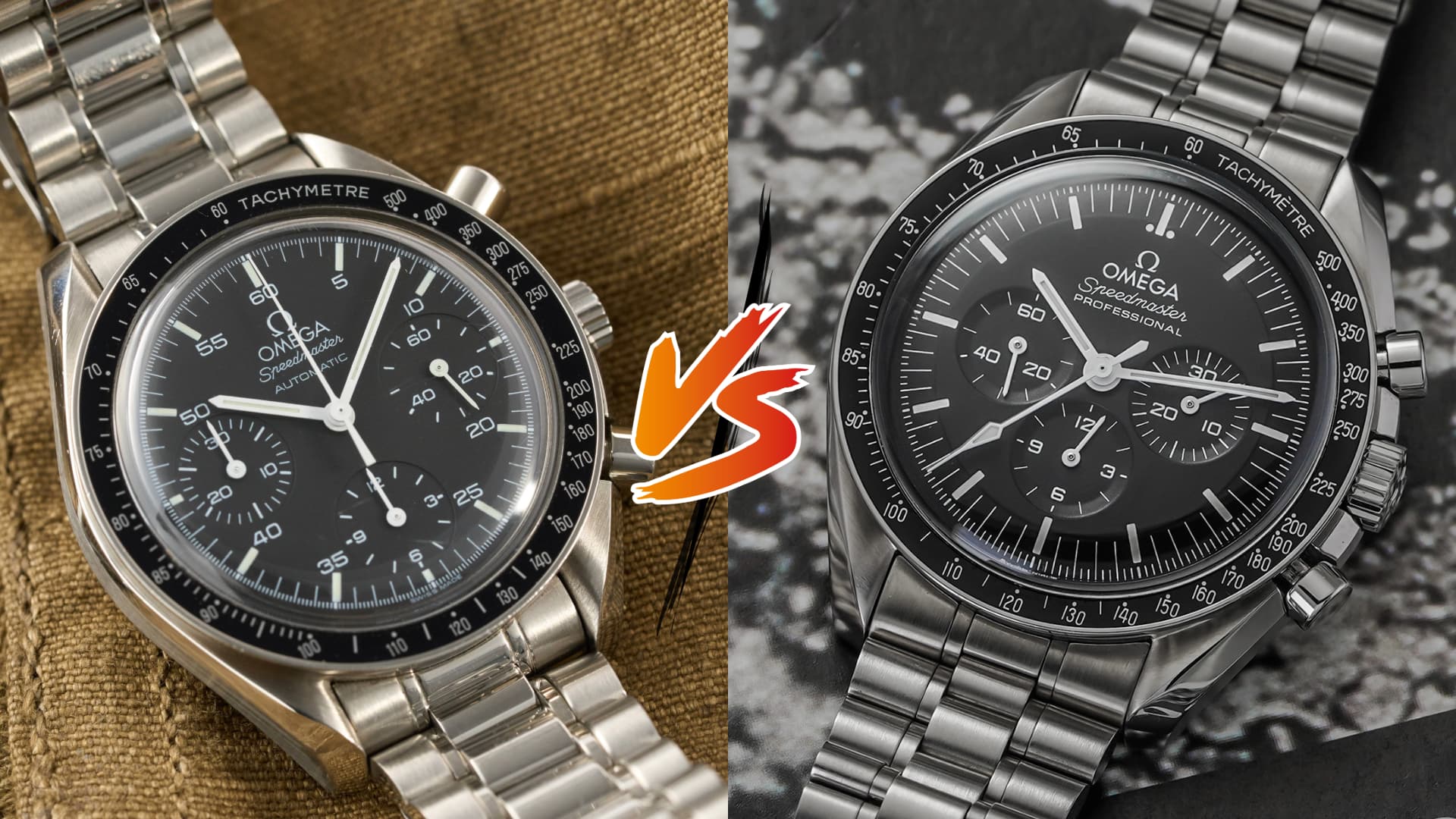
The Omega Speedmaster is among the heavyweight champions of the watch world. For so many out there, it's the entryway into the enthusiast community, a jumping-off point before taking the plunge into watches as a hobby, and the Speedmaster continues to be one of the most recognizable names in the industry. Today, we’re going to get a little more granular on the subject and put two iterations of the icon, which have been the subject of much debate, head-to-head: the Speedmaster Reduced and the classic Speedmaster Moonwatch Professional. Down below, I’ll set up the scene with a little history lesson, and then break down the key similarities and differences between the two to keep in mind.
[toc-section heading="History and Context"]

As one of the legends of watchmaking, the story of the Speedmaster is one often told and retold, so I will keep things quick and to the point here. If you want to go more in-depth on its backstory, feel free to break away from this article and head to our complete guide to the Speedmaster here. A symbol of the Space Race era, the Omega Speedmaster is most well-known for its role on the Apollo 11 mission in 1969, which officially made it the first watch to ever be worn on the Moon. It’s the watch that’s been aboard all six of the moon landing missions, thus earning the “Moonwatch” title once and for all.

Taking off from its original motorsport-oriented intent to be the chosen watch of space exploration, the key DNA of the Speedmaster Professional has been largely unfussed with since it was codified more than 50 years ago. This staunch commitment to maintaining the identity of the Speedmaster is directly tied to its lasting success. In 1988, Omega experimented with shifting up the formula of its already iconic Speedmaster, aiming to deliver a product that might appeal to a slightly different consumer base. Taking many of the key design codes from the Moonwatch, the Speedmaster Reduced shook things up in ways that have been the subject of contention ever since.

The most obvious change for the Speedy Reduced was a matter of size. I mean, it's right there in the name. Measuring 39mm, the Speedy Reduced shaved off a significant amount of wrist real estate. This smaller-scale Speedy was also reduced in terms of its price point, originally retailing for around $1,800, which was several thousand dollars less than its tried and true Moonwatch counterpart. This was, in large part, due to the use of a less mechanically sophisticated automatic movement within (more on that later). While these shifts are compelling (unless you are a Speedmaster purist), the Speedmaster Reduced was not compelling enough to make it last indefinitely. The Reduced Speedy was produced from its launch until 2009, when Omega sent its smaller-scaled take on its Moonwatch into the archive, where its remained ever since. But the brand hasn’t thrown in the towel completely on downsized takes on the Speedmaster. In its current catalog, we have the 38mm size to work with, which has largely been used as a vehicle for the brand to appeal to a more female-leaning audience. Though there are a few 38mm models that lean more into the classic utilitarian design that’s the Speedmaster’s signature, many of the models experiment with more playful and chic color palettes, often outfitting the watches with diamond embellishments.
[toc-section heading="Case"]

As you are already well aware, dear reader, the big point of difference (or, some would argue, contention) is by and large a story of size. The classic, quintessential, iconic Speedmaster asymmetrical case format is always going to be 42mm, since it was codified with the reference ST 105.012, which was the watch that actually made it to the Moon. In its contemporary specs, the Speedmaster Moonwatch Professional is offered with both the more true-to-heritage Hesalite glass and the more contemporary “sapphire sandwich” expressions. For the Hesalite, Omega always pairs these models with a closed caseback, with the seahorse medallion motif at its center, surrounded by engravings that speak to the collection’s space-faring legacy. The Hesalite glass itself also features the Omega logo at the dial’s center, which I find to be a fun touch. The sapphire sandwich, on the other hand, features a sapphire crystal (duh) exhibition caseback, displaying the movement within. Both iterations of the Speedy Pro have 20mm lug widths and measure 47.5mm lug-to-lug, though the hesalite has a case profile just a hair thicker at 13.54mm vs. the 13.18mm profile of the sapphire models.

Moving on to the Speedmaster Reduced, we are, obviously, working with a more compact case. As I’ve mentioned before, the case diameter of this one is 39mm, with a case profile of 12mm, a svelte 45mm lug-to-lug, and 18mm lug width. All of these dimensional ingredients add up to a watch that is much more reasonable for those with smaller wrist sizes. One detail that many hone in on in their arguments against the Speedy Reduced is the lug situation. They are not aligned perfectly level with the crown, which is a source of aggravation for some people who find that visually awkward. But this slightly off-kilter detail does aid in some comfort, preventing the pushers from eating into its wearer’s wrist flesh.

There is some trade-off in the water resistance with this take on the Speedy, rated at 30 meters vs. the 50 meters of the Speedmaster Professional. In either case, this is not a dive watch, nor is it intended to be, so the relatively puny levels of water resistance aren’t that big of a deal, in my opinion. The caseback is closed and free from any nods to NASA, as the Speedmaster Reduced is separate from that legacy, and was never subjected to the rigorous testing or environments that the tried-and-true Moonwatch knocked out with ease. There is the seahorse medallion motif at the center of the caseback, though.
[toc-section heading="Dial"]

To the untrained eye, the differences dial-side between the Speedmaster Professional and the Speedmaster Reduced are relatively minuscule. But for those who know the game, details are make-or-break. The most stark contrast is a matter of visual harmony. To achieve the scaled-down sizing and to account for the different movement within, the signature tricompax chronograph layout on the Speedmaster Reduced is more wideset than the Professional, and the subcounters are a bit smushed into the minutes track at the dial’s perimeter. When you’re accustomed to the sleek harmony and proportionality of the Moonwatch Professional’s layout, this change can feel jarring.

Another aesthetic oddity of the Speedmaster Reduced is the use of numeral gradations at five-minute increments under the hour markers. This is kind of just a quirk of its own and isn’t rooted in the layout of the Speedmaster Professional at all. While we’re on the subject of quirkiness, the tachymeter scale on the Speedmaster Reduced forgoes the accent mark on the word’s first “e.” Not sure exactly what’s going on there, but it is one of those oddball details that stands out.

Effectively, whereas the Speedmaster Moonwatch Professional stays aligned with the iconic design and feels sleek, harmonious, and utilitarian, the Speedmaster Reduced has a bit more clunkiness about it, channeling much of the spirit and ingredients of its Professional family member, but with a more offbeat execution.
[toc-section heading="Movement"]

Onto the inner workings, the long and short of it is that the Speedmaster Reduced does not have the mechanical sophistication and tried-and-tested prowess as the Speedmaster Professional. I don’t look at this as a shortcoming, but a necessary compromise of what the watch was trying to accomplish, which was to deliver a Speedmaster product at a lower price and with smaller measurements. Specifically, we’re working with the Caliber 3220 automatic, which is a modified rendition of the ETA 2890-2 with a Dubois-Depraz chronograph module thrown into the mix. Less technically impressive, yes, but you also get the convenience of an automatic movement, and it ultimately serves the grab-and-go intent of the watch.

The Speedmaster Moonwatch Professional, on the other hand, has all the horological bells and whistles within. Always relying on a manual-wind movement, the current generation of the staple collection utilizes the Omega Co-Axial Master Chronometer Caliber 3861, which has a 3Hz frequency and a 48-hour power reserve.
[toc-section heading="Final Thoughts"]

Maybe it's because I’m a Zillenial, but I rarely find myself in the watch-design-purist camp. I think it also has a lot to do with me being a woman in watches, who often finds the staple sizing of many watch icons to be, frankly, unrealistic for my wrist size, and has to be content to admire a lot of these legendary designs from a more removed, less experiential vantage point.

All that is to say that I have a soft spot for the Speedy Reduced and find a lot of charm in all its quirkiness. Rather than looking at it as a replacement or competitor with the Speedmaster Professional, I tend to view it more as its own quirky piece of the collection’s past. By all means, if you’re a Speedmaster purist, I’m not here to change your mind. I still think it is the ultimate gateway drug into the world of serious watch enthusiasm. The Moonwatch Professional is always going to be an icon; there’s no changing that. Ultimately, I refuse to pick a side of the aisle in this case, as, like most debates in watches, it all boils down to a matter of personal preference.
Shop this Article

Get your watch from TeddyBaldassarre.com and get 0% interest for up to 24 months available on select brands. Checkout with Affirm and spread your payments over 3 to 36 months. Learn More


0 Comments