







































Short on Time
Blancpain is the world’s most historic luxury watchmaker, with nearly 300 years of uninterrupted production. It’s also largely credited with establishing the blueprint of all modern diving watches with its Fifty Fathoms. The formula for the undeniably iconic collection has been largely unfussed with since it forever changed the watch world in 1953. But in recent years, we’ve seen the brand more willing to evolve with the times and expand its staple diver to be more wearable, and more appealing, so a broader scope of watch wearers. The most significant evidence of this change has been the introduction of the most scaled-down take on the line at 38.2mm last year, answering the call for more versatile sizing that many enthusiasts (especially those, like me, with smaller wrists) had been rallying for for years. Down below, I’m going to walk you through why this is such a big deal for this icon of watch history, the key details of the scaled-down Fifty-Fathoms, and some food for thought to keep in mind before trying it on yourself.
[toc-section heading="History and Context"]
Given that we have a complete guide to the Fifty Fathoms collection on our site already, I’m going to keep this section as quick and to the point as I can. I’m also going to hone in on the Automatique sub-collection, as it's the most relevant to our purposes here, and has the most verisimilitude to the original diving archetype in its design language.

Though many brands were experimenting with waterproofness in watches throughout the early 20th century, the Fifty Fathoms really codified the quintessential details of what makes a true, tactical, functional dive watch when it hit the scene over 70 years ago. Deriving its name from its 50 fathoms (or 91.44 meters) depth rating, the original Fifty Fathoms introduced the world to nearly all of the innovations we associate with the dive watch category. This watch was nothing short of revolutionary for the time, with its anti-magnetic case, double-screwed crown, clicking, unidirectional bezel with gradations for timing dives, and self-winding movement, all while maintaining accuracy even at the maximum recommended depth for scuba divers of the era. The sparse dial was optimized for underwater use, setting large and luminous numerals and markers at the hours against a sleek black dial for easy reading in lowlight conditions. But the novelty of the Fifty Fathoms didn’t stop at its impressive suite of innovations. That antimagnetic, highly waterproof case was also massive by the standards of the time, at 42mm. For context, watches, even for men, mostly hovered within the 32mm-35mm range.

In the subsequent years, Blancpain did not show much interest in shaking up the core sizing format (excluding the Bathyscaphe sub-collection), as the success of the Fifty Fathoms proved itself to be long-lasting. The brand’s first experiment in shaking up the scale of its staple diver wouldn’t come until the flagship collection was revamped in 2007, and the hero 45mm Fifty Fathoms was launched and packed with the new (at the time) Caliber 1315 automatic movement. Around the time of the collection’s 70th anniversary, the brand circled back to the 42mm sizing as a nod to the original 1953 model, with updated specs, first, in the form of limited editions, then, entering the staple collection.
In an interesting move, Blancpain first debuted the 38mm sizing in a duo that was heavily geared towards a female consumer. It wasn’t just the smaller scale that read as overtly feminine, but the entire design language: mother-of-pearl dials, which many have dubbed “flashy,” and one model dripping in pink (gasp!). After years of waiting for a more everyday-carry-oriented take on the line, many enthusiasts were up in arms over this perceived slight. But the people didn’t have to wait long to get what they wanted. A mere five days after the first duo launched, the brand dropped the rest of the 38mm lineup, offering two additional dial colors and multiple material options (which I will get into shortly), and thus making the Fifty Fathoms collection feel more versatile and complete than ever.
[toc-section heading="Case and Wear"]

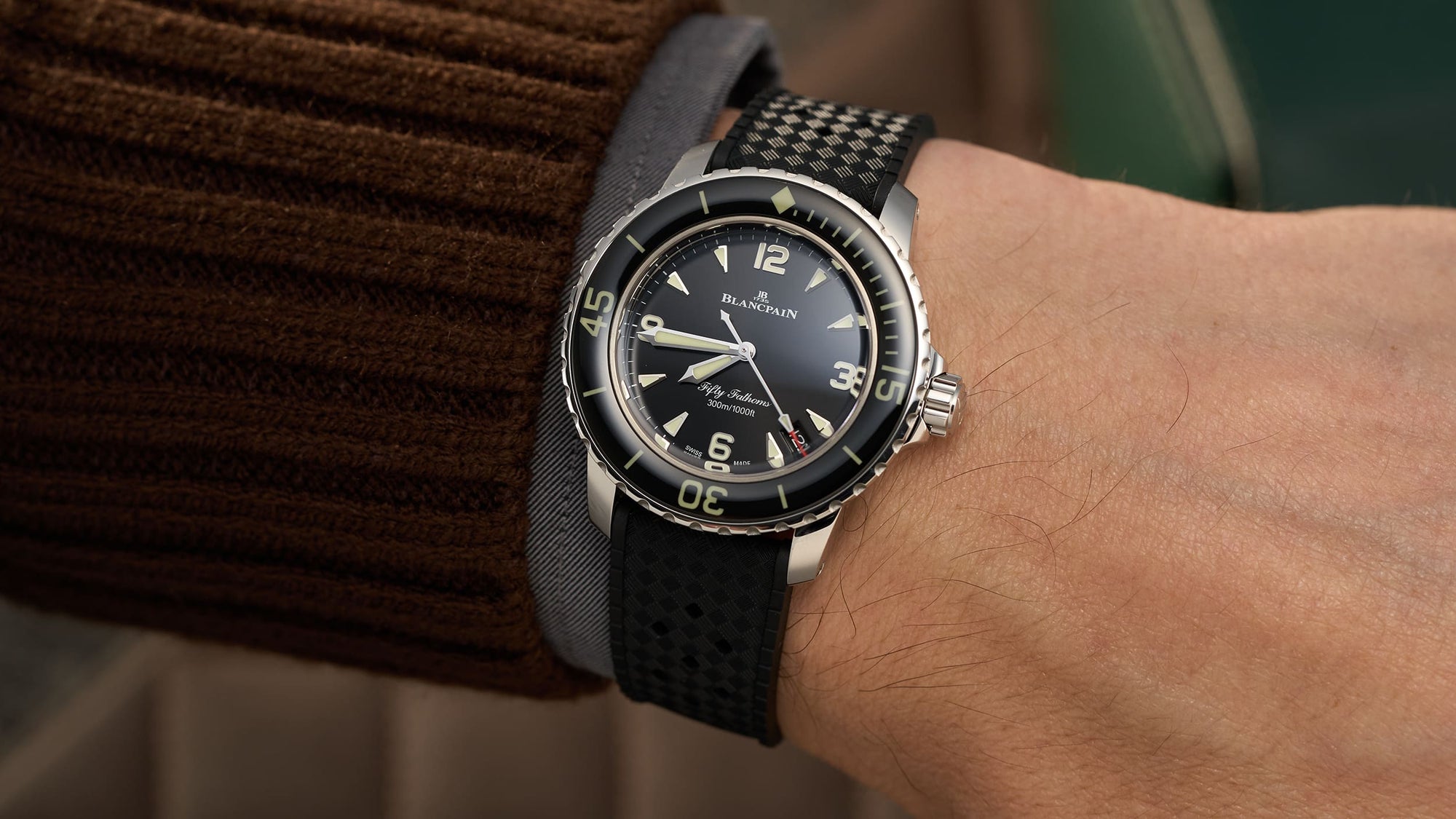
Though I’ve been using 38mm as a shorthand for the sizing we’re here to discuss today, each of the technical measurements of the models at hand is as follows: 38.2mm in diameter, 43.5mm lug-to-lug, with a case profile of 12mm. Now that we’re crystal clear on the facts, I will note that this combo strikes as a winning combination in terms of wearability, putting it in the sweet spot for most wrist sizes, while not feeling overpowering or obtrusive even on smaller wrists. As this corner of the Fifty Fathoms Automatique collection stands, there are currently five distinct models (including the Mother of Pearl dial editions), with your choice between steel, rose gold, and titanium builds.

We’re still in the early stages of this model size, and there are some quirks when it comes to the bracelet and strap options. At the time of writing, the matching three-link bracelet is limited only to the steel model. For the titanium and rose gold models, you do have some strap choices to choose from, but there is no coordinating bracelet available yet. The dial color is also directly connected to which material you go with, but I’ll leave those intricacies for the next section.
[toc-section heading="Dial"]

The dial layout is consistent across all five 38mm models, and will feel pleasantly familiar if you have any previous knowledge of the larger Fifty Fathoms Automatique collection. The design language is a direct callback to the Fifty Fathoms of 1953, though the hour numerals and markers do have a sharpness to them that makes them feel a touch more contemporary. Each model (though colors vary) features a sapphire crystal insert in the diving bezel, which is intended to nod to the sheen and glossy finish of the bakelite inserts used in the mid-20th century.

One thoroughly contemporary anomaly, and what I would argue is the most controversial detail of the Fifty Fathoms Automatique’s modern identity, is the slanted date window positioned at 4:30. This is somewhat of a make-it-or-break-it detail for many people. The good news is that, if you prefer the mother-of-pearl dial options, you don’t have to worry about this conundrum. As I alluded to in the earlier section, the color of the sunray dial options is directly tied to the case material. Currently, the steel model is paired with a black dial with a sunray finish, while the red-gold and titanium models have deep blue dials.
[toc-section heading="Movement"]

Given the dramatic reduction in size as compared to the 42mm models, the 38mm Fifty Fathoms had to switch to an equally downsized movement. For the genderless models, we’re working with the 28-jeweled Caliber 1150 automatic, which has a 3-Hz frequency, 210 components, a silicon balance spring, and a whopping 100-hour power reserve. For the mother-of-pearl dial duo, the date-free automatic Caliber 1153 lies within, which has nearly identical specifications to the 1150, but with 186 components.
[toc-section heading="Final Thoughts"]

The Fifty Fathoms is among the most influential and significant watch designs of all time, and now, the collection feels more dynamic and well-rounded with the introduction of the smaller case design that enthusiasts have been rallying for for years now. The Fifty Fathoms Automatique collection now has a little something for everyone who wants a piece of dive watch history. But Blancpain has, smartly, left enough room to expand and grow the 38mm collection in the coming years, whether it be more dial colorways, expanded bracelet options, or more material experiments moving forward.
Shop this Article
You May Also Like


Get your watch from TeddyBaldassarre.com and get 0% interest for up to 24 months available on select brands. Checkout with Affirm and spread your payments over 3 to 36 months. Learn More


0 Comments