







































Short on Time
The Omega Seamaster Planet Ocean has represented a sweet spot in the now-sprawling Seamaster collection, a rarely achieved intersection between extra-rugged build and unapologetically luxurious design. The latest revamp of the two-decade-old series, which launched in late 2025, doubles down on both while also striving for new levels of comfort and wearability. Here’s a closer look, starting at the beginning.
[toc-section heading="Origins of the Seamaster Collection"]

Omega began making watches in 1848 (originally as La Genérale Watch Co.) and for its milestone 100th anniversary, a few years after the end of World War II, the brand founded by watchmaker Louis Brandt launched the first watch by the name of Seamaster. Not really a “dive watch” as we’d define that term today, it was marketed as a watch for “town, sea, and country” — i.e., a gentleman’s dress watch that just happened to be more waterproof than any other such timepiece of that era. (Omega had been dabbling in making wristwatches water resistant for more than a decade at that point, having released the Marine, below, an early divers’ watch with a sealed, rectangular double-case design, as early as 1932.) What distinguished the Seamaster from its contemporaries was its adoption of an innovative, O-ring-gasket device that sealed the crown into the case to prevent moisture from entering.

Omega had developed that design for the tool watches it made for the British armed forces during wartime, and it provided the template for the first “professional” version of the Seamaster that followed in 1957. The Seamaster 300, which debuted alongside the first Speedmaster and the cult-classic Railmaster in that seminal year for Omega, is considered the true origin point for the modern Seamaster series, as it was indisputably built for diving, with a tested water resistance of 200 meters. (The “300” in its model name was a reflection of Omega’s confidence that the watch could actually withstand pressures down to 300 meters, but there were no measuring instruments at the time that could confirm the claim.) Many versions of the Seamaster followed in the ensuing decades, including the now-legendary PloProf in the 1970s, which achieved an even more robust 600 meters of water resistance; modern versions are rated as high as 1,200 meters.

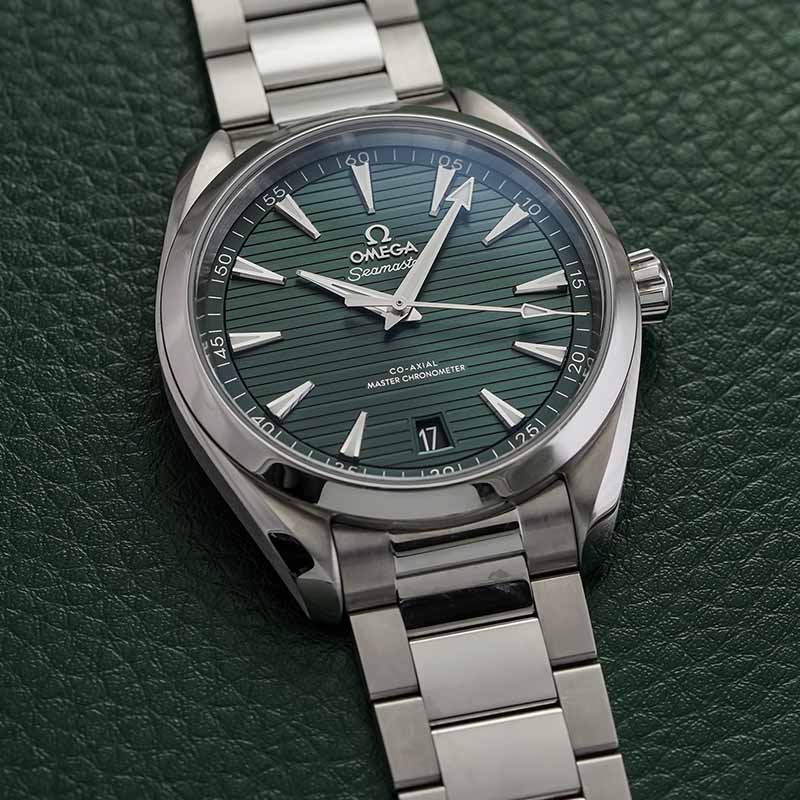
Beginning in the 1990s, the Seamaster began its growth into a wide-ranging tentpole collection for Omega. (Not coincidentally, this was also the period that the model became the official movie watch of James Bond.) In 1995 came the rugged, tool-oriented but stylish Seamaster Diver 300M (above), which incorporated a helium-release valve, a wave-pattern dial, and an “official” tested 300-meter water resistance. The Seamaster Diver, in its various incarnations, is arguably the core Seamaster model today. On its heels, in 2002, came the Aqua Terra series, whose understated, teakwood-patterned dial and lack of dive-watch accoutrements like a rotating bezel called to mind the dressier appeal of the 1948 Seamaster. In 2005, Omega steered the collection in the opposite direction of tool-watch toughness and utility with the first Planet Ocean.
[toc-section heading="Planet Ocean Generation 1 (2005)"]

The Seamaster Planet Ocean, in contrast to the more genteel Aqua Terra, was positioned from the start as a modern dive watch that embraced both sporty utility and luxury. Drawing some of its influences from 1960s Seamaster models of the 1960s, the Planet Ocean was distinguished from the Diver 300 models in several respects: the coin-edged, unidirectional bezel with an aluminum (later also ceramic) insert; the matte black dial with Arabic numerals at 12, 6, and 9; and a set of arrowhead hour and minute hands. From a robustness standpoint, it was an upgrade, featuring not only a helium-release valve at 10 o’clock but also doubling up the Seamaster Diver’s water resistance rating to a substantial 600 meters. The first models contained Omega’s co-axial Caliber 2500, which beat behind a solid caseback adorned with a relief-engraved seahorse, a longtime emblem of Omega’s seaworthy watches. Like the Aqua Terra, the Planet Ocean family would expand into additional complications like chronograph and GMT functions, and a few would find their way into Bond movies, including 2006’s Casino Royale and 2008’s Quantum of Solace. In 2009, the first of several technical innovations from Omega and its parent conglomerate, the Swatch Group, would make its way to the Planet Ocean: a substance called Liquidmetal, an amorphous alloy that bonded with ceramic to create a durable, scratch-resistant surface, was used for the first time for the bezel’s scale.
[toc-section heading="Planet Ocean Generation 2 (2011)"]

The second generation of the Planet Ocean arrived two years after the introduction of Liquidmetal, in 2011. These watches had slightly thicker cases and glossy dials in addition to their use of ceramic bezels with Liquidmetal scales. The movement in this series was Omega’s co-axial Caliber 8500, an in-house engine that was the first in the line to also include a silicon balance spring for increased magnetic resistance. In the Generation 2 models, this movement was on display behind a sapphire exhibition caseback rather than hidden behind a solid metal one. This generation included a GMT model (above) that hosted another impressive material innovation in 2014: the first dive-scale bezel insert made of orange ceramic, a notoriously difficult-to-achieve substance that replaced the orange aluminum inserts of previous models. As orange had been a signature color of the Planet Ocean collection since its inception, this feat was a significant one.
[toc-section heading="Planet Ocean Generation 3 (2016)"]

Omega returned to its most sturdy and technically bold dive-watch series in 2016, finally ushering its modern Master Chronomater caliber series Into the Planet Ocean. This third generation also introduced not only bezel inserts but dials made of ceramic. The series retained the sapphire casebacks, helium-escape valves, and water resistance of their predecessors but introduced new case sizes, both of which were slightly slimmed down (39.5mm diameter at 14.5mm thick, 43.5mm at 16.5mm thick). For the first time, the ceramic diving bezels used colored rubber detailing on the scale. And the groundbreaking Planet Ocean Deep Black models (also released in 2016) took the ceramic innovation to the next level as the first all-ceramic dive watches to achieve the 600-meter water resistance that had become the collection’s hallmark.
[toc-section heading="Planet Ocean Ultra-Deep (2019-2022)"]

In 2019, Omega made history (and scored a win in its longtime battle with rival Rolex for dive-watch record supremacy) when a prototype watch called the Seamaster Planet Ocean Ultra Deep Professional descended more than 10,928 meters (or 35,853 feet) into the Marianas Trench on an undersea expedition headed by ocean explorer Victor Vescovo. That feat bested the previous record of 35,787 feet, set in 2012 by the Rolex Deepsea model that accompanied director James Cameron in his Challenger Deep expedition, and thus established Omega (for a time) as the maker of the world’s most water-resistant watch. The prototype, made of titanium and measuring a hulking 55 mm in diameter and 28 mm thick, was not really made to be worn as a wristwatch, but in 2022, Omega introduced a more wearable version called the Planet Ocean Ultra Deep. The cases, one version in grade 5 titanium like the prototype, six others in a new alloy called O-megasteel, were downsized to 45.5 mm in diameter and 18.2 mm thick — still large, but more wrist-friendly than their predecessor — and offered a still-robust water-resistance of 6,000 meters. Each watch is tested to 7,500 meters — not as punishing a level of pressure as the more than 10,000 meters the prototype endured, but certainly at the upper echelon of underwater toughness for a watch. That watch’s no-date dial design, and several other technical upgrades, are among the elements that informed the fourth and most recent generation of the Planet Ocean, which brings us to our subject at hand.
[toc-section heading="Reviewing Omega Seamaster Planet Ocean Generation 4"]
Case and Bezel:

As part of the “back to basics” ethos of this most recent Planet Ocean evolution, the stainless steel case of the fourth-generation models returns to its original dimensions — 42mm, the size introduced in 2005. The case profile is also thinner, at 13.79mm, thanks in part to a flat sapphire crystal replacing the domed ones of the previous models as well as additional refinements to the case and bezel. The standard size of the third-generation pieces, by contrast, was 43.5mm in diameter and just over 16mm thick. As part of Omega’s new “fitted approach” to the Planet Ocean, which the brand says was inspired by Seamaster models of the 1980s and ‘90s, the case has more sharp and angular surfaces with a meticulous array of brushed and polished finishing. The dive-scale bezel insert is still in zirconium oxide ceramic (orange, blue, or black) with white enamel markings.

The Planet Ocean case has also changed structurally from those of its predecessors, now featuring a simpler two-part design rather than the three-part architecture of previous generations. The structure now includes an inner ring made of titanium — an innovation derived from the original Ultra Deep model that helps ensure the material strength required to seal the watch when it is being used at extreme underwater depths. Perhaps the addition of this practical element (a version of which was also a component of the original Planet Ocean in 2005) is what moved Omega to finally dispense with the helium-escape valve, which had been a hallmark of this Seamaster subfamily since its inception but which has always been a bit controversial among enthusiasts. The absence of this device certainly assists in the new Planet Ocean’s more streamlined, symmetrical look and it doesn’t detract at all from the case’s water resistance, which remains at an impressive 600 meters, double that of the Seamaster Diver.

While fans are likely to be enthusiastic about the slimmed-down dimensions, the integrated-bracelet architecture (more on which below), and the eschewing of the bulky helium-escape device, they may be more divided on the other major change in the case design: a solid, screw-down, wave-edged caseback — made not of steel but of Grade 5 titanium — which replaces the steel back with sapphire exhibition window that has long been an element of the Planet Ocean. On the one hand, the presence of this new closed caseback, which features the Seamaster collection’s historical and iconic Seahorse emblem, prevents a view of the movement, but on the other, it adds both lightness and strength to the watch, and for a dive-watch purist it clearly evokes the tool-watch origins of the Seamaster 300 models from which the Planet Ocean emerged. It’s also, let’s not forget, another callback to the first Planet Ocean from 2005.
Dial and Hands:

Omega has, at least initially, opted for simplicity and stylistic consistency in the dials for the new Planet Ocean collection. While the ceramic bezel inserts vary from sober, monochrome black to marine-inspired blue to the collection's bright, signature orange, all three versions of the dial are matte black. This is another stylistic departure from the previous generation, whose talking points included dials made of ZrO2 ceramic with a polished finish. It’s not immediately clear what the new dials are made of, but it’s likely not ceramic; Omega has only mentioned the material in association with the bezel rings, and the dials don’t feature the discrete telltale “ZrO2” inscription as did their predecessors.

The Planet Ocean’s wide, arrowhead hands and bold, applied indices remain, while the typography of the Arabic numerals at 12, 3, 6, and 9 o’clock has been reworked. The numerals are now openworked, in a nod to the original Planet Ocean dials, and also more angular and squared for better visual harmony with the revamped case and bracelet. The Omega logo is in rhodium plating beneath 12 o’clock, while white transfer lettering appears directly beneath it and also above 6 o’clock. The presence of the 3 o’clock hour numeral also means that a date display is another visual element that Omega has chosen to forego on these new models, a decision probably welcomed by those same dive-watch diehards that applaud the closed caseback. The hands, indexes, and numerals are all filled with Super-LumiNova that glows blue-green in the dark.

Master Chronomater Caliber:
Beating behind the engraved caseback is Omega’s Master Chronometer Caliber 8912, which is essentially the no-date version of the base Caliber 8900, famously launched in 2015, which is itself an evolution of the Co-Axial Caliber 8500 from 2007. The evolution of Omega’s movements has parallelled that of the Planet Ocean. Caliber 8500, the first Omega movement with both a co-axial escapement and a silicon balance spring, was used inside the Generation 2 model from 2011, while Caliber 8900, the first Master Chronometer caliber, found a home inside the Generation 3 models of 2016. The movement inside these new models is the one that animated the Planet Ocean Ultra Deep models from a few years ago.

From a technical standpoint, the movement is as up-to-date as one can find in an Omega, incorporating the brand’s high-efficiency co-axial escapement (which you can learn more about here) and boasting a Master Chronometer certification as per the stringent standards of METAS, the Swiss Institute of Metrology. The latter is an accolade that Omega is almost exclusive throughout the watch industry in attaining (only Tudor has joined it thus far), and among its criteria are antimagnetic resistance to 15,000 gauss. The movement amasses a power reserve of 60 hours and features an array of high-horology decorations. Among these embellishments (which are, of course, only visible when the caseback is removed) are blackened screws and balance wheel, a Geneva wave pattern in Arabesque on the bridges, and rhodium plating on the rotor.
Bracelet and Strap:

Along with the new case shape comes a new, stainless steel bracelet designed in the integrated style that is still enjoying immense popularity in the enthusiast community. The bracelet links are flatter than in previous models, and arranged with two satin-brushed rows on the outside surrounding a center row with a gleaming polished finish. The whole ensemble is slimmer for increased wrist comfort and equipped with Omega’s diver’s extension, which renders the fit adjustable to six distinct positions. In addition to the bracelets, each of the six references are available on an integrated rubber strap that matches the color of the watch’s bezel and fastens to the wrist with a double-folding clasp with a relief Omega emblem on the surface.

Conclusions and Pricing:
Omega launched the new Seamaster Planet Ocean collection toward the end of 2025, and reactions have been generally positive in the enthusiast community, although some longtime fans of the model have lamented the removal of the helium-escape valve, which had long been a signature of the subfamily. Whether intended or not (and who outside of Omega’s closed-door meetings could really say), this newest iteration of the Planet Ocean has been embraced by many as perhaps the brand’s strongest competitor yet to its arch-rival Rolex’s iconic Submariner — more in its league visually and technically than the Seamaster Diver 300M, which, of course, still features a helium-escape-valve case design despite its lower water resistance.

The black-bezel and blue-bezel models cost $8,600 on the rubber strap and $9,200 on the steel bracelet, while the orange-bezel models are priced slightly higher (a bit of a surcharge for the difficult-to-achieve orange ceramic), at $8,900 on the strap and $9,500 on the bracelet. And if you are, after reading this long treatise, among that cohort that is considering the Planet Ocean as a Submariner alternative, that pricing is right in the ballpark of the no-date version of that watch — though the latter may require some time on a waiting list before you can strap it on your wrist. Discover more about all the Seamaster collections on www.omegawatches.com.
Shop this Article
You May Also Like


Get your watch from TeddyBaldassarre.com and get 0% interest for up to 24 months available on select brands. Checkout with Affirm and spread your payments over 3 to 36 months. Learn More


0 Comments