








































Short on Time
In recent memory, few contemporary watch collections have garnered as much lasting praise in the value-for-money category as Hamilton’s Khaki Field. It is heralded as the gold standard for modern field watches, packing a punch from its aesthetics to its craftsmanship and rich historical legacy. While the larger Khaki Field universe has expanded to include a whopping 74 current models, we are gathered here today to discuss one sub-collection in particular: the Hamilton Khaki Field Automatic. What are the key ingredients of this watch’s lasting success? How did this collection become the widely accepted gateway drug into the genre of mechanical field watches in the 21st century? What key details should I consider before deciding I cannot go forward in my watch-collecting life without this one? Down below, I’ll do my darnedest to answer all these pressing questions as concisely and illuminatingly as I can.
Historical Context

Hamilton’s connection and relevance to field watch history is hard to rival. Founded in Lancaster, Pennsylvania, in 1892, its history is also a uniquely American one, grounded in an era in which the USA was at the forefront of horological innovation and production. But the story of the Khaki Field really begins, as all field watches do, in World War I. Before the start of the global conflict, wristwatches were almost exclusively thought of as women’s jewelry pieces, with strapping, well-to-do men, old and young, still favoring pocket watches.
The trench warfare of WWI proved the necessity of some timekeeping innovation. It’s not exactly convenient or safe to check the time, or worse, coordinate time across a group of soldiers, while fumbling around to take your watch out of your pocket. Thus, watchmakers, like Hamilton, began supplying pocket watches that had been revamped and reengineered to be smaller and fastened to a wrist strap, to meet the new demands of the time. With its utility and practicality firmly proven, the wristwatch captured the public imagination, cementing its rise as the most practical and desirable way to keep time long after the war ended.
 Another key detail in our saga is that Hamilton firmly established a relationship with the U.S. Army during its time producing those wrist-bound trench watches. Now we’re going to make a bit of a jump in our historical timeline to 1942. With WWII underway, Hamilton made the daring decision to halt all production on its civilian timepieces, shifting its focus to mass production of watches and other devices exclusively for the war effort. The sheer number of watches Hamilton delivered to the U.S. military over the next three years was nothing short of astounding, totaling well over a million timepieces. The 1950s and 1960s were when the design codes of field watches (and the blueprint of contemporary ones that we see today) were firmly established.
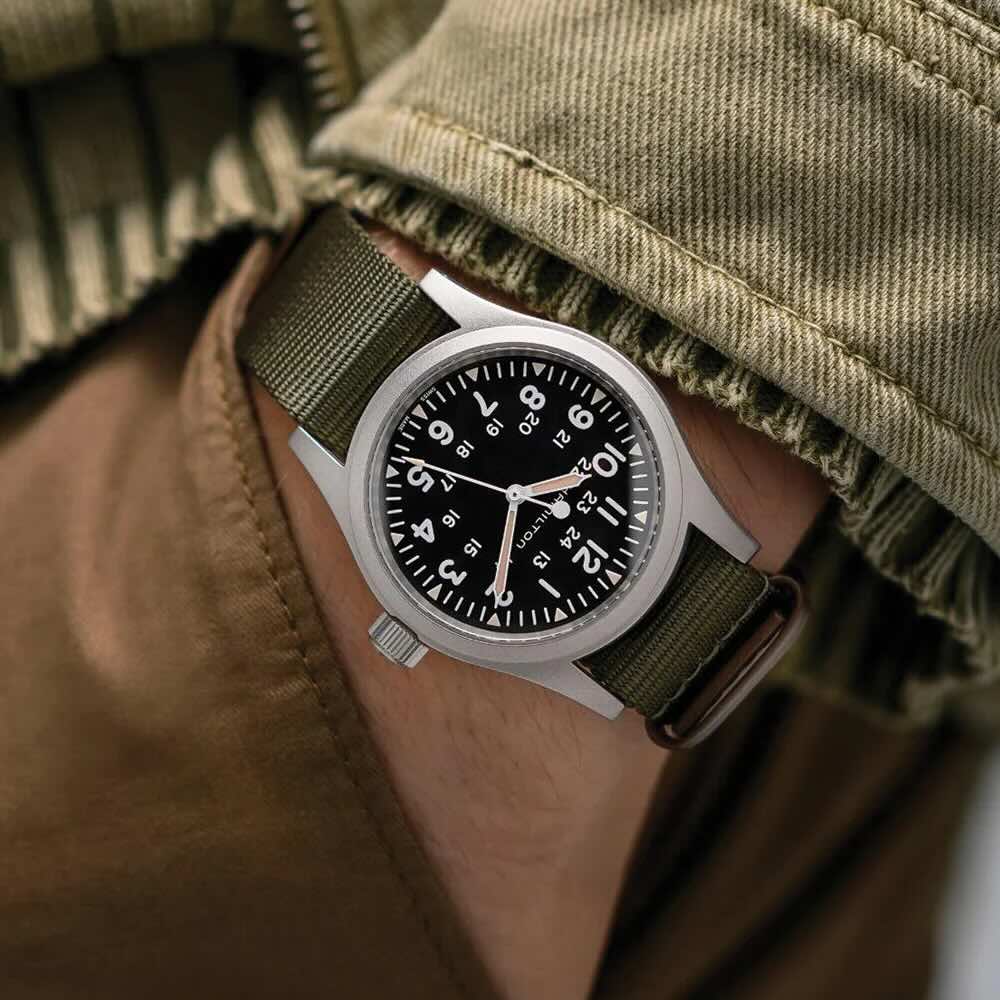
With the Vietnam War underway, the U.S. Department of Defense codified the criteria that watches needed to meet under the first MILSPEC regulations, first in 1962 with MIL-W-3818, then with MIL-W-43674 in 1964. Hamilton was one such watchmaker who produced watches that fit the bill. It was in this era that the essential ingredients of the field watch were established, largely being the oversized Arabic numerals for numbers one through twelve, with a smaller set of numerals to denote the military time, along with triangular markers at each hour.

In 1974, Hamilton would be pulled from its American roots (though it had already moved its production to Switzerland in 1969) with its acquisition by the all-powerful Swiss watchmaking conglomerate Swatch Group, where it remains today. Under the Swatch Group, Hamilton would begin offering its former military-oriented designs to civilians, thus christening the entire collection under the Khaki name. Throughout the 1980s and '90s, these watches were a darling of outdoor-oriented retailers, like L.L. Bean, and many watches with co-branded dials were made and issued at retailers throughout this era. The Khaki Field Automatic, as we know it today, has been a staple among the brand’s catalog since 2009, but has undergone some upgrades and revisions in the subsequent years, including an expansion of dial colorways and material construction options.
Reviewing the Khaki Field Auto
Hamilton Khaki Field Automatic Case And Wear

While the Khaki Field Auto is a faithful reinterpretation of its mid-century predecessors, there are some distinct differences that make it more aligned with the wants and needs of watch wearers in this century, with the most obvious being its current size. Those field watches that were actually worn, well, in the field, are significantly smaller, some would even say tiny, compared to what has become the largely accepted Goldilocks sizing standard of 36mm-40mm of today, usually measuring 33mm in diameter. Currently, the Khaki Field Automatic is available in two distinct sizes: 38mm and 41mm. If you showed either one of those options to someone in the mid-20th century, they would probably call both of them jumbo in comparison.

Another clear act of modernization across the Khaki Field Auto line is the shift to an exposition-style caseback. Across the board, vintage field watches almost universally opted for closed casebacks for security reasons. But, if I may be so bold as to assume you’re a civilian like me, we have a little more room for visual experimentation in this department. And, if you’re buying a mechanical watch in an era where you can easily determine the time on your phone or computer, I will also be so bold as to assume appreciating the caliber within the watch in action is fun for you (as it is for me). Across both sizes, the collection has a number of leather and NATO strap options to choose from, as well as a three-link bracelet with a folding clasp. The NATO strap is the more historically accurate choice, but the bracelet pairing does make the overall impression feel a touch more elevated and contemporary. As far as materials go in the case and bracelet department, the Khaki Field Auto now offers the classic steel, along with the more modern titanium takes, in both the 38mm and 42mm sizes.
Hamilton Khaki Field Automatic Dial

Many of the key, vintage field watch elements are alive and well dial side across the Khaki Field Auto collection, which is a major contributor to the line's continuous success. The main ingredient is, of course, the large Arabic numerals for hours 1-12, paired with the smaller military scale underneath. But Hamilton has taken some stylistic liberties that feel markedly more contemporary.

The most obvious, to my eye, is the date window at 3 o’clock across the date models, which Hamilton seems to be moving more and more towards as of late. The brand has also experimented with dial finishing to visually separate the standard hours, military hours, and the minutes track at the dial’s perimeter, each featuring subtly distinct textures. The large, triangular markers that would’ve typically been above the hours have also been done away with, though there are some small pips above the minutes track. The slim seconds hand now often features a red arrow tip, though there are slight variations across different models. Moving beyond the austere black dial that was a typical hallmark of vintage field watches, the current Khaki Field Auto collection now offers more playful dial color options to have your picking from, including the relatively newly released blue and green sunray options, which are among the most handsome in the bunch, in my opinion.
The Movement

As the “Auto” moniker should have already tipped you off to, we’re working entirely with automatic movements across this sub-collection within the larger Khaki Field universe. To get specific, both the 38mm and 40mm models utilize the H-10 automatic movement, which has the Swiss-made ETA C07.611 movement as a base. Other key things to note about this movement are that it runs on 25 jewels, has a 3 Hz frequency (21,600 vph), and has a fairly extensive power reserve of 80 hours.
Final Thoughts and Pricing

Though I feel like I’m beating a dead horse a bit, it really is hard to beat the Khaki Field Automatic as an entry point into the world of mechanical field watches with Swiss-made chops. Even if we just look at its price point, which is just under the $800 mark when paired with a strap, it's one of the most attainable Swiss-made watches, period, end of story. But in addition to being reasonably priced, it also delivers on the historical front, staying true to its legacy while offering impressive finishing techniques, as well as more fun-forward and playful options for those who want a piece of the robust Khaki history with a little more personality. The entire Khaki collection has set the brand’s own bar quite high, and I still find the Khaki Field Auto in particular to be among the most compelling, value-packed, and flat-out best-looking options within it. You can learn more at hamiltonwatch.com.



0 Comments
Log in or to leave a comment