








































Short on Time
One of the first hurdles to clear for newcomers to watch appreciation is the clarification of two very common horological categories: chronograph vs. chronometer. Quite simply, a chronometer (from the Greek chronos, meaning time, and meter, meaning measure) is any watch or clock that keeps reliably accurate time, usually as determined by an outside independent testing agency, whereas a chronograph (from chronos and graph, i.e., to “write time”) is any watch or clock with the ability to track and record intervals of time, aka a stopwatch. This is, again, the simplest way to look at it. But there’s a bit more to both chronometers and chronographs that a knowledge-hungry watch enthusiast might want to digest — including the fact that the terms are not interchangeable but also not mutually exclusive.

[toc-section heading="Chronometers Defined"]
Our original, classical definition of a chronometer can be traced back to the golden age of seafaring exploration in the 18th Century, when ships required the use of a highly accurate onboard clock that enabled their navigators to determine longitude in order to avoid the perils of running aground or veering hopelessly off course. The man credited with developing the first of these “marine chronometers” was legendary British watchmaker John Harrison; his invention facilitated the celestial navigation used at the time by navigators at sea to determine their ship’s position in coordination with a sextant.
Marine chronometers, which were essentially highly accurate clocks mounted on gimbals inside wooden boxes, were among the first portable timepieces and were instrumental in the global seagoing trade that helped build our modern, interconnected world. Ulysse Nardin, founded by its eponym in 1846 in Le Locle, Switzerland, was one of the most prolific and prestigious makers of marine chronometers (as above), supplying them to navies throughout the world, including those of the United States and Great Britain. Today it is one of several watch manufacturers that make wristwatches that adopt the historical look of a marine chronometer.

[toc-section heading="What Makes a Watch a Chronometer?"]
The term “chronometer” took on a slightly broader meaning as personal, portable timekeeping, as represented by pocket watches and later by wristwatches, became mainstream. Watchmakers focused on the task of optimizing their timepieces’ precision and submitted their proudest accomplishments in the field to “chronometer competitions” — tests conducted at facilities like Switzerland’s Neuchâtel Observatory (above) and London’s Kew Observatory — throughout the late 19th to mid-20th Century.
Zenith, with 2,330 chronometry prizes for accuracy, holds the record for the most historical accolades at these Observatory Trials, which were gradually phased out as the quartz watch became ascendant in the 1970s; they were essentially replaced by the formation of the non-profit agency COSC, whose testing criteria remains the standard for watches seeking the “official” chronometer designation today. COSC evaluates uncased movements, rather than complete watches, over a period of 15 days in several different positions under controlled temperatures. To obtain a COSC chronometer certification, the tested movement needs to achieve a precision of -4/+6 seconds per day. As a general rule, if your watch has “chronometer” on the dial or in its name, and it is Swiss Made, it has met these COSC qualifications.

Over the years, however, several other organizations and individual watchmaking companies have established their own testing regimens and precision standards for "chronometer" designation that exceed COSC’s. Among these are Germany’s DIN 8319 standards, which is similar to COSC’s but involves testing the movement while it is inside the watch; Rolex’s “Superlative Chronometer” certification, which requires an even more stringent daily rate variation of only -2/+2 seconds; and Omega’s “Master Chronometer” criteria, also recently adopted by Tudor, which is conducted by the Swiss Institute of Metrology (METAS) and is notable for subjecting the tested movement to magnetic fields of 15,000 gauss.
[toc-section heading="Chronographs Defined"]

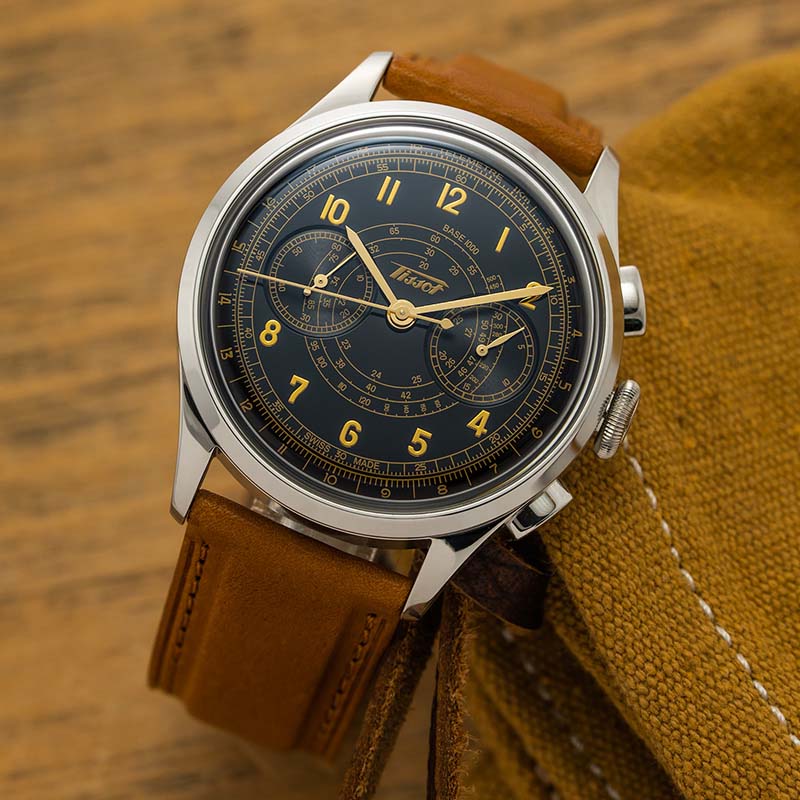
Returning to chronograph watches, they can generally be recognized as watches that not only show the current time but also can measure elapsed times and display the latter on the dial. Most modern chronographs use a center-mounted hand to count the elapsed seconds; subdials or “totalizers,” to tally the elapsed minutes and/or hours; and pushers or buttons on the side of the case to start, stop, and reset the chronograph hands.
Originally, chronographs were equipped with a single pusher (“monopusher” or “monopoussoir” in French), often positioned directly in the center of the crown, to operate all the stopwatch functions, and some chronograph watches are still designed in this vintage style. Breitling invented the more common two-button chronograph design in 1923, in which one pusher starts the chronograph and stops it while the other pusher resets it to zero. Most chronograph dials are either bicompax (with two subdials) or tricompax (three subdials, like the Tissot PRX Chronograph above), though some chronographs have even more novel ways of tallying elapsed times.

[toc-section heading="Chronographs Throughout History"]
It’s a very popular style of timepiece now — just ask any avid fan of the Omega Speedmaster, Rolex Daytona, Breitling Navitimer, TAG Heuer Monaco, or any number of other notables — but where did chronographs originate and how long have they been around? As early as 1815, a French horologist named Louis Moinet (1768 - 1853) began working on a device called a Compteur de Tierces, or “counter of thirds,” which has been recognized by Guinness World Records as the “World’s First Chronograph.”
Finished in 1816, it was a hand-held device similar to a modern stopwatch, with a stop, start and reset function controlled by two push-buttons and a dial with a central hand that rotated around the dial once per second. Invented for use in astronomy, Moinet’s Compteur de Tierces (above) had a movement with an astonishing frequency of 30Hz, or 216,000 vph, a feat which would not be achieved again by a mechanical timepiece for nearly a century.

For several years before the discovery of Moinet’s invention, and its subsequent recognition by Guinness, it was French clockmaker Nicolas Matthieu Rieussec (1781 - 1866) who had been regarded as the originator of what we now call the chronograph. His device (above), which was the first timekeeping machine to use “chronograph” in its name, was in fact a literal “time writer.” In 1821, Rieussec, a watchmaker to the French royal court, invented his “Chronograph with Seconds Indicator” for the purpose of timing the horse races that were popular in Paris at the time: it consisted of a large watch movement inside a wooden box, topped with two enamel dials with scales for seconds and minutes and a thin hand with an ink-filled nib positioned above them.

When activated at the start of a race, the dials rotated; as each horse crossed the finish line, the user pressed a button to trigger the hand to leave an ink impression on the dials, thus recording each horse’s finishing time. The Rieussec chronograph was believed at the time to be the first instrument that could measure short time intervals and is still the most literal interpretation of the “time writer” concept in the history of horology. Appropriately, it is Montblanc, a respected maker of high-end writing implements before it began making watches, that today offers a chronograph wristwatch that pays homage to the design of Rieussec's invention (above).
What earns Moinet’s Compteur de Trieces the nod over Rieussec’s equestrian-timing device as history's first chronograph is not only the timing of its invention five years prior but its use of the start-stop-reset functions that are considered essential to our modern definition of the term. It was Swiss watchmaker Adolphe Nicole who patented this return-to-zero mechanism in 1862 and who has long been credited as its inventor, but Moinet’s device incorporated the technology nearly 50 years earlier.

It was Longines that first brought the chronograph function to a wristwatch in 1913, That watch, equipped with the Swiss watchmaker’s Caliber 13.33Z, was a monopusher, with an accuracy to ⅕ second. Two years later, in 1915, Gaston Breitling, head of the Breitling watch company and son of its founder Leon Breitling, designed a timing watch with a separate pusher to control the start, stop and reset functions. The positioning of the additional pusher — on the side of the case at 2 o’clock, just above the crown, where it was easiest to reach and operate, would shortly become the standard for the many chronograph wristwatches that followed.
Fast forward to 1969, which saw the first wristwatch-intended chronograph movements with automatic winding — most famously, Zenith’s El Primero (above), but also the influential Caliber 11 “Chrono-Matic” from a consortium that included Breitling, Heuer, and Hamilton; and Seiko’s Japanese-made Caliber 6139. Automatic (self-winding) chronograph movements can be found in many chronographs at all levels of the market today.
[toc-section heading="Types of Chronographs"]

Once you’re familiar with the basics of what a chronograph is, you can start exploring the fascinating technical variations on it that speak to true enthusiasts. A flyback chronograph (known in French as a “retour-en-vol”) has a function that enables the user to stop, return to zero, and instantly restart the elapsed-seconds hand to begin timing a new interval — distinguishing it from a standard chronograph in which stopping, returning to zero, and restarting each require a separate push. From a practical standpoint, flyback chronographs (like the Frederique Constant pictured above) are ideal for timing multiple events that have the same start time but different finish times, like a pilot keeping track of the various timed stages of a flight, since the central hand “flies back” to the starting point swiftly to record another interval after being stopped to record the first.

Not the same as a flyback but similar in its complex utility is a split-seconds chronograph (often referred to by its French name, rattrapante (for “catch up”), which is equipped with not one but two elapsed-seconds hands, one positioned directly above the other while the chronograph is switched off. Both hands are started and returned to zero simultaneously via a pusher. A second pusher allows the split-seconds or rattrapante hand, usually the one underneath, to repeatedly separate from the upper hand to record split times and then be instantly returned into its position under the other, still-moving hand (i.e., it “catches up”). A split-seconds chronograph, like the TAG Heuer Monaco special edition above, is particularly useful for timing a series of events in quick succession, like laps in a track meet or an automobile race.
[toc-section heading="Is a Chronometer a Chronograph?"]

As touched upon at the beginning of this article, one of the major takeaways from this analysis of chronograph vs. chronometer is that it’s not necessarily a question of your watch being one or the other. A watch equipped with chronograph functions, as described above, can also be a chronometer if it has met a set of criteria for precision and accuracy predetermined by its manufacturer, and a watch with “Chronometer” as part of its name can also be a chronograph if it can perform those time-measuring functions. The Rolex Daytona, Omega Speedmaster, Breitling Navitimer (above) and Tudor Black Bay Chrono are all chronometers as well as chronographs, each earning a chronometer certification via a set of tested criteria. To many enthusiasts, a watch that can boast both designations is a true prize, offering reliable accuracy whether you’re casually checking the time or obsessively tallying race results.
Shop this Article
You May Also Like



Get your watch from TeddyBaldassarre.com and get 0% interest for up to 24 months available on select brands. Checkout with Affirm and spread your payments over 3 to 36 months. Learn More
0 Comments