








































Short on Time
The invention of the automatic movement was indisputably a milestone in the history of wristwatches, ensuring that wearers of timepieces with these self-winding mechanisms could count on their watch to run and maintain accuracy. Sometimes, however, nothing beats the old-school, tactile delight of hand-winding a watch as part of one's regular routine. And while one might think that automatics, by now, would have made their manually wound predecessors obsolete, that is not entirely true. Here is a selection of 10 watches with manually wound mechanical movements that are still relevant and (in most cases) still quite popular among the watch enthusiast community, in a wide range of price tiers.
Timex Marlin Hand Wound 34mm

Price: $259, Case Size: 34 mm, Case Height: 10 mm, Lug To Lug: 41 mm, Strap Width: 18 mm, Crystal: Acrylic, Water Resistance: 30 meters, Movement: Manually wound Mechanical
The original Timex Marlin first went on the market in 1960, during the company’s U.S. Time Corporation years, and was one of the most popular watches of its era, conjuring up images of nautical leisure and sport fishing. When Timex revived the Marlin in 2017, it was the first mechanical watch the company had made in over 30 years (let alone a manual wind watch). Timex’s designers were obviously not shy about sticking to the original model’s modest case dimensions, just 34 mm in diameter. Under a domed acrylic crystal, the hour numerals on the glossy, sunray dial are charmingly retro in their curvilinear font. With its thin bezel, hand-wound mechanical movement, faux lizard-skin strap, and retro size, the Marlin could easily pass for one of those actual mid-century vintage models that are all the rage these days.
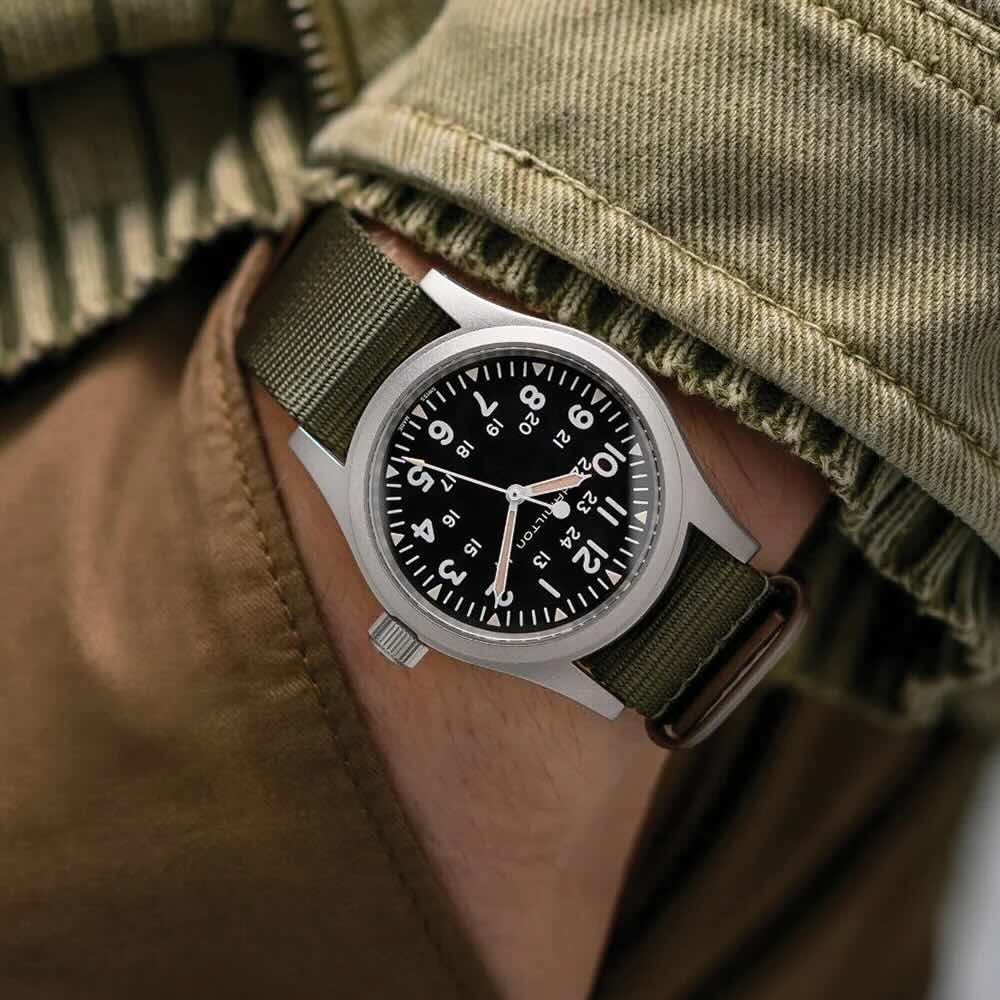
Hamilton Khaki Field Mechanical

Price: $675, Case Size: 38mm, Thickness: 9.5mm, Lug width: 20mm, Lug to Lug: 47mm, Crystal: Sapphire, Water Resistance: 50 meters, Movement: Mechanical Hamilton Caliber H-50
Field watches are an enduringly popular category of timepiece, and without Hamilton, the style as we know it might not even exist. Hamilton basically invented the genre with the “trench watches” that it supplied to American troops during World War I, kicking off a long tradition of making tough, reliable timepieces for U.S. military units. The most direct inspiration for Hamilton’s Khaki Field family of military-inspired watches is the 1960s model worn by troops during the Vietnam War, which were built according to strict specifications by the U.S. Defense Department. Khaki Field watches today are available in a wide range of colorways, and with quartz, manually wound mechanical, or self-winding mechanical movements. The Khaki Field Mechanical, the models most true to their historic predecessor, combines the classically retro 12/24-hour dial with a period-accurate 38mm case and a nylon NATO strap of the type that soldiers would have worn in the field during wartime. The manually winding Caliber H-50 beats inside, storing a lengthy 80-hour power reserve.
Tissot PR516 Chronograph Mechanical

Price: $2,100, Case size: 41mm, Thickness: 13.7mm, Crystal: Glassbox Sapphire, Water Resistance: 100 meters, Movement: Manually Wound ETA Valjoux A05.291
Tissot’s PR516 Chronograph Mechanical, the flagship of the brand’s recent revamp of its racing-inspired PR516 family, traces its inspiration to the Ref. 40528 from the 1970s and features a manually winding mechanical movement, a rarity for Tissot. The ETA Valjoux A05.291, based on the automatic Valjoux 7753 represents a new level of technical sophistication, replacing the base movement’s rotor with a bridge inscribed with “TISSOT 1853,” and a redesign of the mainspring to lock it when the watch is fully wound. Its newly designed barrel architecture allows for a 68-hour power reserve (up from the base caliber's 48 hours) and its Nivachron balance spring renders the mechanism a high level of magnetic resistance. The spirit of the watch’s 1970s ancestor also lives on in its exterior aesthetics, particularly the dual-scale (tachymeter and pulsometer) bicolor bezel and its classical subdial arrangement, with chronograph counters at 3 o’clock (30 minutes) and 6 o’clock (12m hours) and running seconds at 9 o’clock.
Rado Captain Cook Over-Pole

Price: $3,200, Case Size: 37mm, Thickness: 10.3mm, Lug-to-Lug: 43.1mm, Water Resistance: 100m, Crystal: Sapphire, Movement: Manually wound Rado R862 (ETA 2804-2 base)
Rado’s Captain Cook models are based on a 1960s diving watch and eschew the modernist aesthetic that chiefly defines Rado’s collection in favor of a sporty, vintage look. Like many popular watch families, the Captain Cook line has expanded into complicated versions, including the “Over-Pole” world-time model that comes in at a very wearable 37mm in steel. Surrounding the gradient dial with its emblematic hands, hour markers, ruby anchor emblem, and red-type date window, is a large, rotating bezel with a laser-engraved city ring on a ceramic insert. The 24 cities inscribed on the bezel, which has an easy-to-grip serrated edge, can be aligned with the 24-hour numerals that accompany the 12 applied markers, to read world times outside the wearer’s home time zone. Rado has opted for a manually winding movement inside, the ETA-based Caliber R862, which is showcased behind a sapphire caseback and delivers an 80-hour power reserve.
Nomos Tangente 2Date

Price: $3,370, Case size: 37.5mm, Thickness: 6.8mm, Crystal: Sapphire, Water Resistance: 50 meters, Movement: Manually Wound Caliber DUW 4601
Germany’s Nomos is a watchmaker known for its adherence to Bauhaus minimalism in its watch designs and for taking, for the most part, a practical approach when it comes to complications. With the Tangente 2Date, however, which it released in the fall, Nomos makes a rare foray into creative impracticality, and somehow it works. The watch, the latest member of Nomos’ flagship, 1930s-inspired Tangente family, contains the manual-winding Caliber DUW 4601, which powers a unique “dual date” display — one via a standard numeral disk in a window at 6 o’clock, the other by way of Nomos’s own peripheral system. In the latter, a 1-to-31 date scale encircles the main dial while a moving disk with a small colored section fills in the apertures around each numeral to identify the date. For the Tangente 2Date, explored in more detail here, Nomos has even pulled out all the stops to make the movement special, applying the “sunbeam” decorative motif that it has used previously only on the movements of its gold-cased limited editions.
Omega Speedmaster Professional 'Moonwatch'

Price: $7,800, Case size: 42mm, Thickness: 13.54mm, Lug Width: 20mm, Lug to Lug: 47.5mm, Crystal: Hesalite, Water Resistance: 50 meters, Movement: Manually Wound Caliber 3861
The Omega Speedmaster is not only the first watch on the moon; it’s also often the first “serious watch” in a budding connoisseur’s collection. Best of all for traditionalists, the standard “Moonwatch” reference on a bracelet is still more or less identical to the manual wind watch that Buzz Aldrin rocked on the Apollo 11 mission more than 50 years ago, with a 42mm steel case, a Hesalite crystal over the tricompax dial, luminous hands and hour markers, and the trendsetting tachymeter-scale bezel that speaks to the Speedy’s origins as a watch for auto racing. It’s even equipped with a modern version of the hand-wound movement that powered the original, Omega Caliber 1861, with a 3Hz frequency and a 48-hour power reserve. With this reference, Omega takes the adage “If it ain’t broke, don’t fix it” to heart.
Breitling Premier B09 40

Price: $9,950, Case Size: 40mm, Thickness: 13mm, Lug Width: 20mm, Lug to Lug: 47.5mm, Water Resistance: 100m, Crystal: Sapphire, Movement: Manually wound Breitling Caliber B09
Breitling’s Premier collection, a revival of an elegant gents’ model introduced by founding-family scion Willy Breitling in 1943, debuted in 2018 with automatic movements, and new models with more historically appropriate manually wound calibers followed them up in 2021. One of the most noteworthy is the Premier B09 Chronograph 40, with a 40-mm steel case and an unusual “pistachio green” dial. Inside the 100-meter water-resistant case is Breitling’s manufacture Caliber B09, a manual-winding version of the company’s flagship base movement, the self-winding, chronograph-integrated B01, with a column wheel, vertical clutch, and 70 hours of power reserve. Among the Premier collection’s design hallmarks are the grooved lines in the sides of the cases, which Breitling says were “inspired by speed;” period-style Arabic hour numerals; and beveled, speedometer-style hour and minute hands treated with lume. The alligator straps are finished with tone-on-tone stitching and each movement meets COSC chronometer requirements for reliability and accuracy.
Grand Seiko Evolution 9 Hi-Beat SLGW003

Price: $11,600, Case Size: 38.6mm, Thickness: 9.95mm, Lug Width: 20mm, Lug to Lug: 45.4mm, Water Resistance: 30 meters, Crystal: Sapphire, Movement: Manually wound 9SA4
Grand Seiko’s Evolution 9 Ref. SLGW003, featuring the Japanese maison’s “White Birch” textured dial, contains the first manual wind, high-frequency movement to join Grand Seiko’s lineup in 50 years, Caliber 9SA4. It offers a frequency of 10 beats per second, thanks to a highly efficient dual-impulse escapement, and carries a power reserve of 80 hours in two barrels. Giving this caliber, a descendant of the automatic 9SA5, its distinctive visual charm is the manually winding click mechanism, formed in the shape of a wagtail, a bird native to the area around the Japanese city where the watch is made. Through the sapphire caseback, the wearer can watch the bird-like pecking motion of the click as the movement is wound. Like all Grand Seiko mechanical movements, this one features an elite level of finishing, with a wave pattern on the plates and bridges inspired by Japan’s Shizukuishi River, and a power-reserve indicator incorporated into one of the bridges. The understated 38.6mm case is in Grand Seiko's Brilliant Hard Titanium, with multifaceted lugs that are narrower than those of previous Evolution 9 watches. The crowd-pleasing “White Birch” dial has an elegantly textured surface pattern that takes its inspiration from the bark of white birch trees that grow in northern Japan.
Jaeger-LeCoultre Reverso Tribute Monoface Small Seconds

Price: $11,700, Case Size: 45.6mm x 27.4mm, Lug Width: 20mm, Crystal: Sapphire, Water Resistance: 30 meters, Movement: Jaeger-LeCoultre Manually Wound Caliber 822
Jaeger-LeCoultre’s signature dress watch, the Reverso, was originally designed as a sports watch, its reversible swiveling case making it a practical timekeeper for polo players during a match. In production since 1931, the Reverso is now available in numerous variations but the core three-handed Reverso Tribute model most faithfully echoes the classical Art Deco look of its ancestor. The rectangular case is distinguished by clean lines and gadroons; the dial features Dauphine hands, trapezoidal applied hour indexes, and a small seconds subdial at 6 o’clock. Jaeger-LeCoultre’s manually wound manufacture Caliber 822, shaped to fit the case’s soft rectangular dimensions, beats inside. In another callback to the Reverso’s polo-playing origins, the leather strap, which echoes the forest green tones of the dial, is from Casa Fagliano, an Argentinean purveyor of high-end polo boots.
A. Lange & Söhne Lange 1

Price: $49,500, Case Size: 38.5mm, Case Height: 9.8mm, Crystal: Sapphire, Water Resistance: 30 meters, Movement: Manual wound Caliber L121.1
The now-iconic Lange 1 has been the modern flagship of the reconstituted A. Lange & Söhne brand since its introduction in 1994. (The original company, founded by Ferdinand Adolphe Lange in 1845, played a major role in the rise of the watchmaking industry in Germany.) The watch, now at the heart of an entire family of complicated models, has changed little in over a quarter-century, with an off-center subdial at 9 o’clock for hours and minutes, a small seconds subdial at 4:30, a bold Grande Date display at 2 o’clock, and an analog power-reserve indicator at 3 o’clock. Inside the understated 38.5-mm gold case,ticks the manually wound manufacture Caliber L121.1, with a 72-hour running autonomy. The in-house movement also bears the influence of Saxon watchmaking traditions, like the three-quarter mainplate made of untreated German silver and decorated with Glashütte stripes, Germany’s variation on the Swiss “Geneva waves” motif; hand-engraved finishing on the balance cock; and the “swan’s neck” regulating device.




0 Comments
Log in or to leave a comment