







































Short on Time
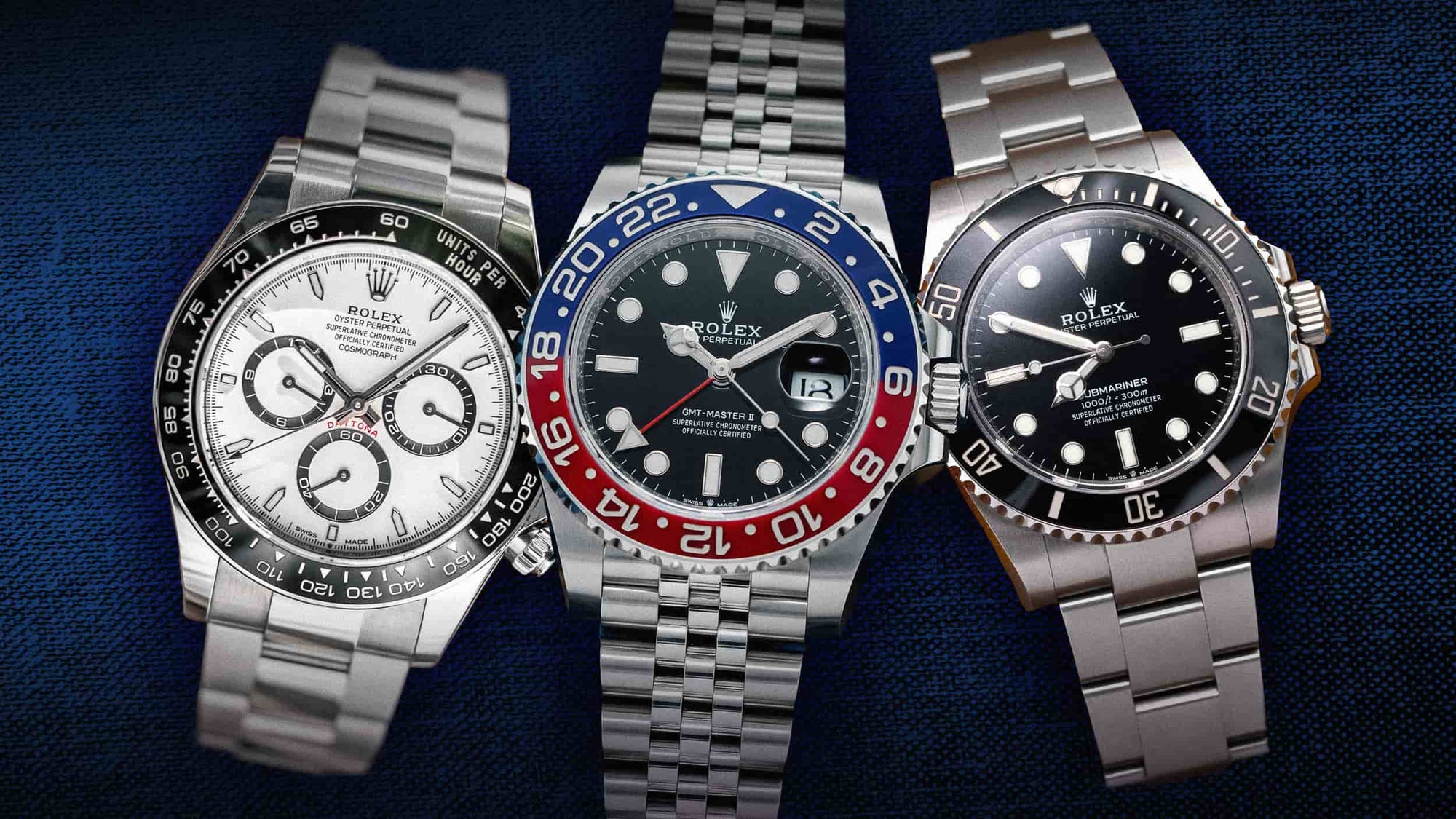
If you’ve somehow made it this far in life without hearing the name Rolex, congratulations. You may be the last living human to do so. Rolex sits at the very center of the horological universe. The brand is so vast and culturally omnipresent that calling it “successful” is a little like describing the Louvre as “a building with some pretty paintings in it” — technically correct but hopelessly inadequate. Here we will take a look at some of the most popular Rolex watch models, spanning the current production catalog as well as past models with staying power.
Though we have seen the demand for luxury watches rise, dip, and plateau over the last few years, the desirability to own a Rolex watch remains exceptionally high. Factors such as scarcity, brand provenance, and consistent appreciation in the resale market drive this remarkable demand. All of these influences are compounded by waitlists, which have elevated desire into near-mythic obsession. However, if you’re entirely new to Rolex, consider this your gentle initiation. In fact, even if you own several Rolex watches and want to learn more about the brand and its most popular references, this deep dive is going to provide you with more information than many people will acquire in a lifetime. First, let’s kick things off with a historical overview of this timekeeping titan.
[toc-section heading="Crown and Legacy: A Brief History of Rolex"]
It might surprise you to learn that Rolex’s history didn’t just emerge overnight as a perfectly polished Submariner on a boutique shelf. The brand’s story unravelled modestly, from the year 1905, when a young man named Hans Wilsdorf joined forces with British businessman Alfred Davis in London. Together, they decided that pocket watches were passé and that the future of timekeeping belonged on the wrist. Legend has it that whilst on an omnibus ride through London in 1908, Wilsdorf had an epiphany. The name “Rolex” came to him like a whisper in his ear. It was short, memorable, and rolled off the tongue. It wasn’t exactly Shakespearean, but it had a ring to it. Together, Wilsdorf and Davis planted the seeds of an empire. [quote-media quote="Legend has it that whilst on an omnibus ride through London in 1908, Wilsdorf had an epiphany. The name “Rolex” came to him like a whisper in his ear. It was short, memorable, and rolled off the tongue." author="" image="https://cdn.shopify.com/s/files/1/0278/9723/3501/files/Rolex-founder-Hans-Wilsdorf-2_eb55a9c5-9b79-42ce-bc73-0042cdebb47c.jpg" caption="Rolex founder Hans Wildorf" media="right"]Rolex quickly demonstrated that it wasn’t in the business to make ordinary watches. In 1910, the company obtained its first official Swiss chronometer certificate, proving that even small timepieces could match the accuracy of the largest marine chronometers. In 1926, Rolex unleashed the first of its revolutionary designs – the first waterproof and dustproof wristwatch. The Rolex Oyster case transformed the future of the wristwatch by combining a hermetically sealed, water‑resistant design with a striking dial design, creating the blueprint for a watch that could survive anything from deep dives to daily wear. It found its way onto the wrist of the first British woman to swim the English Channel. On October 7th, 1927, the Oyster watch endured 10 hours submerged in water as Mercedes Gleitze set her record, verifying the watch’s waterproof capabilities by emerging from the water and presenting it without a single scratch.
In 1931, Rolex introduced its first watch with a Perpetual movement. The wearer’s wrist motion powered this self-winding mechanism. It wasn’t the first automatic watch ever made, but it showcased the kind of refinement that set the standard for automatic watches thereafter. Rolex’s timepieces went on to prove themselves in some of the most challenging conditions over the next decade. Racing drivers, explorers, and climbers all tested them to extremes. Each time, the watches in question performed flawlessly, defying land-speed records and freezing temperatures at dizzying altitudes.
[quote-media quote=" The Rolex Oyster case transformed the future of the wristwatch by combining a hermetically sealed, water‑resistant design with a striking dial design, creating the blueprint for a watch that could survive anything from deep dives to daily wear." author="" image="https://cdn.shopify.com/s/files/1/0278/9723/3501/files/Rolex-Oyster-watch-1926-2_5ec685ef-eeca-469f-bedb-23114aa4dddd.jpg" caption="The first Rolex Oyster case, launched in 1926" media="left"] During the 1940s and 1950s, Rolex introduced models that would define the crown brand as a leader in its field. The Datejust launched in 1945, complete with the iconic Cyclops lens positioned above the date aperture. It was the first wristwatch with an automatic date-changer. Around the same time, models like the Submariner Reference 6204 surfaced (1954), complete with a perfectly proportioned 37mm case that was water-resistant to 100 meters. The GMT-Master watch (Reference 6542) followed in the same year, primed for long-haul air travel with its two-tone bakelite bezel for tracking two time zones at once. It was during this time that the Explorer was quietly rising to fame as well. Sir Edmund Hillary and Tenzing Norgay famously reached the summit of Mount Everest wearing the Rolex Oyster Perpetual, providing Rolex with all the data it needed to refine its tool-watch criteria, resulting in a watch even more legible and durable. The result was the Explorer Reference 6350, with a minimalist, no-nonsense design.
Rolex has never been one for chasing fleeting trends. Instead, its genius has been subtle and persuasive. Each of these key collections (along with others) has evolved significantly over the years, signaling outstanding achievement, taste, and horological dominance.
Now that you’re somewhat familiar with the general story behind Rolex, it’s time to get a little more concrete. Some of the models mentioned above have achieved near-mythical status, each with its own milestones, quirks, and cultural footprint. You can think of this guide as a sort of roadmap to Rolex’s greatest hits. We’re going to guide you through some of the most popular Rolex references and what makes them so iconic and desirable.
[toc-section heading="The Sport Watches"]
The Rolex Daytona

The Daytona is the conversational duct tape of the horological world, so it's no wonder to see it up top here on the list of most popular Rolex watches. Its design is so coveted that it has turned grown adults into desperate collectors. In recent years, acquiring some of the most popular Daytona references at retail price was about as successful as finding a four-leaf clover while blindfolded. Original models like the Daytona 6239 proved desirable beyond measure, especially once American actor and racing driver, Paul Newman, took a liking to the Daytona, stylizing it on his wrist both on the track and on the silver screen. His own model even sold for over $17 million at auction in 2017. Today, prices for this reference range from around $30,000 to $160,000. The humble chronograph was the first to feature a tachymeter scale for measuring speeds based on distance, along with a "panda" or "reverse panda" dial. Launched in 1963, the Daytona Ref. 6239 featured a 36mm steel case and pump-style pushers, and was powered by a Valjoux movement, becoming a blueprint for all future Daytona watches. Of course, we have to remember that the Daytona wasn't a hit when it first debuted but has gained iconic notoriety over the last few decades.
[text-media heading="" text="Over the decades, the Daytona watch collection has evolved and now offers modern iterations such as the Daytona reference 116520 (released in 2000), highlighting both technological and stylistic progress. The 40mm stainless steel model was fitted with the in-house Calibre 4130 and featured a polished steel bezel and screw-down pushers for improved water resistance. Prices for this model today start around $20,000, whereas the Reference 116523, released in the same year, features a two-tone configuration, sporting stainless steel and yellow gold. Then, there’s the 116500LN, the black-and-white ceramic-bezel sensation that has caused bidding wars at every auction. This is the black Cerachrom bezel that gave the Daytona its modern sporty edge. " image="https://cdn.shopify.com/s/files/1/0278/9723/3501/files/Rolex-Daytona-116523-Eric-Wind.jpg" caption="The Daytona Ref. 116523 (Image by Eric Wind)" media="right"]Under the three-counter configuration (running seconds, 30‑minute counter, 12‑hour counter) is the in‑house automatic chronograph movement, calibre 4130, complete with a column wheel and vertical clutch arrangement for a smoother, more precise chronograph performance. Though the Reference 116500LN is no longer in production, you can pick it up for around $31,000 on the secondary market.
The Rolex Submariner

When providing an overview of one of the world’s most popular dive watch collections in history (let alone most popular Rolex models), it makes sense to start with the very first reference. The original Rolex Submariner watch was the reference 6204, featuring a 37mm case, 100M water resistance, and the choice of a honeycomb or non-honeycomb gilt dial. These models were powered by the A260 or A296 movements, which caused the casebacks to bulge, earning them the nickname “Bubble Back Subs.” The models that followed were the Reference 5512, which resembles the Subs we know today, and the Reference 1680 – the first to feature the date window under the famous Cyclops lens.
Produced from 1988 to 2010, the Rolex Submariner Reference 11610 was part of the modern Submariner lineup. The models from this production featured thicker, 904L stainless steel cases, sapphire crystals, and a unidirectional rotating bezel.These were followed up with updated models with ceramic bezels. Amongst the series was the Ref. 116610LV “Hulk” with a green bezel insert and a matching green dial. (No prizes for guessing how it got its nickname.) Sporting a “Maxi Dial” surrounded by a punchy green 60-minute diver scale, it proved a significant chapter of the Sub’s history. The discontinuation of the green Submariner only further fueled the frenzy, pushing prices past the $23,000 mark.
[text-media heading="" text="In 2012, Rolex launched a purist’s version of the Rolex Sub with no date. In many ways, it was considered the spiritual successor to the 16610, which debuted in 1988. The 40mm model had a clean black dial, offered 300M water resistance, and was powered by the brand’s tried-and-tested Calibre 3130. It is still one of the most stripped-back yet purposeful-looking Subs on the market, and you can pick it up today for around $11,000. This model still demonstrates the demand for function over fuss in a watch design. The contemporary iteration is the Ref. 124060 priced at $9,500." image="https://cdn.shopify.com/s/files/1/0278/9723/3501/files/Rolex-Submariner-Starbucks.jpg?" caption="" media="left"]The Rolex Submariner Reference 126610LN is still in production and is yet another highly sought-after reference from the brand’s dive watch lineage. Bearing slightly larger proportions at 41mm in diameter, its beating heart (the Caliber 3235) and slimmer lugs are both shared with the 126610LV “Starbucks” – the watch’s unofficial nickname that stuck after collectors began associating the watch's color with the coffee chain. The latter features a green bezel insert as opposed to the classic black dive scale and was launched to celebrate 50 years of the Submariner. Depending on your preference, you can pick either of these models up for around $13,000 to $15,000.
[toc-section heading="The Everyday Rolexes"]
The Rolex Explorer

The legendary Rolex Explorer owes its existence to one of the 20th Century's greatest feats of exploration. In 1953, mountaineer and philanthropist Sir Edmund Hillary and Sherpa Tenzing Norgay successfully conquered Mount Everest, becoming the first men to reach the summit. Rolex and the Oyster Perpetual played an important role in the expedition and the specific model that Hillary had with him became a piece of history. Soon after, Rolex launched the Explorer. The launch of the Explorer model officially commemorated Hillary and Norgay’s achievement. These early watches were characterized by a simple, highly legible design, featuring the waterproof Oyster case, a smooth bezel, distinctive Mercedes hands, and a black dial with prominent Arabic numerals at 3, 6, and 9.
While the spirit of the Explorer remains that of a no-nonsense, rugged tool watch, its modern counterpart, the Reference 224270, features a bolder, 40mm case. Little has changed in the fundamental design, but much has evolved beneath the dial. Its technical prowess is highlighted by the sophisticated Caliber 3230 movement, which delivers an impressive 70- hour power reserve. The hands and markers, treated with highly legible Chromalight, move across the classic black display. Even after all these years, the Explorer is still a beacon of technical performance, now wrapped in a more contemporary size. Rewinding the clock, the Rolex Explorer Reference 1016 stands out as a key model for its enduring popularity. Produced between 1963 and 1989, it is widely considered the definitive vintage Explorer.
[quote-media quote=" In 1953, mountaineer and philanthropist Sir Edmund Hillary and Sherpa Tenzing Norgay successfully conquered Mount Everest, becoming the first men to reach the summit. Rolex and the Oyster Perpetual played an important role in the expedition and the specific model that Hillary had with him became a piece of history. Soon after, Rolex launched the Explorer." author="" image="https://cdn.shopify.com/s/files/1/0278/9723/3501/files/Rolex-Explorer-1_23e44de9-82aa-4c95-9caa-58f8ce9ce4a5.jpg" caption="" media="right"]Cases during this era were notably smaller, and this reference maintains the classic 36mm diameter. Its defining features include the legendary matte black dial paired with painted tritium markers. This combination of elements grants the Explorer 1016
unparalleled vintage charm, significantly driving its collectability among enthusiasts today. The Rolex Explorer Reference 214270 (launched in 2010) marked a significant step in the model's evolution, demonstrating the intersection of classic heritage and modern
engineering. It stood out immediately with a notable shift to a contemporary 39mm diameter.
Under the hood, the integration of the Calibre 3132 represented a major technical leap, including innovative Rolex technologies such as the anti-magnetic Parachrom hairspring and superior Paraflex shock absorbers. As a certified Superlative Chronometer, it promises exceptional accuracy (-2/+2 seconds per day). Today, the Explorer is generally recognized as the ultimate "Go Anywhere, Do Anything" (GADA) watch, offering maximum legibility, superb robustness, and perfectly embodying Rolex’s enduring philosophy of form follows function.
The Rolex Datejust

Rolex launched the Datejust in 1945, pairing the Oyster-style waterproof case with a Jubilee or Oyster bracelet for “slap-on-a-suit” versatility. The signature Cyclops date dial was offered in a dizzying array of dial colors and metals (not to mention a whole host of exotic dials). The OG, however, was the Ref. 4467. This yellow gold “Bubble Back” version debuted the Jubilee bracelet and featured the first-ever wristwatch complication that automatically flipped the date at midnight. Today, its design still personifies vintage elegance, with prices reaching around $20,000.
[text-media heading="" text="The Rolex Datejust 1601 was a watch of mid-century chic styling. Its fluted bezel and pie pan dial measured 36mm in diameter on the wrist and were available in steel or yellow gold. Comparing this reference to more modern iterations, such as the 126200, underscores how much Rolex has refined and evolved this collection without compromising its original charm. The Reference 16220, which preceded the 126200 generation, featured scratch-resistant sapphire, a more advanced movement (the Caliber 3135), slightly thicker lugs, and the option of a smooth bezel.Similarly, the newer Datejust references like the Ref. 126234 are even more advanced, boasting the newer Caliber 3235 inside refined case proportions, a sleeker side profile, and more ergonomically formed lugs." image="https://cdn.shopify.com/s/files/1/0278/9723/3501/files/Rolex-Datejust-1601-sothebys.jpg" caption="" media="left"]
The Rolex Oyster Perpetual

The Rolex Oyster Perpetual personifies the crown brand stripped down to its essence. There is no date, no complications, just pure and simple timekeeping. Today, models like the Ref. 114300 prove a popular Goldilocks size. Measuring 39mm in diameter, the stainless steel model features a smooth domed bezel and is available in modest dial colors ranging from rhodium to black. Inside the case, the Caliber 3132 hums, with a 48-hour power reserve. Because it was produced only between 2015 and 2020 and is now a discontinued model, the Ref. 114300 is mainly found on the secondary market, averaging $8,500 to $12,000.
Slightly larger is the Oyster Perpetual Reference 124300, which measures 41mm and is available in a vast palette of colors, each upgraded to the 3230 Calibre. The model first launched in 2020 with its three-piece Oyster bracelet, becoming somewhat of a playground for Rolex. Several sunburst finishes are available, as are lacquered coloured dials, some of which have developed cult-like followings. [text-media heading="" text="When you place the newer Oyster Perpetual 126000 beside the 124300 and the earlier 114300 models, you start to see Rolex’s pattern in refining its bulletproof formulas rather than reinventing the wheel. The 114300 was the modern-era reboot of the simple, dateless Oyster. It featured the clean dial and the no-nonsense layout, and was powered by the brand’s in-house 3132 calibre. It wore like a classic Rolex should: solid and balanced, but not exempt from a bit of refinement. The 124300 moved things forward with the new-generation 3230 movement, bringing a longer power reserve and improved efficiency, but the reference 126000 tightened the edges that little bit more. It kept the upgraded movement while introducing a slightly more ergonomic case and bracelet, giving the watch a softer profile and a more natural fit against the wrist. The 126000 wears lighter, neater, and more balanced with price starting just around $6,500. That kind of value and attainability has kept the collection near the top of the most popular Rolex collections for years." image="https://cdn.shopify.com/s/files/1/0278/9723/3501/files/Rolex-Oyster-Perpetual-1.jpg" caption="" media="left"]
[toc-section heading="The Travel Watches"]
The Rolex GMT-Master

The Rolex GMT‑Master arrived at the golden age of air travel in the 1950s, when transcontinental flights were becoming more common, and pilots needed a reliable watch to track multiple time zones. It quickly became the cockpit companion of choice, combining practicality with an unmistakable style that would ultimately make it a collector’s icon.
Widely hailed as the “Sweet Spot GMT,” the GMT-Master II ref. 16710 “Coke” was a significant release. Outfitted with that classic bi-color bidirectional rotating bezel, it remains an appealing proposition for collectors today thanks to its distinctive black-and-red aesthetic and enduring appeal as a functional luxury timepiece. The model that first kicked off the GMT-Master II line, however, was the Ref. 16760 “Fat Lady”. It featured a chunky case, sapphire glass, “Coke” bezel, and carried lots of vintage-collector weight due to being the first to feature the sapphire crystal.
[text-media heading="" text="The Rolex GMT‑Master II reference 116710BLNR “Batman” is the model that introduced the modern bi-color ceramic bezel insert, with a striking black-and-blue colourway. It gave the GMT-Master aesthetic a new, stealthy, urban-traveller vibe. Crafted from Oystersteel and treated with lashings of modern lume, this travel companion offered better bezel durability than its aluminium predecessors. On the pre-owned market, you can expect to pick this reference up for around $14,000 to $15,000. The Rolex GMT‑Master II reference 126710BLRO “Pepsi” is the modern standard bearer. Collectors affectionately call it the “Pepsi” GMT because of its ability to revive the vintage red and blue classic, while featuring modern scratch- and fade-resistant Cerachrom." image="https://cdn.shopify.com/s/files/1/0278/9723/3501/files/Rolex-GMT-16710-EricWind.jpg" caption="" media="right"]Inside this modern version is one of Rolex’s state-of-the-art movements – the Calibre 3285, complete with a Parachrom hairspring that resists magnetic fields and shocks. The Rolex GMT‑Master II Ref. 126710BLRO “Pepsi” is still in production today and is as popular as ever, regularly trading for around $21,000 despite a retail price of $11,300.
The Rolex Explorer II

The Explorer II perfectly blends Rolex’s rugged engineering with a practical complication: a fixed 24-hour bezel. This makes the Explorer II fit for a myriad of outdoor pursuits from cave dwelling to polar exploration, trekking, and everything in between. With this design, a fixed 24-hour bezel pairs with an additional GMT-style hand, allowing the wearer to distinguish AM from PM or track a second time zone.
From day one, the Explorer II has carved out a niche for itself as the understated, adventure-ready alternative to the more glamorous sports models. Its purpose-built utility is the equivalent of a Swiss Army knife in a tuxedo. It’s polished enough to look part of your daily attire but rugged enough to survive a spelunking expedition. The Rolex Explorer II Reference 1655, affectionately nicknamed the “Steve McQueen” (though it's not entirely clear why) was released in 1971. With its bold orange 24-hour hand, it was instantly distinctive. That hand sweeping once around the dial every 24 hours let the wearer know whether it was midday or midnight. Measuring 39mm, its Oyster case offered 100 meters of water resistance, while its black dial with lume-filled markers ensured visibility underground. Beloved by vintage Rolex collectors, these can start around $20,000 and go up to (and over) $73,000, depending on condition.
The Rolex Explorer II reference 16570 was released 18 years later, featuring a modernised movement (calibre 3185/3186) and a sleeker, slimmer 40mm wide case and dial with red GMT hand. It remained in production until 2011 and was available with a white “Polar” dial or a classic black dial. Over the years, the model evolved considerably, replacing the tritium lume with LumiNova and, eventually, Super-LumiNova for expert legibility in the dark. For the Reference 16570, you can expect to pay around $7,000 to $13,000.
[quote-media quote="Its purpose-built utility is the equivalent of a Swiss Army knife in a tuxedo. It’s polished enough to look part of your daily attire but rugged enough to survive a spelunking expedition." author="" image="https://cdn.shopify.com/s/files/1/0278/9723/3501/files/Rolex-Explorer-II-16570.jpg" caption="" media="right"] The Rolex Explorer II reference 216570, released in 2011 for the Explorer II’s 40th anniversary, expanded the case to 42 mm, brought back the bright orange 24-hour hand in homage to the 1655, and introduced a movement with improved shock and magnetic resistance. This reference was Rolex’s first major overhaul of the Explorer II in decades. The dial was also upgraded to the “Maxi” format, featuring larger hands and hour markers. Chromalight lume was also added, and the 24-hour hand served a double duty as a day/night indicator and a second timezone tracker all in one.
One other popular Rolex Explorer II model deserves a mention, too. The Reference 226570, launched in 2021, keeps the 42mm case but updates the movement. Compared to the reference 216570, which can be acquired for around $10,000 on the pre-owned market, the younger reference 226570 retails for around the same at $10,050. The Caliber 3235 is the real upgrade here, promising a 70-hour power reserve, along with a Paraflex System and Chronergy escapement. This movement propelled a set of new white-gold hands across the black-dial iteration, while the “Polar” models received new PVD-coated hour markers.
[toc-section heading="The President"]
The Rolex Day-Date

What list of most popular Rolex watches could be complete without the "President" itself? Yes, the Day-Date is the seminal solid-gold status watch that communicates "I've made it" to the world. The Rolex 1803 was not the first Day-Date reference, but it is a coveted collectible all the same. It sports a 36mm yellow gold case, an acrylic crystal, and the desirable champagne colored “pie pan” dial that defined the collection throughout the 1960s. On the pre-owned market, you can still pick up a Day-Date Reference 1803 for around $13,000, though models with rarer dials (like the Stella dial) can push a little higher. The Day-Date was the first wristwatch to feature the day of the week spelled out in full alongside the date.
The evolution of the Day-Date brought in a sapphire crystal front in the Reference 18038. The introduction of the Caliber 3055 also provided a “single quick‑set” for the date. Complete with the distinctive President bracelet intact (a three-link, semi-circular polished-and-brushed bracelet designed for comfort and elegance), the Reference 18039 is still a popular choice amongst collectors, selling for around $20,000 on the pre-owned market. The release of the Rolex Day-Date Reference 18238 marked a significant change from previous models. The Caliber 3155 had a double-quickset feature that allowed the wearer to adjust the weekday and date indicators easily. While there are several iterations of this generation that are appealing, the black onyx dial is a favorite. The classic look of the yellow gold case, combined with the onyx black dial, makes this one of the most popular neo-vintage Day-Date collectibles of all. It famously has no hour or minute markers, yet the applied gold Rolex coronet, along with the golden text, evokes a sense of grandeur and luxury across the dial.
[quote-media quote="The black onyx dial is a favorite. The classic look of the yellow gold case, combined with the onyx black dial, makes this one of the most popular neo-vintage Day-Date collectibles of all. It famously has no hour or minute markers" author="" image="https://cdn.shopify.com/s/files/1/0278/9723/3501/files/Rolex-Day-Date-18238-onyx.jpg" caption="" media="right"]The Rolex Day-Date 228235, however, is the modern-day Day-Date in the brand’s proprietary Everose gold material. Its 40mm Oyster architecture and scratch-resistant sapphire crystal glass make it a robust yet indulgent companion for modern-day wear. The Calibre 3255 is capable of delivering a 70-hour power reserve, too. With a price of $47,500, the Reference 228235 is a solid gold piece of horological history that has earned its Presidential moniker.
[toc-section heading="The Honorable Mentions"]

The Rolex Yacht-Master has always occupied a somewhat more curious corner of the crown brand’s catalogue. And while it's not one of the most popular Rolex watches, it has maintained some staying power. It was born in the 1990s and, surprisingly, wasn’t created for timing regattas or surviving the Mariana Trench. It was simply Rolex’s take on a nautical-themed watch, and though it’s certainly tough enough to face extreme challenges out at sea, it is still perfectly happy spending more time on polished teak than on perilous waves. Indeed, the Yacht-Master has sailed a slightly more glamorous course than some of Rolex’s more robust tools. As such, its design is aimed at those who appreciate Rolex’s more classic and pared-back offerings.
The Yacht-Master 40 reference 126622 is arguably the most beloved version of the lineup. Its 40mm steel case takes on the solid, honest Oyster architecture, topped with a platinum bezel (Rolesium). After all, the Yacht-Master has never been shy about splashing a touch of decadence here and there. The bezel is sandblasted and raised to enhance the legibility of the polished numerals, and the dial details are equally impressive. The sunburst slate blue display, adorned with the iconic Mercedes hands and a blue seconds hand, is an attractive combination. The Caliber 3235 sits beneath the dial and features a 70-hour power reserve. But perhaps the 126622’s biggest party trick is its comfortable Oyster bracelet with a butter-smooth clasp. Though it manages to be sporty, the Yacht-Master 126622 is still luxurious. Prices for this model begin at around $14,000.

Unlike the Submariner or Daytona, which have practically defined the idea of a luxury sports watch, the Air‑King has always flown a little under the radar (pun fully intended). Rolex originally designed this as a tribute to aviation pioneers and the golden age of flight. Its unmistakable DNA occupies a unique and slightly rebellious corner of the company’s portfolio. Large hour markers and a prominent minute scale contribute to the Air-King’s distinctive but simple look, as does a robust Oyster case construction.
The current 126900 stands out as one of the most coveted. First introduced in 2022, it’s a relatively young addition and is still in production today. The watch features a distinctive black dial with large hour markers and legible hands, designed for navigational timekeeping. The 40mm Oystersteel watch is matched with an Oyster bracelet and Oysterclasp, and features a visible green seconds hand. While it may not carry the same instant recognition as the Submariner or Daytona, the Air‑King 126900 retails for $7,750 and tends to hold its value.
Take a step back and examine Rolex’s most coveted and iconic models, and a clear pattern emerges. Despite decades of updates and refinements, each collection retains a timeless appeal, looking just as modern and relevant today as it did when it first appeared. From boardroom meetings to crossing time zones, or enjoying a weekend out on the water - Rolex watches are designed to do everything you need them to do, and then some. Engineering is the backbone of the brand’s watchmaking philosophy. Without it, these watches would be decorative objects. Each reference retains its classic identity while benefiting from modern improvements, which goes some way to explaining why these most popular references, with a proven track record for value retention, will likely remain highly coveted for decades to come.
If this wasn't enough Rolex for you, you can learn more over at rolex.com.


0 Comments